What decides whether you step in
- Bystander intervention means helping someone in need when you are simply one of the people who happen to be there.
- Situational factors come from the setting you are in, such as how many other people are around and how costly helping looks.
- Personal factors come from you, such as who you are, what you are able to do and whether you see the victim as being like you.
Situational factors
Definition
Diffusion of responsibility
The tendency to feel less personal duty to act when others are present, because each person assumes someone else will take responsibility.
- The number of other people present is the factor behind the bystander effect.
- The usual explanation is diffusion of responsibility, where each person present feels less personally responsible because they assume someone else will act.
- Piliavin et al. found no strong correlation between the number of bystanders and helping on the subway, so present diffusion of responsibility as an explanation rather than as a settled fact.
- The cost of helping rises when stepping in looks risky, unpleasant, difficult or embarrassing, and helping falls away as that cost rises.
- In Piliavin et al., help arrived within 70 seconds in 52 of 57 trials where the victim appeared ill and carried a cane, but in only 5 of 24 trials where the same victim appeared drunk.
- Piliavin et al. read this as people weighing their arousal at seeing the emergency against the costs and rewards of acting, with a drunk victim carrying the higher cost.
- In 21 of the 103 trials a total of 34 people left the critical area, more often when the victim seemed drunk, which is people removing themselves rather than paying the cost.
- Whether someone has already started helping is part of the situation too, and Piliavin et al. built this into the design by varying whether a model stepped in early, about 70 seconds after the collapse, or late, at about 150 seconds.
Example
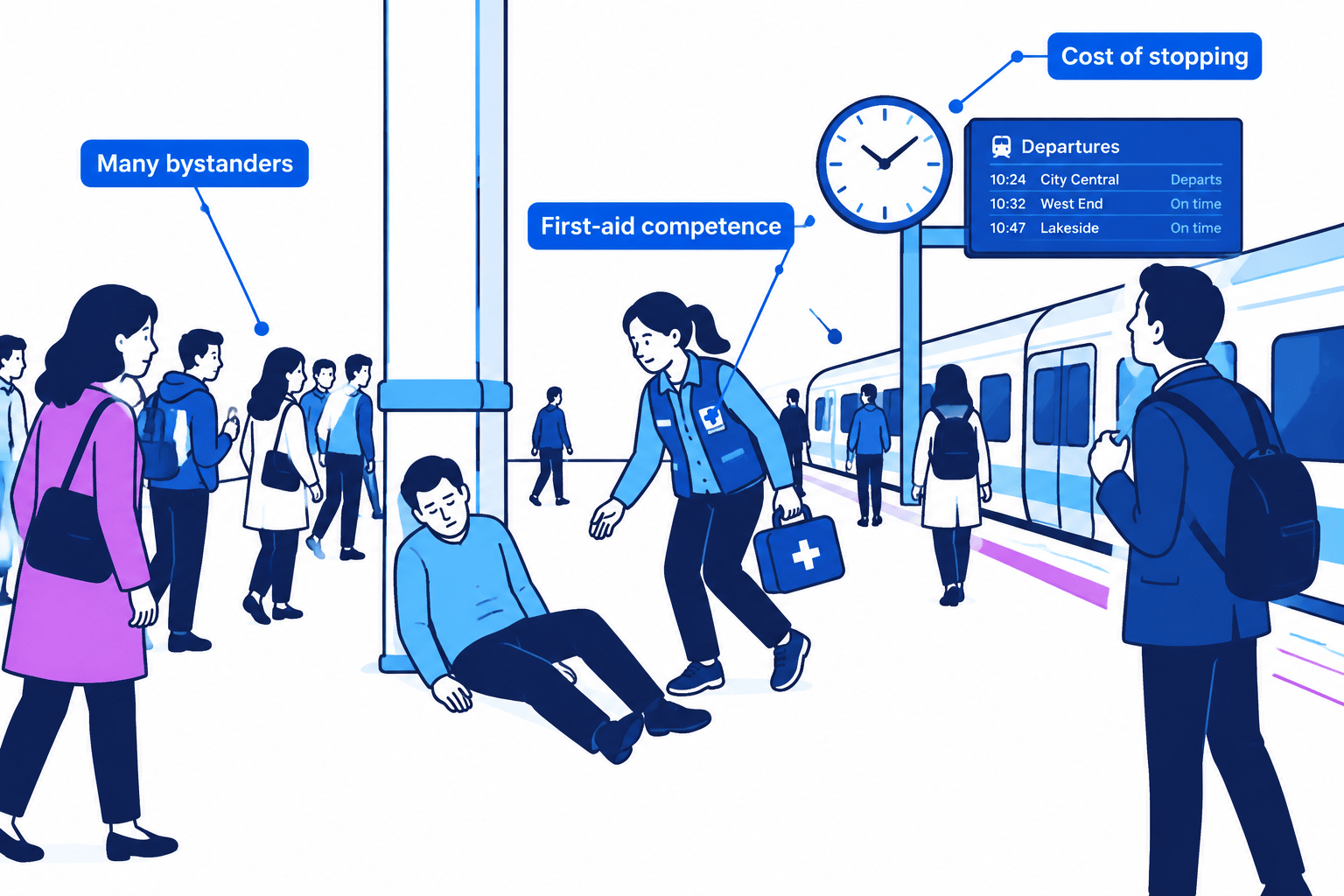
- Picture a packed platform at Birmingham New Street in rush hour, where a man stumbles and slumps against a pillar.
- Every one of those commuters can assume somebody else will deal with it, and the risk of missing a train adds to the cost of stopping.
- Change nothing about the man and nothing about you, but empty the platform, and the same person is far more likely to stop.
Personal factors
- Who you are shifts the odds, and of the 81 people who helped first without any prompting in Piliavin et al., about 90 per cent were male, even though only around 60 per cent of those present were male.
- A factor like this travels with the person, so it would show itself on a bus or in a shopping centre just as it did in a subway carriage.
- Whether you see the victim as similar to yourself makes helping more likely, because you identify with someone you take to be like you.
- Same-race helping in Piliavin et al. was far more common for the drunk victim, at 16 same-race helpers against 3 of a different race, than for the ill victim, at 36 against 26.
- Notice that this personal factor mattered most when the situational cost was highest, so the two kinds of factor are not sealed off from one another.
- How competent you feel matters as well, since someone with first aid training feels able to act while someone who feels out of their depth hangs back.
Common Mistake
- Do not label the number of bystanders a personal factor, because it belongs to the setting and vanishes the moment the setting changes.
- Do not claim Piliavin et al. proved diffusion of responsibility, because the subway data showed no strong link between the size of the crowd and the amount of helping.
Turning this into marks
- Name the factor and say which kind it is, because a situational factor belongs to the setting while a personal factor travels with the individual.
- When you are asked to explain, give the mechanism rather than the effect, so add that each person assumes someone else will act instead of only saying a big crowd means less help.
- The mark most often lost is answering a scenario without naming the detail in it, such as the street being busy or the passer-by being a nurse.
Self review
- What is the difference between a personal factor and a situational factor?
- Give two situational factors affecting bystander intervention.
- Give two personal factors affecting bystander intervention.
- What did Piliavin et al. find about the number of bystanders and the amount of helping?
- Why did the ill victim get help far more often than the drunk victim?