What CBT is
Definition
Cognitive behavioural therapy
A talking treatment that works on the unhelpful thoughts a person has and on the behaviours linked to those thoughts, changing both so that symptoms ease.
- CBT is a talking treatment, so it works on what a person thinks and does rather than on their brain chemistry.
- It rests on the idea that thoughts determine feelings, so changing what a person thinks changes how they feel and what they do.
- The version built on Beck's cognitive triad is the one usually called CBT, while the version built on Ellis's irrational beliefs is called rational emotive behaviour therapy, or REBT.
- CBT is present-focused, meaning the therapist works on the thinking and the habits you have now rather than searching your past for a cause.
- Sessions are structured and time-limited, with a goal agreed for each session and tasks to try between sessions.
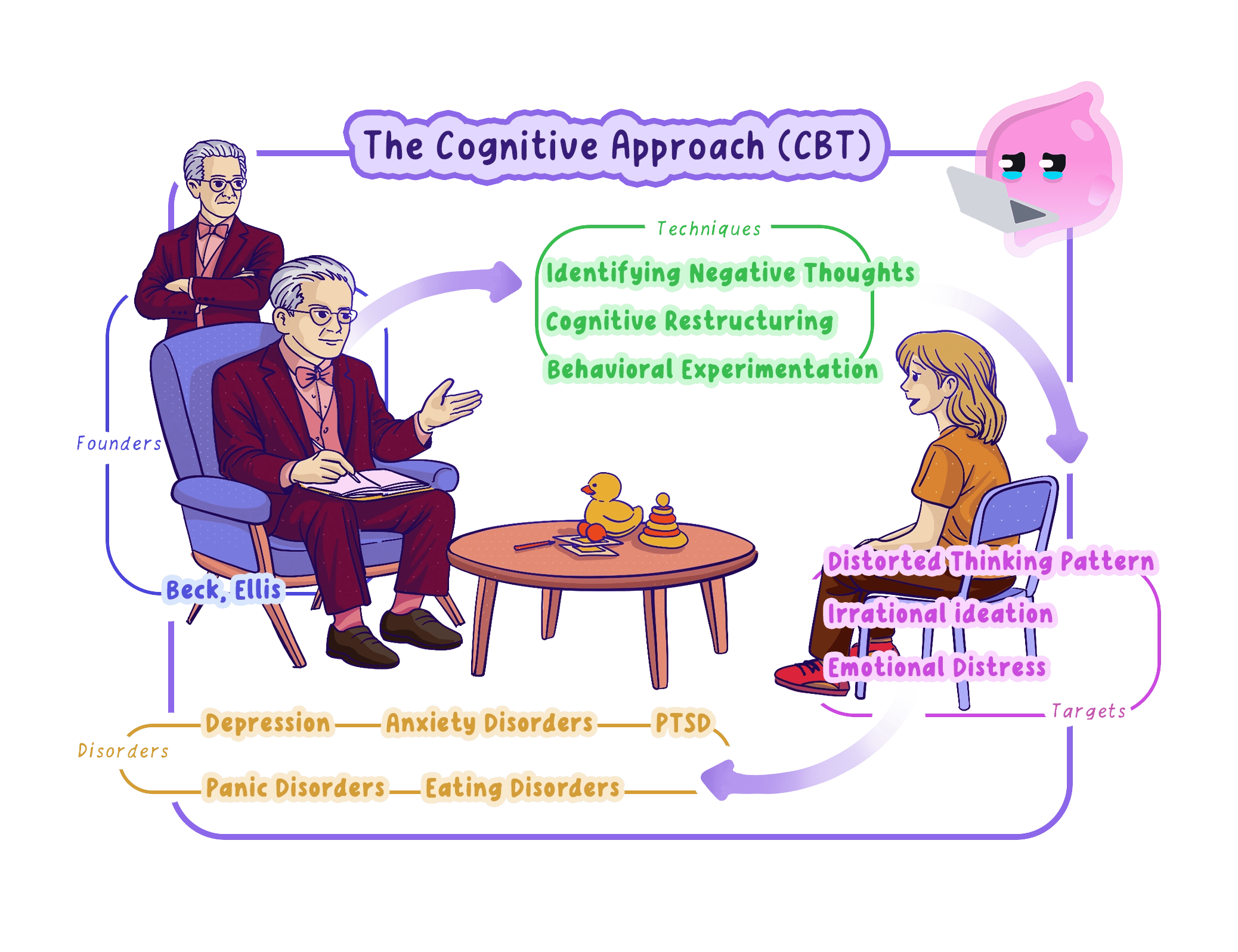
The techniques used in a CBT session
Definition
Cognitive restructuring
The technique used in CBT of identifying a negative or unrealistic thought, testing it against the evidence, and replacing it with a more balanced one.
- The first step is to notice the negative automatic thoughts that arrive without being chosen.
- Patients are taught to monitor their thoughts and to identify the ones that trigger faulty, irrational feelings.
- Each thought is then treated as a claim to be tested against real evidence rather than as a fact.
- A more balanced thought is put in its place, and this replacing of one thought with another is the cognitive half of the therapy.
- Homework tasks make up the behavioural half, because between sessions you practise using the new, more rational ways of thinking and then see what actually happens.
Example
- You hold the thought 'nobody wants to hear from me', so you never message anyone.
- Your therapist sets a task of sending two messages this week, and the replies become evidence against the thought.
CBT for depression
- The cognitive explanation says that low mood is kept going by negative, unrealistic thinking, and CBT targets exactly that thinking.
- You and the therapist identify the negative views you hold about yourself, about the world around you and about your future.
- Those views are challenged with evidence, so a thought such as 'I always fail' is checked against the things that actually went well.
- Cognitive restructuring then puts a fairer thought in its place, such as 'some things went badly this week and some went well'.
- You also learn new coping skills and ways to prevent a relapse, so the change is more likely to hold once the sessions end.
CBT for addiction
- Learning theory explains addiction as behaviour that has been learned and reinforced, so CBT works on what triggers the behaviour and on what the person believes about it.
- The first task is to identify the triggers and high-risk situations that reliably lead to the behaviour.
- The beliefs attached to the behaviour are then challenged, such as 'I cannot cope without it' or 'one more time will not matter'.
- Cognitive restructuring replaces those beliefs with more accurate ones that make the behaviour easier to resist.
- You then learn and rehearse coping responses to use in place of the behaviour when a trigger appears.
- A relapse prevention plan is agreed, which is an agreed set of steps for what to do when the urge returns so that one lapse does not become a full return to the behaviour.
Young (2007) as the evidence for CBT
- Young studied 114 clients at the Center for Online Addiction to find out how effective CBT is for internet addiction.
- Clients were screened with the Internet Addiction Test, and high-risk cases were excluded.
- The problem clients reported most often was time, at 96%, followed by relationship problems at 85%.
- Most clients had improved by session 3, were managing their symptoms effectively by sessions 8 and 12, and still held those gains at the 6-month follow-up.
- Young concluded that CBT reduced compulsive thoughts and behaviours around use and supported relapse prevention.
Strengths and weaknesses of CBT for depression
- A strength is that it treats the negative thinking the cognitive explanation blames for the depression, rather than only easing the symptoms.
- A second strength is that it has no physical side effects, unlike drug treatment.
- A weakness is that it asks for weeks of effort, and the low energy and hopelessness that are themselves symptoms of depression make attending and completing tasks genuinely hard.
- A second weakness is that it works slowly, so it is a poor fit for someone who needs relief quickly.
Strengths and weaknesses of CBT for addiction
- A strength is that it targets the learned triggers and the reinforcement that learning theory says keep the addiction going.
- A second strength is the evidence from Young (2007), where the gains were still there six months after treatment.
- A weakness is that Young used no control group, so the improvement could have come from time, motivation or the attention of a therapist rather than from CBT itself.
- A second weakness is generalisability, because all 114 clients came to a single centre for help with one kind of addiction, so the findings may not transfer to other people or other addictions.
Setting CBT against drug treatment
- The two treatments come at the same problem from opposite ends, because CBT changes the thinking and the behaviour while drugs change the brain chemistry.
- That makes CBT the more holistic treatment, since it takes in the person's thoughts and circumstances rather than their biology alone.
- Drugs act faster, which is one reason the two are often used together, with medication easing symptoms enough for the person to engage with therapy.
- The trade-off is speed against durability, since drugs work sooner but CBT leaves behind skills that outlast the treatment.
Common Mistake
- Do not write that CBT cures depression or addiction, because it reduces and manages symptoms.
- Do not reduce CBT to talking about feelings, because that loses the challenging of thoughts and the behavioural tasks.
Turning this into marks
- For a describe item give one technique plus a developed detail rather than two bare names.
- An explain item needs the point, the reason it counts and the link back to depression or addiction.
- The mark most often lost is retelling Young's procedure without stating the point it proves.
Self review
- What are patients taught to monitor in a CBT session, and why?
- Name two things CBT targets when it is used for addiction.
- What did Young (2007) find at the 6-month follow-up?
- Give one weakness of CBT as a treatment for depression.
