Addiction as learned behaviour
- Learning theory explains addiction as behaviour that is picked up through experience, in the same way as any other habit, rather than as something a person is born with.
- It works through three processes you should be able to name and keep apart: classical conditioning, operant conditioning and social learning.
- Most real cases involve all three at once, with one process starting the behaviour and another keeping it going.
Classical conditioning and learned cues
Definition
Classical conditioning
Learning by association, in which something neutral that is repeatedly paired with something that already produces a response comes to produce that response on its own.
- Classical conditioning is learning by association, and it explains the cues that come to trigger a craving.
- A place, a time of day, a smell or a particular group of people is present again and again when the substance or activity is used, so it becomes paired with the effect.
- After enough pairings the cue on its own produces the craving, without the substance being anywhere near.
- This is why cues make relapse likely, because someone who has stopped can still feel a strong urge simply by walking past the place where they used to use.
Example
- If you always open a game the moment you sit down at your desk, the desk itself starts to trigger the urge to play.
- Nothing about the desk is rewarding, it has simply been paired often enough with something that was.
Operant conditioning and reinforcement
Definition
Reinforcement
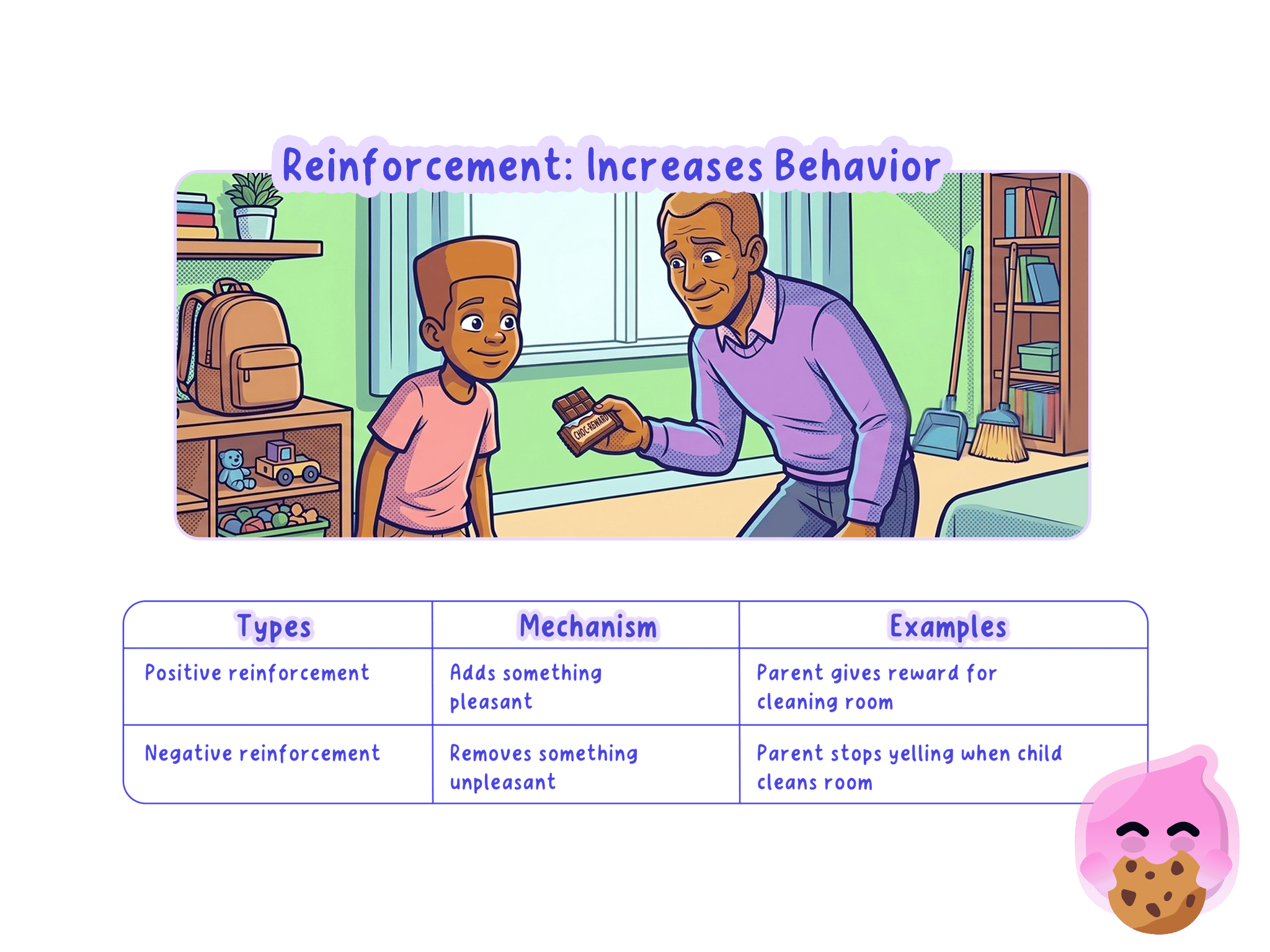
Anything that follows a behaviour and makes that behaviour more likely to happen again. Positive reinforcement adds something pleasant, such as praise, while negative reinforcement removes something unpleasant.
- Operant conditioning means behaviour is shaped by its consequences, so a consequence the person welcomes makes the behaviour more likely to be repeated.
- Positive reinforcement happens when using adds something pleasant, such as a rush of enjoyment or a feeling of belonging, which strengthens the behaviour.
- Negative reinforcement happens when using removes something unpleasant, such as withdrawal discomfort, boredom or anxiety, which strengthens the behaviour just as powerfully.
- Negative reinforcement explains why an addiction becomes so hard to stop, because after a while the person is using to stop feeling bad rather than to feel good.
Note
- Negative reinforcement is not punishment, because both kinds of reinforcement make the behaviour more likely.
- Punishment would make the behaviour less likely, so it is not the process that maintains an addiction.
Social learning and modelling
Definition
Modelling
Demonstrating a behaviour that other people can watch and imitate; the person whose behaviour is copied is called the model.
- Social learning theory explains how the behaviour starts, through watching other people rather than through direct experience.
- People imitate models they identify with, which for a young person usually means friends, older siblings, family members or figures in the media.
- Vicarious reinforcement means seeing the model rewarded, for example looking relaxed, confident or accepted by the group, which makes imitation more likely before the observer has ever tried it.
- Approval that follows the first attempt then acts as direct reinforcement, so modelling hands the behaviour over to operant conditioning.
Strengths of the explanation
- It explains relapse in a way a purely biological account struggles with, because conditioned cues keep their power long after the substance has left the body.
- It is supported by treatments built on relearning, and Young (2007) found that clients treated with cognitive behavioural therapy for internet addiction were managing their symptoms effectively by sessions 8 and 12 and had held those gains at a six-month follow-up.
Weaknesses of the explanation
- It is environmentally reductionist, explaining addiction through experience alone and leaving out the inherited vulnerability that the genetic explanation describes.
- It cannot account for individual differences, because many people meet the same models and the same cues and never develop an addiction.
Common Mistake
- Write about a person with an addiction rather than labelling anyone as an addict.
- Do not present addiction as a lack of willpower, because learning theory explains it through conditioning and imitation rather than through character.
Turning this into marks
- This is set on addiction only, so learning theory applied to depression earns nothing here.
- Attach the point to the mechanism, so negative reinforcement because using removes the discomfort of withdrawal counts, while they picked it up from their friends does not.
- The mark most often lost is describing the three processes without naming which cue, which reinforcer and which model appears in the person's situation.
Self review
- Which process explains why a place can trigger a craving?
- What is the difference between positive and negative reinforcement in addiction?
- What does vicarious reinforcement add to modelling?
- Give one reason learning theory cannot be a complete explanation of addiction.
