What counts as primary data
Definition
Primary data
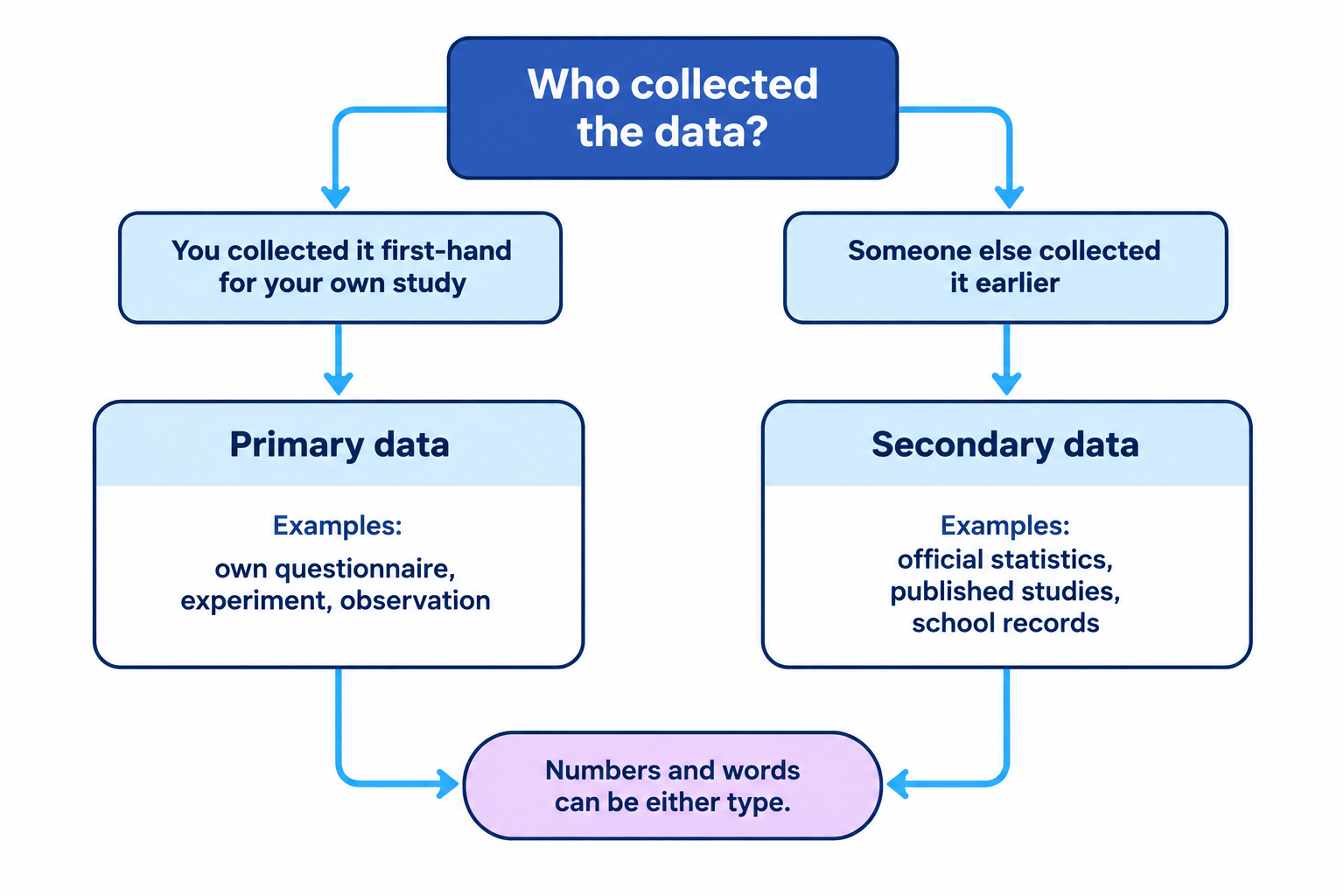
Data a researcher collects first-hand for their own study, for example by running their own experiment, questionnaire or observation.
- Primary data is anything you gather yourself, first-hand, for the study you are running.
- Timing your own participants, handing out your own questionnaire or watching and recording behaviour yourself all produce primary data.
- A student who stands in the canteen with a stopwatch and times how long eight pupils queue is collecting primary data.
What counts as secondary data
Definition
Secondary data
Data that already exists because someone else collected it, such as official statistics, past studies or records.
- Secondary data already exists because somebody else collected it before you came along.
- Official statistics, the findings of published studies, school attendance registers and hospital records are all secondary data when you use them.
- The same student turning instead to the canteen till system, which already logs how many meals were served in every five-minute block, is using secondary data.
Key Idea
- The label is about who did the collecting, not about whether the data is numbers or words.
- The same set of figures is primary to the person who gathered it and secondary to everyone who borrows it afterwards.
Strengths and weaknesses of primary data
- One strength is that it fits your aim exactly, because you designed the measurement around the question you wanted to answer.
- A second strength is that you know precisely how it was collected, so you can judge its reliability and validity for yourself.
- One weakness is that collecting it is slow and demanding, and the time it swallows is often why a study is cut short.
- A second weakness is that the sample you can reach alone is small and close to hand, so eight pupils from one queue tell you little about the year group.
Strengths and weaknesses of secondary data
- One strength is that it is quick and cheap, because the hard work of collecting has already been done by somebody else.
- A second strength is that it often covers far more people, or a far longer stretch of time, than you could ever manage alone.
- One weakness is that it was gathered for somebody else's purpose, so the till log counts meals served rather than minutes waited.
- A second weakness is that you cannot check how carefully the original collecting was done, so any flaw is now hidden inside your results.
Common Mistake
- Do not assume a published figure is trustworthy just because it is published, since a poor source is worse than no source.
- Do not confuse the source with the type, because primary and secondary data can each come as numbers or as words.
Choosing between them for a real investigation
- Go primary when no existing record answers your question, or when you need to control exactly how the measurement is taken.
- Go secondary when time is short, or when your question is about a scale or a period you could never cover yourself.
- Using both is often the strongest move, because setting your own small sample against a large existing record shows whether your group is typical.
- Whichever you use, ask who collected it, when they collected it and who they collected it from before you build an argument on it.
Example
The student times eight pupils queueing and records 90, 120, 75, 150, 110, 95, 130 and 100 seconds.
- Total = 90 + 120 + 75 + 150 + 110 + 95 + 130 + 100 = 870 seconds.
- Mean = 870 divided by 8 = 108.75, which is 109 seconds to three significant figures.
- That figure is precise about her eight pupils but silent about the other two hundred, which is exactly where the till records would help.
Turning this into marks
- Give the strength or weakness together with the reason it helps or hurts, since a bare phrase such as it is cheaper rarely scores.
- Name the pupils, the queue or the records from the scenario rather than talking in general.
- The mark most often lost comes from writing about the source the question did not name.
Self review
- Define primary data and secondary data in one sentence each.
- A researcher uses last year's published exam results to compare two schools, so which type of data is that and why?
- Give one strength of primary data and explain why it matters.
- Give one weakness of secondary data and explain why it matters.