Communicating without words
Definition
Non-verbal communication
Passing on a message without using words, for example through eye contact, facial expression, gestures, posture, touch or the distance you keep from someone.
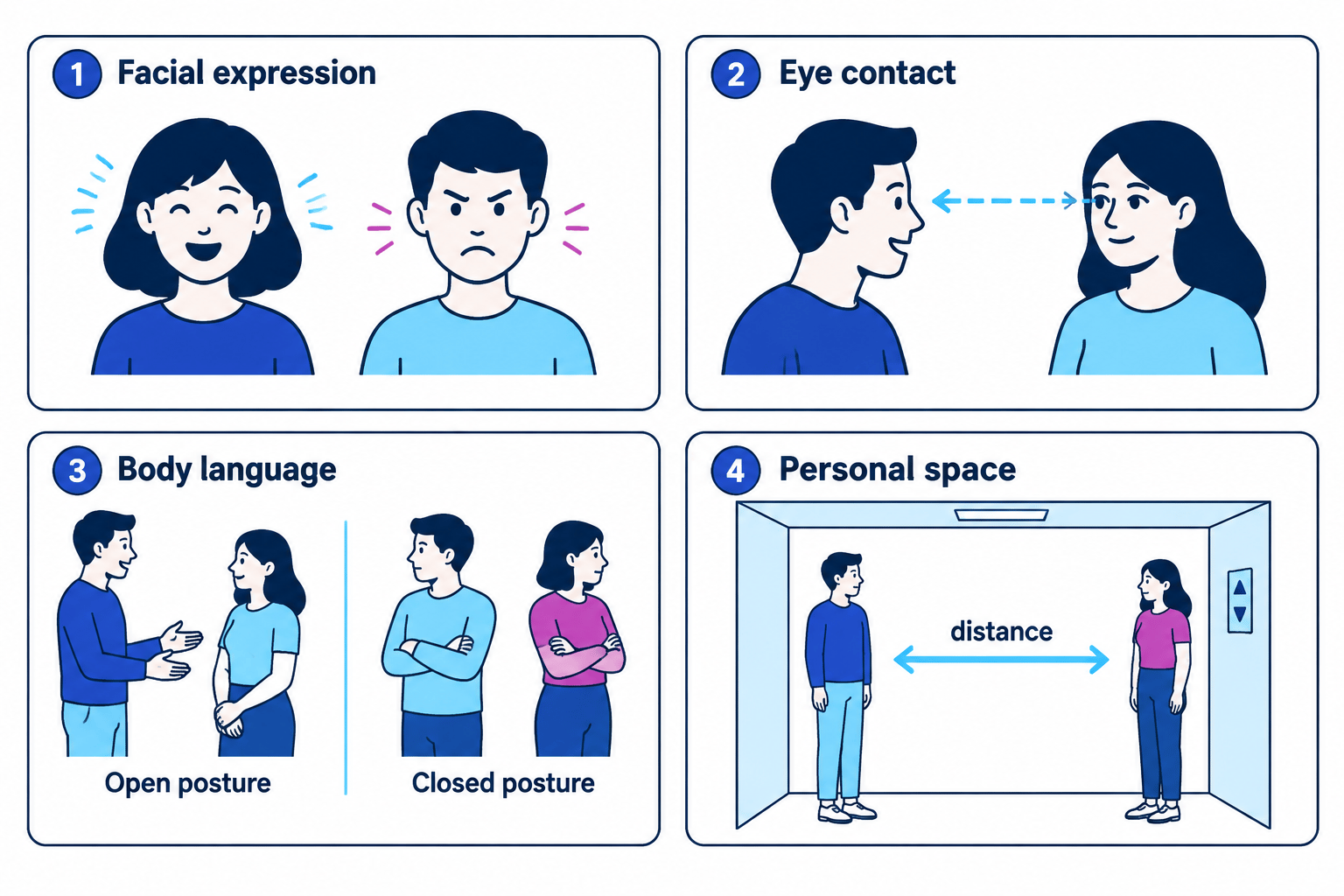
- There are four channels to learn, and they are facial expressions, eye contact, body language and personal space.
- Some of what these channels do looks the same everywhere, and some of it is clearly learned within a particular culture.
Facial expressions
- Your face signals emotion faster than you can put that emotion into words, so a grin reads as happiness and a scowl as anger from across a room.
- Expressions such as happiness, sadness, fear and anger are recognised very widely, which is one reason they are treated as a channel in their own right.
- Many expressions start involuntarily, but you can also manage them, which is why a polite smile is possible when you feel nothing of the sort.
Eye contact
- Eye contact regulates a conversation, because glancing away as you take a long turn and looking back as you finish tells the other person when to come in.
- Eye contact signals attraction and interest, since holding someone's gaze a little longer than usual says you want the exchange to continue.
- Eye contact expresses emotion, because the eyes widen in fear and narrow in anger while the rest of the face is still catching up.
- Too little gaze can read as evasive and too much as confrontational, so the amount matters as much as the presence.
Note
- How much eye contact counts as polite is not the same everywhere.
- In some communities steady gaze towards an older person shows attention, while in others lowering the eyes is the respectful choice.
Body language, posture and gestures
- Open posture means uncrossed arms and legs with the body angled towards the other person, signalling that you are relaxed and willing to engage.
- Closed posture means folded arms, crossed legs and a body turned away, signalling defensiveness or discomfort even when the words are perfectly friendly.
- Postural echo is unconsciously mirroring the other person's posture, which signals that the two of you are getting on.
- Gestures are movements of the hands, arms or head that carry an agreed meaning, such as a wave, a thumbs-up or a point.
- Because the meaning of a gesture is agreed rather than natural, it has to be learned, and the agreement is not the same in every country.
- The same hand movement can be a friendly signal in one place and an insult in another, which is a genuine source of misunderstanding between people who mean each other no harm.
Personal space and proxemics
Definition
Proxemics
The study of how people use the space and distance between themselves and others during social interaction.
- Personal space, studied as proxemics, is the distance you keep between yourself and another person, and it works like an invisible bubble you carry around.
- The size of that bubble shifts with how well you know the person and with the situation you are both in.
- When someone comes closer than the situation allows, most people restore the gap by stepping back, turning side on or dropping eye contact.
Example
- Two strangers in an empty lift stand in opposite corners, and as it fills they shuffle to share the space evenly and look at the floor.
- Dropping their eyes is a way of handing back some of the space they can no longer keep physically.
Cultural differences in non-verbal communication
- The comfortable conversational distance differs between cultural groups, so a distance that feels ordinary to one person can feel crowding to another.
- Gesture meanings differ in the same way, and so does the amount of eye contact that counts as attentive.
- Even the way a face is read varies, because Yuki et al. (2007) found that Japanese participants gave more weight to the eyes when judging how happy or sad a face was, while American participants gave more weight to the mouth.
- Taken together these differences show that a good deal of non-verbal communication is picked up from the people around you rather than simply arriving with you.
Turning this into marks
- Name the channel and say what it signals, then lift a detail out of the scenario you have been given.
- For a cultural difference, quote Yuki's finding that Japanese participants weighted the eyes and American participants the mouth.
- The mark most often lost comes from a vague statement that cultures vary, with no channel and no evidence attached.
Self review
- Name three things eye contact does in a conversation.
- What is the difference between open and closed posture, and what does each signal?
- What is proxemics, and what do people do when their personal space is invaded?
- Give one cultural difference in non-verbal communication with evidence for it.