A checklist for what counts as language
- Aitchison (1983) set out criteria of language features, which are the properties a communication system has to have before it counts as true language.
- The ones you will be asked to use most are displacement, semanticity, structure dependence and creativity.
Displacement
Definition
Displacement (in language)
A property of human language: the ability to talk about things that are not present here and now, including past, future and imaginary events.
- Displacement lets you talk about what is not in front of you, so you can reach into last week, next Saturday or something that has never existed.
- Most animal signals are set off by whatever is happening at that instant, such as a predator appearing or a rival arriving.
- That makes displacement the single clearest gap between human language and most animal systems.
Semanticity
Definition
Semanticity
A property of human language: using symbols such as words to stand for objects, actions and ideas, so that shared meanings can be passed on.
- Semanticity means a sound stands for something rather than being that thing, so the word dog is not a dog and does not resemble one.
- Because the link is a shared agreement rather than a resemblance, meanings can be taught and passed on to the next generation.
- Animal signals are usually tied to a fixed situation instead of standing in for an idea that can be discussed on its own.
Structure dependence and creativity
- Structure dependence means the arrangement of the words carries meaning of its own, so the dog bit the postman and the postman bit the dog use identical words and say opposite things.
- Creativity means a limited set of words can be recombined into an unlimited number of new sentences, including ones nobody has ever produced before.
- This is why you can understand a sentence you have never encountered, which a fixed set of calls could never allow.
What human and animal communication share
- Both are systems for getting information from one member of a species to another, and both only work because the receiver can interpret the signal.
- Both use the same channels, since sound, sight, movement and scent all carry messages for humans and for other animals.
- Both serve overlapping social purposes, including warning others of danger, attracting a mate, holding on to territory and pointing others towards food.
- Some animal systems meet some of the criteria, so the difference is one of degree rather than an absolute divide.
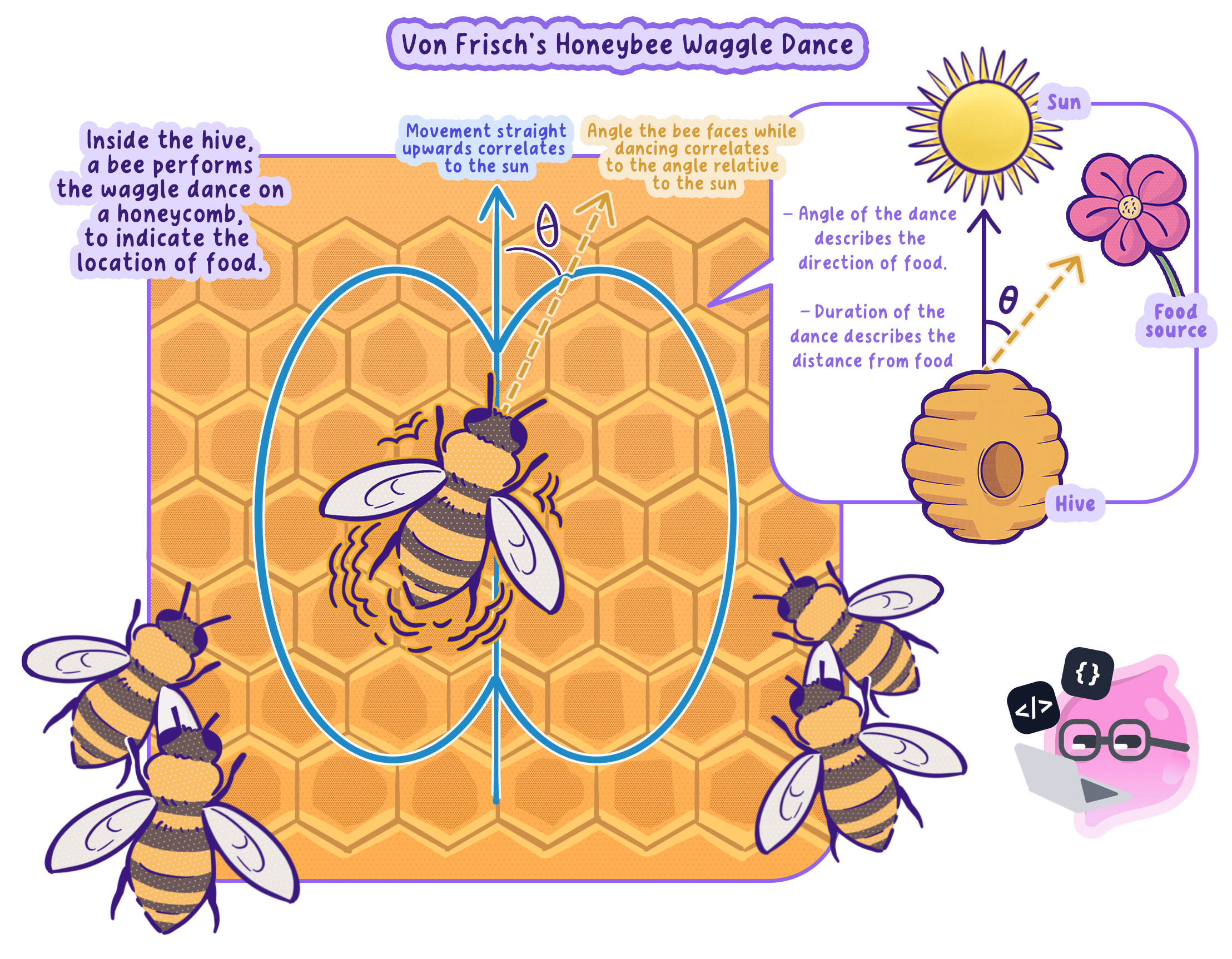
- A honeybee returning to the hive dances in a way that tells the others the direction and the distance of a food source they cannot see, which is a limited form of displacement.
Where they differ
- Human language meets the criteria as a complete set, while animal systems meet only some of them.
- Animal signals are largely inherited and limited in number, whereas human vocabulary is learned and open, so new words are added constantly.
- Animal signals do not depend on structure, so there is no equivalent of rearranging the parts to reverse the meaning.
- Animals cannot produce an unlimited set of new messages, so a bee can report where food is but cannot report that there was none yesterday.
- The fair conclusion is that both groups communicate, but only human communication satisfies the criteria for true language.
Common Mistake
- Do not claim that animals do not communicate, because their communication is real and often highly effective.
- The claim you are defending is narrower, that animal communication is not true language.
Turning this into marks
- Name the criterion, say whether the behaviour meets it, then justify that with a detail lifted straight from the description.
- Quote the honeybee dance when you need a similarity, since it shows an animal partly meeting displacement.
- The mark most often lost is the similarity, because answers list differences only.
Self review
- What are Aitchison's criteria of language features for?
- Define displacement and semanticity.
- Give two similarities between human and animal communication.
- Give two differences between human and animal communication.
- Which criterion does a honeybee's dance partly meet, and why only partly?
