Revision notes for AQA GCSE Psychology Effects of significant mental health problems on individuals and society. Open the guide for explanations and worked examples. Written against the AQA GCSE Psychology (8182) specification, so the content matches what's examinable rather than general Psychology background.
Effects of significant mental health problems on individuals and society
What you'll learn
- What psychologists mean by a significant mental health problem.
- How mental health problems can affect an individual’s relationships, daily life and physical wellbeing.
- How individual difficulties can create wider social effects, such as pressure on services and the economy.
- How to apply this topic carefully in exam scenarios without making stigmatising claims.
Starting point: what is a significant mental health problem?
A mental health problem is a difficulty involving a person’s thoughts, feelings or behaviour. It becomes significant when it seriously affects everyday functioning, causes distress, or means the person needs support from other people or services.
This topic is not asking you to diagnose anyone. Instead, you need to explain the possible effects of serious mental health problems on:
- the individual — the person experiencing the problem
- society — other people, services, communities and the economy
Definition
Significant mental health problem
A significant mental health problem is a psychological difficulty that has a serious negative effect on a person’s everyday life, wellbeing, relationships or ability to function.
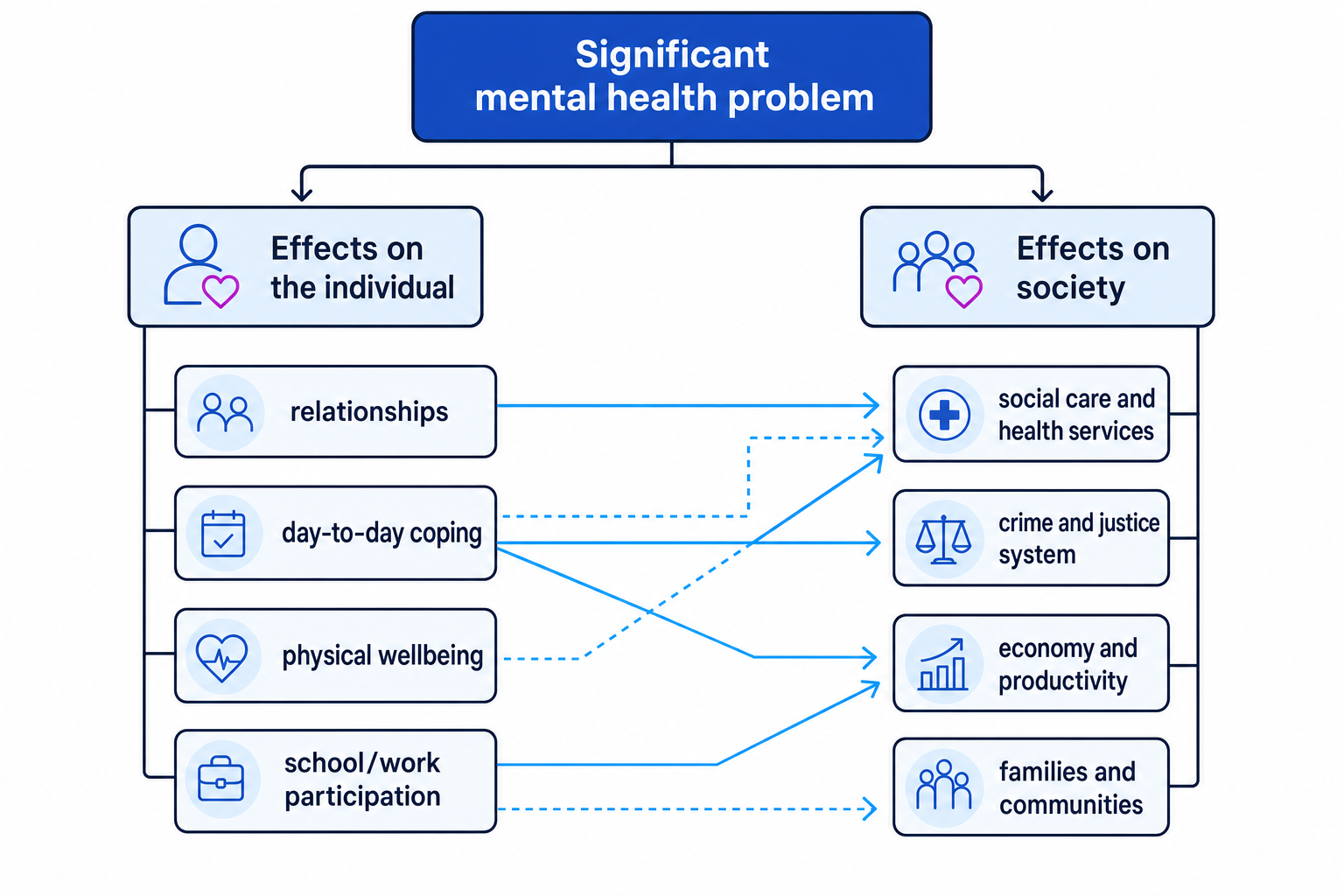
A useful way to think about this topic is: private difficulties can create public consequences. For example, if someone cannot cope with work because of severe depression, that affects them personally, but it may also affect their workplace, family income, health services and the wider economy.
Key Idea
Two levels of effect
For GCSE Psychology, always separate individual effects from social effects. Individual effects happen directly to the person; social effects happen to wider society, services or the economy.
Effects on the individual
1. Damage to relationships
A relationship is a connection between people, such as friendships, family relationships, romantic relationships or working relationships.
Significant mental health problems can make relationships more difficult. For example, a person may withdraw from friends, become irritable, struggle to communicate, or feel ashamed and avoid others. Other people may not understand what is happening, which can lead to arguments, isolation or loss of support.
This can create a difficult cycle: the person’s mental health problem damages relationships, and the loss of supportive relationships may then make the mental health problem worse.
Definition
Social support
Social support means practical or emotional help from other people, such as listening, giving advice, helping with tasks or offering reassurance.
2. Difficulties coping with day-to-day life
Day-to-day life means ordinary activities such as getting up, eating regularly, going to school or work, keeping appointments, managing money, travelling, and looking after personal hygiene.
A significant mental health problem can make these tasks feel overwhelming. For example:
- depression may reduce motivation and energy
- anxiety may make leaving the house or speaking to people very difficult
- addiction may disrupt routines, sleep and responsibilities
This matters because GCSE exam questions may give you a short scenario and ask you to identify how the person is affected. You need to link the behaviour in the scenario to a clear effect.
Example
Identifying individual effects in a scenario
Sam has been experiencing a significant mental health problem. They have stopped replying to friends, often miss school, forget to eat lunch and say they feel exhausted most of the time.
- Decide whether each detail mainly affects Sam personally or wider society. The details here are mostly about Sam’s own functioning, so they are individual effects.
- Link “stopped replying to friends” to damage to relationships, because Sam’s friendships may weaken if communication stops.
- Link “often miss school” to difficulty coping with day-to-day life, because attending school is part of normal daily functioning.
- Link “forget to eat lunch” and “feel exhausted” to negative impact on physical wellbeing, because eating and energy levels are part of physical health.
3. Negative impact on physical wellbeing
Physical wellbeing means the health and functioning of the body. Mental health and physical health are closely connected.
A significant mental health problem may affect physical wellbeing because the person might:
- sleep too much or too little
- eat too much or too little
- neglect exercise, hygiene or medical appointments
- experience stress-related symptoms such as headaches or stomach aches
- use alcohol, drugs or other risky behaviours to cope
This does not mean the mental health problem is “not real” or “just physical”. It means psychological difficulties can affect the body as well as the mind.
Common Mistake
Separating mind and body too sharply
Do not write as if mental health only affects thoughts and feelings. The specification expects you to know that significant mental health problems can also have a negative impact on physical wellbeing.
Effects on society
A social effect is an impact on wider groups, organisations or systems. This could include families, schools, workplaces, health services, social care, the criminal justice system or the economy.
1. Need for more social care
Social care means practical support for people who need help to live safely and manage daily life. This may include support workers, housing support, community care, crisis teams, or help for families and carers.
If many people experience significant mental health problems, society may need more services to support them. This can put pressure on:
- local councils
- NHS mental health services
- charities
- schools and colleges
- families and unpaid carers
More social care can be positive because it helps people stay safe and recover. However, it also requires funding, trained staff and long-term planning.
Definition
Social care
Social care is practical support provided to people who need help with everyday living, safety, independence or wellbeing.
2. Increased crime rates
The specification includes increased crime rates as a possible social effect. You must handle this point carefully.
Some significant mental health problems may be linked to crime in certain circumstances. For example, addiction may increase the risk of stealing to obtain money for substances, or untreated severe distress may lead to public disorder. Mental health problems may also be linked with homelessness, poverty or lack of support, which can increase contact with the criminal justice system.
However, it is very important not to suggest that people with mental health problems are usually dangerous or criminal. Many people with mental health problems never commit crimes, and people with mental health problems are often more likely to be vulnerable or victims of crime.
Common Mistake
Avoid stigma
Do not write “mental illness causes crime” as a simple blanket statement. A safer exam answer is: some significant mental health problems may increase the risk of certain crimes in some circumstances, especially when combined with factors such as addiction, poverty or lack of support.
3. Implications for the economy
The economy means the system involving money, work, production, spending and services in a country or community.
Significant mental health problems can affect the economy in several ways:
- people may need time off work
- some people may be unable to work for long periods
- employers may lose productivity
- the NHS and social care services may need more funding
- families may lose income if someone becomes a carer
- benefits or financial support may be needed
This is not about blaming individuals. It is about recognising that mental health problems can have costs beyond the person experiencing them.
Definition
Economic impact
An economic impact is an effect on money, work, productivity, public spending or financial resources.
Example
Classifying social effects in a scenario
A local area reports that more adults are needing community mental health support. The council funds extra support workers, some employers report more staff absence, and police spend more time responding to incidents involving people in crisis.
- Identify effects that go beyond one individual. Extra support workers, staff absence and police time all involve wider services or organisations, so they are social effects.
- Link “council funds extra support workers” to the need for more social care, because the local authority is providing practical support.
- Link “employers report more staff absence” to economic implications, because absence can reduce productivity and increase costs.
- Link “police spend more time responding to incidents” to the criminal justice system, but phrase it cautiously: it shows extra pressure on services, not that all people with mental health problems commit crimes.
How individual and social effects link together
Individual and social effects often interact. A problem may begin as an individual difficulty, but if many people experience similar difficulties, the effects become social.
For example, one person struggling to attend work is an individual effect. If many people are absent from work due to significant mental health problems, this becomes an economic issue because workplaces lose productivity and public services may need to provide support.
Analogy
Ripples in water
Think of a significant mental health problem like a stone dropped into water. The first ripple affects the individual, but later ripples can reach family, school, work, services and society.
This “ripple effect” is useful for exam answers because it helps you develop a point. Instead of writing one short sentence, you can explain how one effect leads to another.
For example:
- depression may reduce motivation
- reduced motivation may make school or work harder
- this may reduce achievement or income
- support services may become involved
- this creates wider social and economic effects
Using evidence and data carefully
In this topic, you may be given information in a short passage, table or graph. At GCSE, you do not need inferential statistics. You may need to read values, describe patterns, calculate simple percentages, or compare groups.
For example, if a question says that 12 out of 40 people using a support service needed help with housing, you could turn that into a percentage:
1240×100=30%\frac{12}{40} \times 100 = 30\%4012×100=30%That would support the point that significant mental health problems can increase the need for social care.
Tip
Data in application questions
If you are given numbers, use them directly. A sentence like “30% needed housing support, showing increased demand for social care” is stronger than a vague sentence like “some people needed help”.
AO3: evaluating claims about effects
For AO3, you need to go beyond describing effects. You should think about how strong, fair and accurate a claim is.
Effects vary between individuals
Not everyone experiences the same effects. Two people may have the same diagnosis but very different levels of support, coping skills, symptoms and outcomes.
This means you should avoid deterministic language. Deterministic means suggesting that one outcome definitely must happen. It is better to write “may lead to” or “can increase the risk of” than “will always cause”.
Cause and effect can be difficult to prove
If people with significant mental health problems are more likely to be unemployed, this does not automatically prove that the mental health problem caused unemployment. Other factors could be involved, such as poverty, discrimination, physical illness, education, family support or local job opportunities.
This matters because many findings in psychology are correlational. A correlation is a relationship between two variables, but it does not prove that one variable caused the other.
Common Mistake
Assuming correlation proves cause
If two things are linked, such as mental health problems and unemployment, do not automatically say one caused the other. A third factor, such as poverty or lack of support, could affect both.
Stigma can make effects worse
Stigma means negative attitudes or unfair treatment towards a group of people. If society stereotypes people with mental health problems, individuals may feel ashamed and avoid seeking help.
This can worsen individual effects because the person may become more isolated. It can also worsen social effects because untreated problems may place greater pressure on services later.
Definition
Stigma
Stigma is a negative label or attitude that leads to prejudice, discrimination or shame towards a person or group.
Pulling it together for exam answers
A strong answer usually does three things:
- Names the effect clearly.
- Explains how it affects the individual or society.
- Applies it to the scenario using details from the question.
For example, if a scenario says someone has lost contact with friends and stopped attending work, you could write:
- Losing contact with friends shows damage to relationships, an individual effect.
- Stopping attendance at work shows difficulty coping with day-to-day life.
- If this leads to long-term absence or loss of productivity, it may also have economic implications, which is a social effect.
Exam technique
In the exam
- Separate your answer into individual effects and social effects so the examiner can see you know the difference.
- Use cautious wording for crime, such as “may increase the risk in some circumstances”, to avoid stigmatising or overgeneralising.
- For application questions, quote or paraphrase a detail from the scenario and link it to a named effect, such as relationships, daily coping, physical wellbeing, social care, crime or the economy.
Self review
Check yourself
- What is the difference between an individual effect and a social effect?
- How might a significant mental health problem damage relationships and physical wellbeing?
- Why should you be careful when writing about mental health problems and crime?
You've reached the end
Test yourself on this topic, or move on to the next guide.
How was this guide?