Revision notes for AQA GCSE Psychology Characteristics of clinical depression. Open the guide for explanations and worked examples. Written against the AQA GCSE Psychology (8182) specification, so the content matches what's examinable rather than general Psychology background.
Characteristics of clinical depression
What you'll learn
- How clinical depression is different from ordinary sadness.
- The difference between unipolar depression and bipolar depression.
- How the International Classification of Diseases (ICD) is used to diagnose unipolar depression.
- How to apply symptoms and severity to short exam scenarios.
The big picture
In this topic, you are learning how psychologists and clinicians describe depression as a psychological problem, not just as “feeling sad”. The key exam skill is to compare different mood experiences and explain how diagnosis is based on a pattern of symptoms.
Definition
Clinical depression
Clinical depression is a mental health condition involving a persistent pattern of depressive symptoms that significantly affects a person’s thoughts, feelings, behaviour and everyday functioning.
The diagram below summarises the main distinction between sadness, unipolar depression and bipolar depression, then shows how ICD diagnosis works.
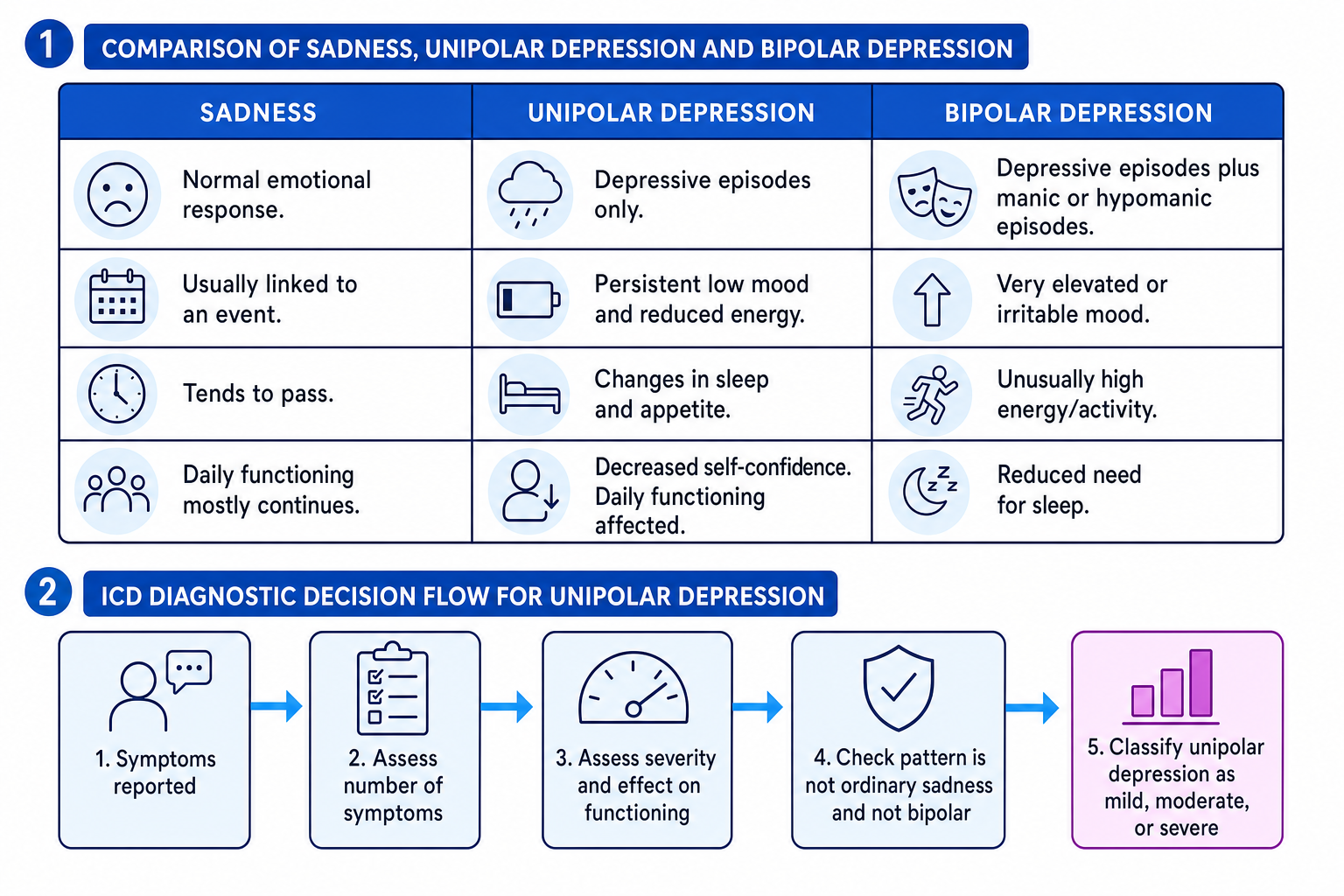
Sadness, unipolar depression and bipolar depression
Sadness
Sadness is a normal human emotion. It is often linked to a clear event, such as an argument, disappointment, bereavement or stress.
Sadness can feel very unpleasant, but it usually does not involve a full set of depressive symptoms. A person may still enjoy some activities, keep up with school or work, eat and sleep fairly normally, and feel better with time or support.
Unipolar depression
Definition
Unipolar depression
Unipolar depression is depression involving depressive episodes only, without manic or hypomanic episodes.
“Uni” means one. In unipolar depression, the main mood “pole” is depression. The person may experience symptoms such as low mood, reduced energy, changes in sleep and appetite, and decreased self-confidence.
A depressive episode is a period where depressive symptoms occur together and have a noticeable effect on everyday life.
Bipolar depression
Definition
Bipolar depression
Bipolar depression refers to depressive episodes that occur as part of bipolar disorder, where the person also has manic or hypomanic episodes at other times.
Mania is a period of unusually elevated or irritable mood, high energy, increased activity and sometimes risky behaviour. Hypomania is similar but usually less severe than mania.
The important difference is not that someone’s mood changes quickly during one day. The key point is the pattern over time: depressive episodes plus manic or hypomanic episodes suggests bipolar disorder.
Tip
Remember the poles
Unipolar means one mood pole: depression. Bipolar means two mood poles: depression and mania or hypomania.
Common Mistake
Bipolar is not just mood swings
Do not describe bipolar depression as simply “being happy one minute and sad the next”. For GCSE, focus on depressive episodes plus separate manic or hypomanic episodes.
Example
Classifying mood patterns
A teacher hears three students describe different experiences: Finn feels tearful for two days after falling out with a friend but still goes to football; Maya has had three weeks of low mood, very low energy, poor sleep and low self-confidence; Rory has low periods but also separate weeks where he sleeps very little, feels unusually energetic and acts impulsively.
-
Finn is best described as experiencing sadness, because his feelings are linked to a clear event, are short-term, and his daily functioning mostly continues.
-
Maya’s description fits unipolar depression better than sadness, because several depressive symptoms occur together over a longer period and affect her daily life.
-
Rory’s pattern suggests bipolar depression, because depressive periods are combined with separate periods of unusually high energy and reduced need for sleep, which point towards mania or hypomania.
Using the ICD to diagnose unipolar depression
A diagnosis means identifying a disorder by comparing a person’s symptoms with agreed criteria. A symptom is a reported or observed sign that may indicate a condition.
Definition
International Classification of Diseases
The International Classification of Diseases, usually shortened to ICD, is a diagnostic system produced by the World Health Organization. It helps clinicians classify physical and mental health conditions, including unipolar depression.
A clinician is a trained health professional, such as a doctor, psychologist or psychiatrist. Clinicians may use interviews, questionnaires and observations to build up a picture of the person’s symptoms.
Symptoms used in ICD diagnosis
For unipolar depression, the ICD considers the number and severity of symptoms. Symptoms include:
- Low mood — feeling persistently sad, empty, hopeless or emotionally flat.
- Reduced energy levels — feeling tired, slowed down, or unable to manage usual activities.
- Changes in sleep patterns — sleeping much less or much more than usual.
- Changes in appetite levels — eating much less or much more than usual.
- Decrease in self-confidence — feeling worthless, incapable or much less confident than usual.
ICD diagnosis can also consider other depressive symptoms, such as loss of interest or enjoyment, poor concentration, guilt, pessimism about the future, or thoughts of self-harm. At GCSE, make sure you know the symptoms named in the specification especially well.
Number and severity
The ICD does not diagnose unipolar depression from one symptom on its own. It looks at a pattern.
Number of symptoms means how many depressive symptoms are present together. Severity means how intense the symptoms are and how much they affect everyday functioning, such as school, work, friendships, self-care and family life.
Unipolar depression may be classified as:
- Mild — fewer symptoms, with some distress but many activities still possible.
- Moderate — more symptoms, with clear difficulty in everyday activities.
- Severe — many symptoms or very intense symptoms, with major impairment in daily life.
Key Idea
Diagnosis is based on a pattern
For ICD diagnosis, the key idea is: more symptoms plus greater severity and impairment means a more serious classification of unipolar depression.
Example
Applying ICD features to a vignette
Tia has felt very low for several weeks. She has very little energy, sleeps much more than usual, has lost her appetite, feels she is “useless”, and has stopped meeting friends or completing homework.
-
The symptoms include low mood and reduced energy, which are central features of unipolar depression.
-
Tia also shows changes in sleep, changes in appetite, and decreased self-confidence, so there is a pattern of several symptoms rather than one isolated feeling.
-
Her symptoms affect daily functioning because she has stopped socialising and is not completing homework, so the severity is more than mild everyday sadness.
-
If there is no evidence of manic or hypomanic episodes, the description fits unipolar depression better than bipolar depression.
AO3: Evaluating ICD diagnosis
Strengths
One strength of the ICD is that it gives clinicians a shared system. This can improve reliability, which means consistency. If two clinicians use the same criteria, they are more likely to reach a similar diagnosis.
The ICD also helps communication. A diagnosis can guide treatment, support at school or work, and further assessment. It can make a person’s difficulties feel recognised rather than dismissed as “just being sad”.
Limitations
A limitation is that symptoms can overlap with other issues. For example, poor sleep and low energy may also happen with stress, physical illness or anxiety. This affects validity, which means whether the diagnosis is accurately measuring the condition it claims to measure.
Diagnosis can also depend on self-report. Self-report means the person describes their own thoughts, feelings and behaviour. This is useful because depression is partly internal, but people may under-report symptoms due to embarrassment, fear of stigma or difficulty explaining how they feel.
Cultural factors matter too. People from different backgrounds may describe emotional distress differently. Some may focus more on physical symptoms, such as tiredness or appetite changes, rather than saying they feel “depressed”.
Common Mistake
One symptom is not enough
Do not write that someone has clinical depression simply because they feel sad or tired. In exam answers, refer to a pattern of symptoms, their number, their severity, and their effect on everyday functioning.
Ethics and sensitivity
Mental health diagnosis must be handled carefully. In real life, confidentiality is important: personal information should not be shared unnecessarily. However, if someone is at serious risk of harm, a professional may need to involve safeguarding support.
In psychological research about depression, researchers should follow ethical guidelines such as informed consent, the right to withdraw, protection from harm, confidentiality and debriefing. This is especially important because discussing mental health symptoms can be upsetting.
Common Mistake
These notes are not a diagnosis
If you recognise some symptoms in yourself or someone else, do not try to diagnose from revision notes. Speak to a trusted adult, GP, school counsellor or appropriate support service.
Quick summary
Clinical depression is more than ordinary sadness. Sadness is a normal emotional response, while unipolar depression involves depressive episodes only. Bipolar depression involves depressive episodes plus manic or hypomanic episodes.
The ICD is used to diagnose unipolar depression by considering the number and severity of symptoms, including low mood, reduced energy, sleep changes, appetite changes and decreased self-confidence.
Exam technique
In the exam
-
When comparing sadness, unipolar depression and bipolar depression, focus on duration, symptoms, functioning and mood pattern.
-
For ICD questions, mention both the number of symptoms and the severity or impact on daily life.
-
For evaluation, use terms like reliability, validity, self-report and ethics to explain strengths and limitations of diagnosis.
Self review
Check yourself
- How is unipolar depression different from bipolar depression?
- Why might ordinary sadness not meet ICD criteria for unipolar depression?
- What symptoms would you look for in a vignette about clinical depression?
You've reached the end
Test yourself on this topic, or move on to the next guide.
How was this guide?