Revision notes for AQA GCSE Psychology An introduction to mental health. Open the guide for explanations and worked examples. Written against the AQA GCSE Psychology (8182) specification, so the content matches what's examinable rather than general Psychology background.
An introduction to mental health
What you'll learn
- What psychologists mean by mental health and significant mental health problems.
- Key characteristics of good mental health, including coping and social engagement.
- Why beliefs about mental health can vary between cultures.
- Why the recorded incidence of mental health problems may change over time.
Starting point: what is mental health?
Mental health is about a person’s emotional, psychological and social wellbeing. It affects how someone thinks, feels, behaves, copes with stress, relates to others, and makes choices.
It is not the same as “being happy all the time”. Everyone feels sad, anxious, angry or stressed sometimes. In psychology, we are more interested in whether these feelings are persistent, intense, difficult to manage, or interfere with everyday life.
Definition
Mental health
Mental health refers to a person’s emotional, psychological and social wellbeing, including how they cope with challenges, manage emotions, form relationships and take part in society.
A mental health problem becomes more significant when it causes clear distress or makes everyday functioning difficult, such as attending school, maintaining friendships, sleeping, eating, concentrating or taking care of yourself.
Definition
Significant mental health problem
A significant mental health problem is a pattern of thoughts, feelings or behaviours that causes distress or seriously affects everyday life.
This topic is mainly about the introduction to psychological problems: how we recognise mental health, how beliefs differ, and why recorded rates of problems may change across time.
Common Mistake
Thinking mental health means always feeling good
Good mental health does not mean never feeling upset. A mentally healthy person can still experience stress, grief or worry. The key issue is whether they can usually cope, recover and keep functioning.
Characteristics of mental health
Psychologists often describe mental health using positive characteristics. These are signs that someone is generally functioning well, even if life is not perfect.
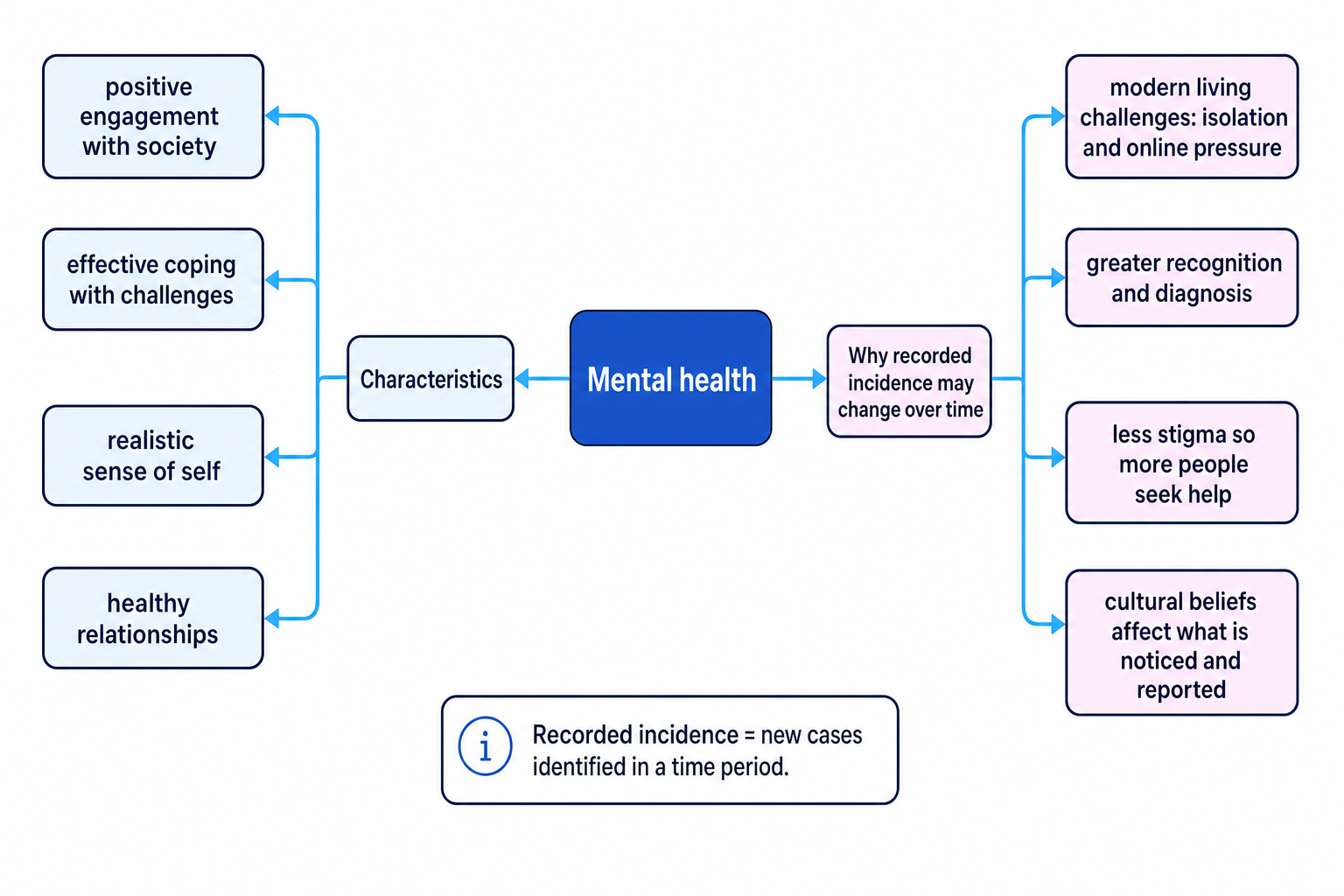
Positive engagement with society
Positive engagement with society means taking part in everyday life in a meaningful way. This might include going to school or work, joining activities, having friendships, helping others, or feeling connected to a community.
This does not mean everyone must be highly sociable. Someone can be quiet or introverted and still be mentally healthy. The important point is whether they can connect with others and participate in life in a way that works for them.
Effective coping with challenges
Coping means using thoughts, behaviours or support to manage stress and difficulty. Effective coping might include asking for help, problem-solving, taking breaks, using calming strategies, or talking to someone trusted.
Ineffective coping might include avoiding all problems, using aggression, withdrawing completely, or relying on harmful behaviours.
Key Idea
Mental health is about functioning, not perfection
Mental health is best understood as how well someone can manage emotions, cope with challenges, build relationships and take part in everyday life.
Example
Applying characteristics of mental health
A student has exams coming up. They feel nervous, but they make a revision plan, talk to a teacher when confused, keep seeing friends, and sleep reasonably well.
- The student feels stress, so they are not perfectly calm — but this alone does not show a significant mental health problem.
- They are using effective coping because they plan, seek help and manage their routine.
- They still show positive engagement with society because they continue school life and friendships.
- A psychologist would be more concerned if the anxiety became persistent, overwhelming, and stopped them attending school or functioning day to day.
Mental health as a continuum
A useful way to think about mental health is as a continuum. A continuum is a scale with gradual differences, rather than two separate boxes.
Someone may move along this continuum over time. For example, a person might usually cope well, then experience poor mental health during bereavement, then improve with support.
Definition
Continuum
A continuum is a gradual scale. In mental health, it means people can move between better and poorer wellbeing rather than being simply “healthy” or “ill”.
This matters because it reduces “us and them” thinking. Mental health problems are not rare or strange; many people experience them at some point.
Cultural variations in beliefs about mental health problems
A culture is a set of shared beliefs, values, customs and behaviours within a group or society. Culture can influence how people understand mental health problems, how symptoms are expressed, and what kind of support is seen as acceptable.
Definition
Cultural variation
Cultural variation means differences between cultural groups in beliefs, behaviours or interpretations. In mental health, it can affect what is seen as normal, worrying or needing treatment.
For example, one culture may understand hearing voices mainly as a symptom needing medical treatment, while another may interpret it in spiritual or religious terms. Some cultures may emphasise family support, while others may encourage individual therapy. Some people may describe emotional distress through physical symptoms, such as headaches or tiredness, rather than saying they feel anxious or depressed.
This does not mean one culture is “right” and another is “wrong”. It means psychologists must be careful when judging behaviour using only one cultural viewpoint.
Why cultural variation matters
Cultural beliefs can affect:
- Recognition: whether symptoms are noticed as a mental health issue.
- Diagnosis: whether professionals label the problem in a particular way.
- Help-seeking: whether someone asks a doctor, therapist, family member, religious leader or nobody at all.
- Stigma: whether the person fears shame, rejection or blame.
- Treatment choice: whether talking therapy, medication, community support or another approach is preferred.
Tip
Use culture carefully
In exam answers, avoid stereotypes such as “all people in this culture think…”. Say culture can influence beliefs and behaviour, but individuals within a culture still differ.
How the incidence of mental health problems changes over time
The specification asks you to know how the incidence of significant mental health problems changes over time.
Definition
Incidence
Incidence means the number of new cases of a problem identified in a population during a particular time period.
For example, if more students are newly diagnosed with anxiety disorders this year than ten years ago, the recorded incidence has increased.
However, this is where you need to think carefully: a rise in recorded incidence does not always mean the actual amount of mental illness has definitely increased. It might mean more people are being recognised, diagnosed or willing to report difficulties.
Common Mistake
Confusing actual incidence with recorded incidence
If official records show more diagnoses, this could mean more people have the problem — but it could also mean better awareness, easier access to services, or less fear of asking for help.
Increased challenges of modern living
One explanation for a rise in mental health problems is that modern life can create more psychological stress.
Examples include:
- Isolation: people may have less face-to-face contact, especially if they spend more time online or live far from extended family.
- Social media pressure: people may compare themselves with edited images or feel pressure to be constantly available.
- Academic and work pressure: exams, competition and uncertainty can increase stress.
- Economic pressure: worries about money, housing or future careers can affect wellbeing.
- Reduced rest: constant notifications and screen use can make it harder to switch off.
This explanation suggests that the real incidence of some mental health problems may have increased because people face more stressors.
Evaluation of the modern living explanation
A strength is that it fits everyday observations: many people report loneliness, online pressure and stress. It also helps explain why younger people may discuss anxiety and low mood more openly today.
However, it is difficult to prove cause and effect. If social media use and anxiety both rise, that does not automatically prove social media caused the anxiety. Other factors may be involved, such as family circumstances, sleep, poverty, school pressure or personality.
Key Idea
Modern life may increase stress, but evidence needs care
Modern living can create genuine pressures, but psychologists must avoid assuming that one modern factor directly causes mental health problems without good evidence.
Increased recognition and reduced stigma
Another explanation is that mental health problems are now more likely to be recognised and recorded.
Recognition means people understand symptoms better. For example, a teacher, parent or GP may now be more likely to notice signs of depression, anxiety or eating problems.
Stigma means negative attitudes or shame attached to a person or condition.
Definition
Social stigma
Social stigma is a negative label or attitude that can make people feel ashamed, judged or excluded.
In the past, some people may have hidden mental health problems because they feared being called weak, dangerous or attention-seeking. As stigma lessens, more people may talk openly, seek help and receive a diagnosis. This can increase recorded incidence even if the true number of people struggling has not changed as much.
Why this is important
Better recognition is a positive change because it can help people get support earlier. But it also makes it harder to compare rates across different time periods. If the methods of recording mental health problems improve, the figures may rise because the measurement is better.
Example
Explaining a rise in recorded diagnoses
A local health service reports that new anxiety diagnoses in teenagers have increased over the last decade.
- One possible explanation is a real increase: teenagers may face more stress from isolation, exams, online comparison or uncertainty.
- Another possible explanation is increased recognition: teachers, parents and doctors may now be better at identifying anxiety symptoms.
- A further explanation is reduced stigma: teenagers may feel more able to ask for help rather than hiding the problem.
- The best conclusion is balanced: the rise may reflect both genuine modern pressures and improved reporting or diagnosis.
Research methods link: measuring changes over time
To study incidence over time, psychologists might use:
- medical records
- school or workplace referrals
- questionnaires
- interviews
- national surveys
Each method has strengths and weaknesses.
Medical records may seem objective, but they only include people who accessed services. Questionnaires can reach more people, but responses may be affected by memory, honesty or misunderstanding of questions. Interviews can give rich detail, but people may hide sensitive information.
Reliability and validity
Reliability means consistency. A reliable questionnaire should give similar results if used again with similar people in similar conditions.
Validity means whether the method measures what it claims to measure. A questionnaire about “stress” may not validly measure clinical depression, for example.
When comparing mental health across time, validity is a big issue because diagnostic labels, public awareness and willingness to disclose may change.
Ethics
Mental health research can be sensitive. Researchers should follow British Psychological Society guidelines, including:
- gaining informed consent
- protecting confidentiality
- giving the right to withdraw
- avoiding psychological harm
- offering a debrief
- providing support information if questions cause distress
Common Mistake
Sensitive topics need extra care
Research into mental health must protect participants carefully because questions about distress, self-esteem or symptoms may be upsetting or personal.
Pulling the topic together
For GCSE Psychology, the key skill is to avoid oversimplifying. Mental health is not just “ill” or “well”. Incidence over time is not just “more people are mentally ill now”. Culture, stigma, recognition, diagnosis and modern pressures all affect what is noticed, recorded and treated.
A strong answer usually gives a balanced explanation: modern life may create more challenges, while improved awareness and reduced stigma may also increase the number of people identified as having a mental health problem.
Exam technique
In the exam
- Define key terms clearly, especially mental health, incidence, culture and stigma.
- When explaining rising incidence, include both sides: possible real increases due to modern living and possible recorded increases due to recognition and reduced stigma.
- Add AO3 by commenting on measurement problems, cultural differences, reliability, validity or ethics.
Self review
Check yourself
- What are two characteristics of good mental health?
- Why might recorded incidence increase even if the actual number of cases has not risen much?
- How can culture affect whether someone seeks help for a mental health problem?
You've reached the end
Test yourself on this topic, or move on to the next guide.
How was this guide?