This article covers 3.2.4 Psychological problems of the AQA GCSE Psychology specification.
What Mental Health Means
- Mental health is your emotional and psychological wellbeing, and it shapes how you think, feel and handle daily life.
- Good mental health means being able to handle life's ups and downs, rather than feeling happy every minute of the day.
- Your mental health matters just as much as your physical health.
Key Idea
- Mental health is about overall wellbeing, not simply the absence of a problem.
- You can sum it up as how well you cope, connect and feel from day to day.
Signs of Good Mental Health
- You engage positively with the people around you, keeping up friendships and family ties.
- You cope effectively with everyday challenges, such as a tight deadline or a difficult day.
- You can recognise and manage your emotions rather than feeling overwhelmed by them.
- You bounce back after setbacks, which psychologists call resilience.
Example
- Picture yourself in the run-up to your GCSEs: you feel nervous, but you plan your revision, talk to friends and ask a teacher for help.
- That steady coping is a sign of good mental health, a bit like a phone that keeps running smoothly even with several apps open at once.
The Mental Health Continuum
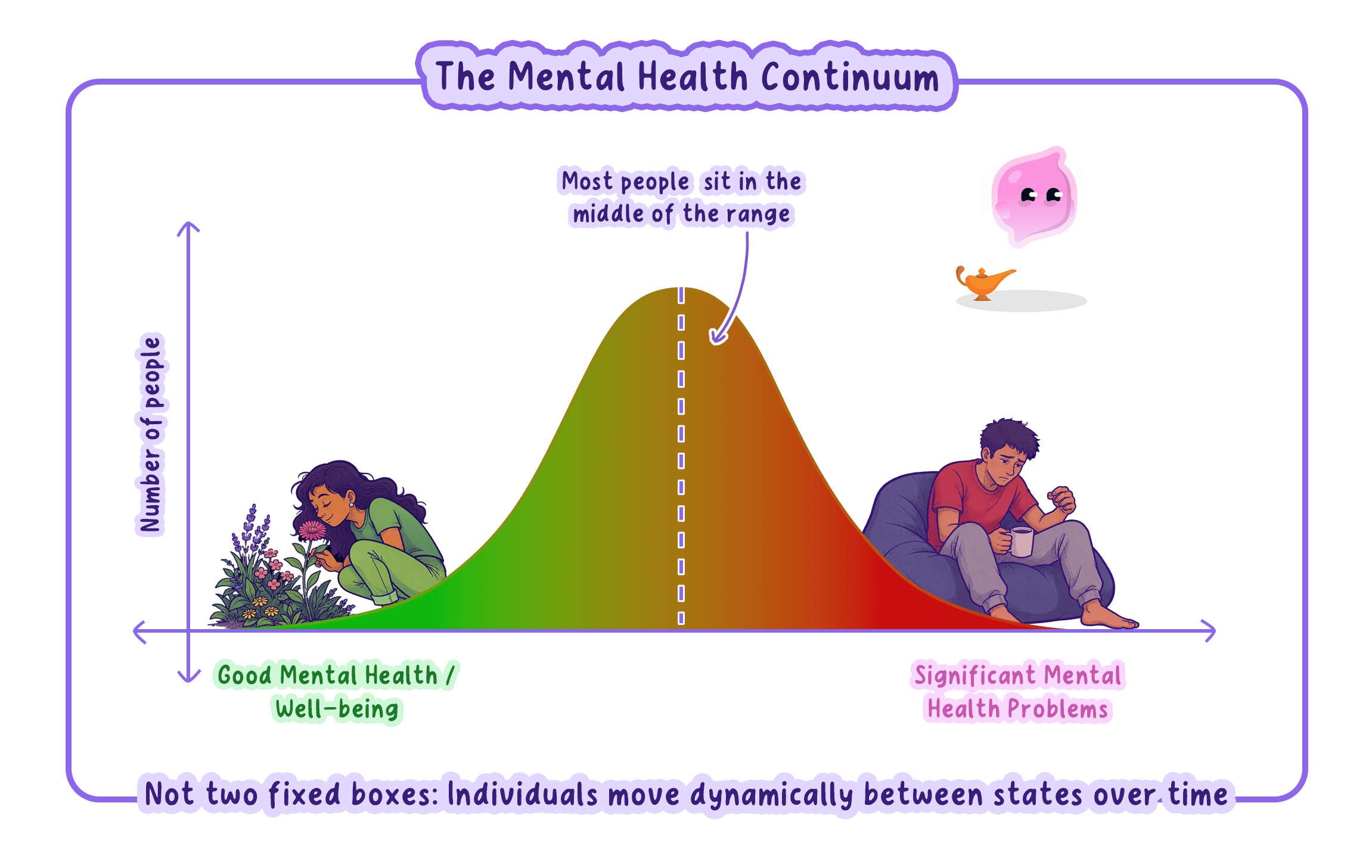
- Mental health sits on a continuum, a scale that runs from strong wellbeing at one end to significant problems at the other.
- Everyone sits somewhere on this scale, so it is not a simple case of having either good or bad mental health.
- You can move along the continuum over time as your circumstances and support change.
- A stressful period can shift you towards the problem end, while rest and support can help you move back.
Note
- Think of the continuum like physical fitness: almost nobody is either perfectly fit or completely unfit.
- Your position can change from month to month, and small habits nudge you one way or the other.
Key Terms
Definition
Mental health problem
A mental health problem is a condition that affects a person's thoughts, feelings or behaviour strongly enough to make everyday life harder. Depression and anxiety disorders are common examples.
- Wellbeing describes the healthy end of the continuum, where you feel able to cope and take part in life.
- A mental health problem describes difficulties serious enough to disrupt your everyday functioning.
- The continuum links these two ideas, reminding you that they are points on one scale rather than fixed opposites.
Self review
- What is mental health?
- Give two signs of good mental health.
- What does the mental health continuum show?
- Can a person's position on the continuum change over time?