This article covers 3.2.3 Brain and neuropsychology of the AQA GCSE Psychology specification.
Localisation of Function
- Localisation of function means a particular job is carried out mainly by a particular area of your brain, rather than being spread evenly across all of it.
- When you speak, see or feel a touch, you are leaning on a different region for each of those tasks.
- Once you can map each function onto its area, you have grasped the main idea.
Key Idea
- A localised function has a home: one main area is responsible for it.
- Because of this, damage to that area tends to disrupt that one function while your other abilities carry on.
The Main Areas: From Movement to Language
- Motor and somatosensory areas
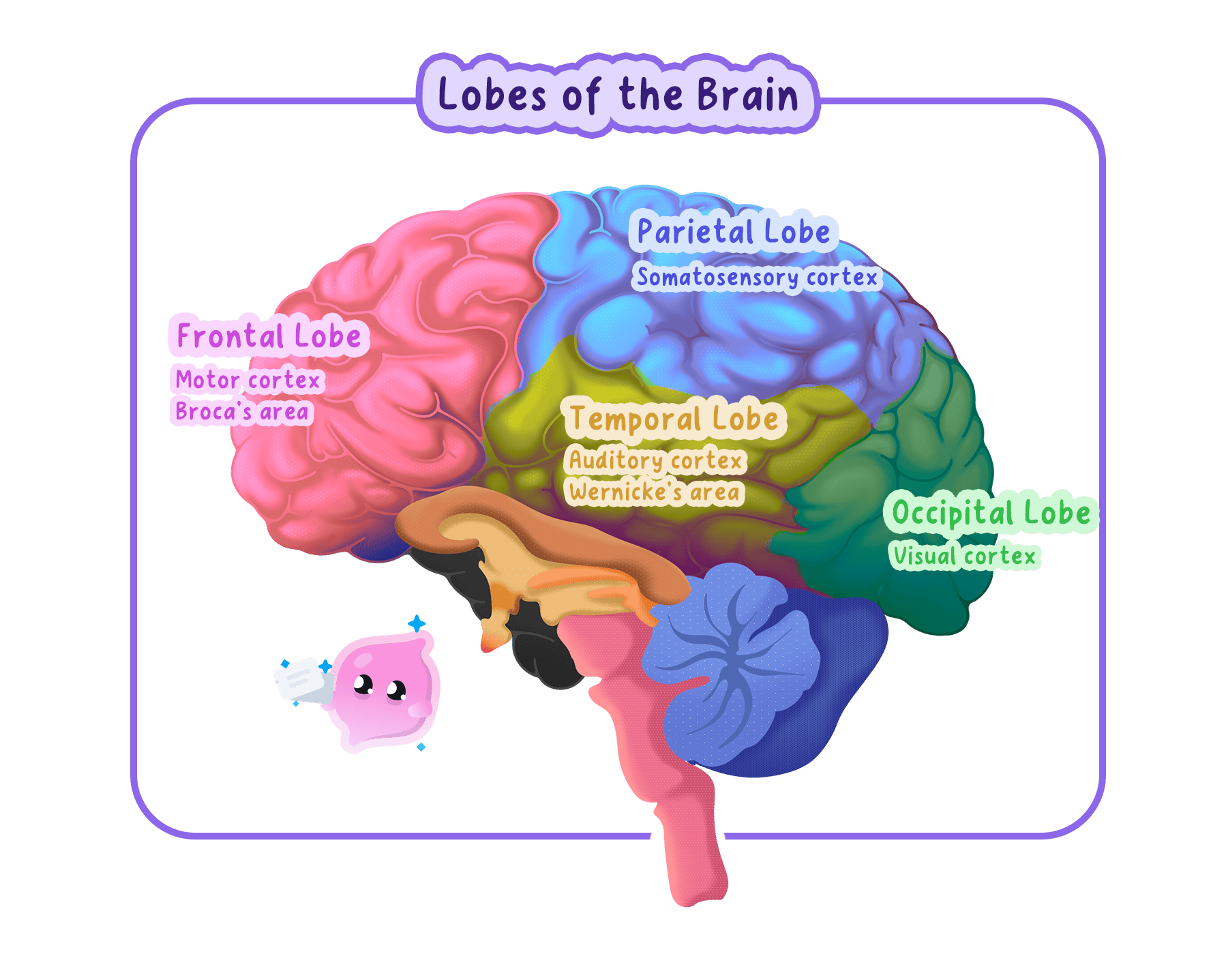
- The motor area, at the back of the frontal lobe, sends out the signals that move your muscles, while the somatosensory area, just behind it in the parietal lobe, receives information about touch, temperature and pain.
- Visual and auditory areas
- The visual area sits in the occipital lobe at the back of your head, and the auditory area sits in the temporal lobe by your ear, so what you see and what you hear are handled in separate places.
- Language areas
- Broca's area, in the left frontal lobe, lets you produce fluent speech, while Wernicke's area, in the left temporal lobe, lets you understand the words you hear and read.
Example
- Picture yourself ordering at a chippy in Leeds on a Friday night.
- Your auditory area picks up the question, your Wernicke's area works out what it means, and your Broca's area shapes your reply.
- Your motor area then moves your mouth to say 'salt and vinegar, please', with each area doing its own job in the space of a second.
What 'Localised' Really Means
- It means functions are not shared equally by the whole brain, because each key job has its own main area.
- It also means you can predict a deficit from a location, so if you know which area is damaged you can often say which ability will suffer.
- Most of the evidence comes from brain damage, where losing one area disrupts one function while the rest keep working.
Common Mistake
- Do not mix up the motor area, which sends movement out, with the somatosensory area, which takes sensation in.
- Keep Broca's area (producing speech) separate from Wernicke's area (understanding it), because examiners often test exactly this pair.
Mapping a Function in an Answer
- Name the function the question gives you, such as vision or speech production.
- Name the area responsible and say roughly where it sits, because the location often earns an easy mark.
- Finish by stating what damage there would do, since linking the area to the deficit is where the marks usually sit.
Self review
- What does localisation of function mean?
- Where are the visual and auditory areas, and what does each one process?
- What is the difference between Broca's area and Wernicke's area?
- How does evidence from brain damage support localisation?