This article covers 3.2.3 Brain and neuropsychology of the AQA GCSE Psychology specification.
Neurons: The Cells Built to Carry Signals
Key Idea
- Neurons are the cells that carry electrical signals around your nervous system.
- They come in three types, sensory, relay and motor, but all share the same basic parts.
The Parts of a Neuron and What Each Does
Definition
Neuron
A specialised cell that carries electrical signals through the nervous system. Its shape lets it receive, conduct and pass on messages.
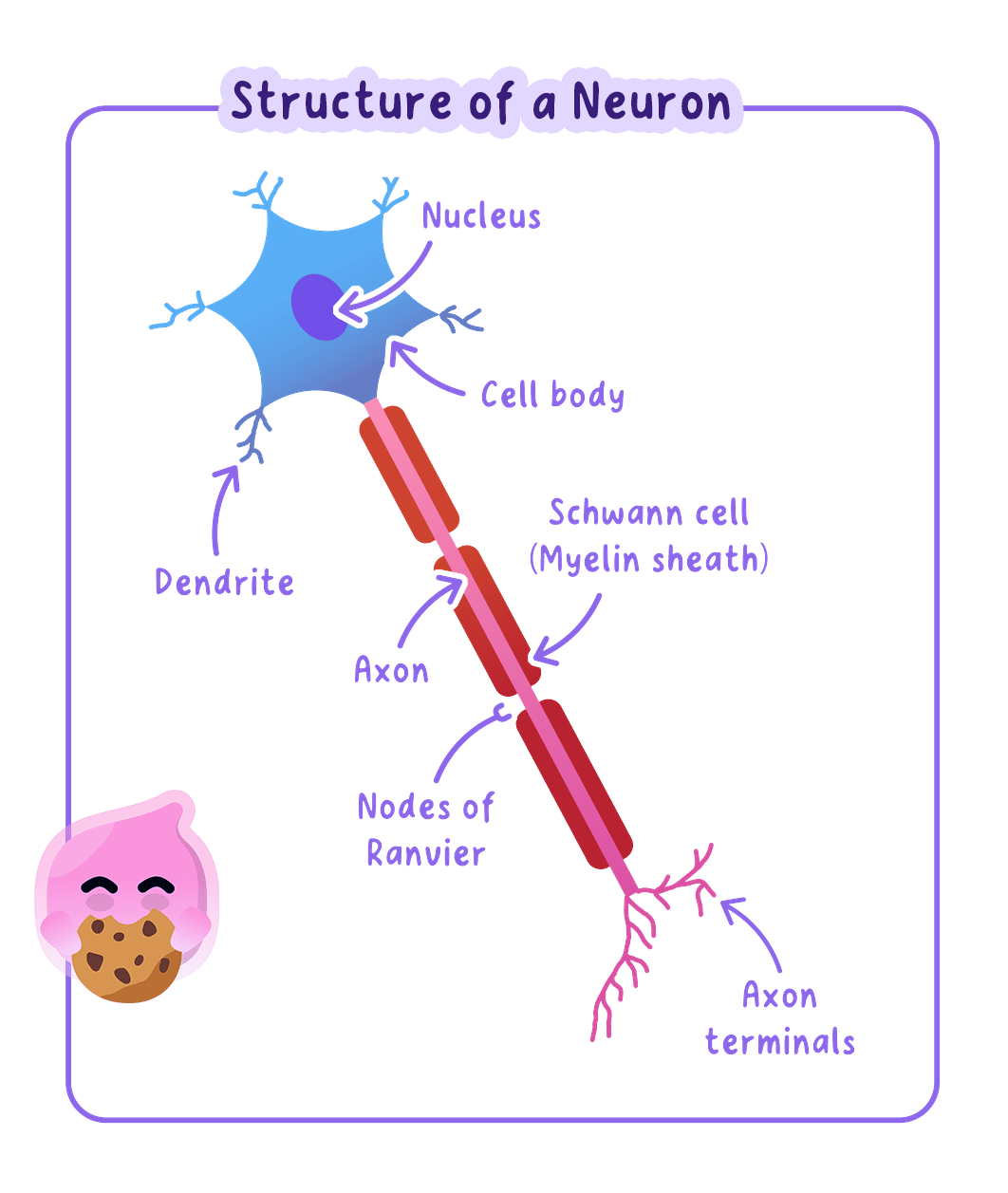
- Dendrites
- Branch-like endings that receive signals from other neurons.
- Cell body
- Holds the nucleus and combines the incoming signals.
- Axon
- The long fibre that carries the signal away from the cell body.
- Myelin sheath
- A fatty layer wrapped around the axon that speeds the signal up.
- Axon terminals
- The endings that pass the signal on to the next neuron.
Example
- The motor neuron running to the muscle in your big toe has an axon that can be nearly a metre long.
- That single fibre carries the signal the whole way from your spinal cord down to your foot.
Three Types of Neuron, Three Jobs
- Sensory neuron
- Carries signals from sense receptors, such as those in your skin, into the central nervous system.
- It has one long dendrite and a shorter axon, with the cell body branching off to the side.
- Relay neuron
- Connects neurons inside the central nervous system, linking sensory input to motor output.
- It is short, with many dendrites and a short axon, and it stays within the brain and spinal cord.
- Motor neuron
- Carries signals from the central nervous system out to muscles or glands so they act.
- It has short dendrites and a long axon that reaches all the way to the effector.
The Three Types in a Reflex Arc
- A receptor in your skin detects the sharp point of a drawing pin you have just leaned on.
- A sensory neuron carries the signal from the receptor into the spinal cord.
- A relay neuron inside the spinal cord passes the signal straight across to a motor neuron.
- The motor neuron carries the signal out to the muscle in your arm.
- The muscle contracts and your hand jerks away before the pain even reaches your brain.
Common Mistake
- Do not swap the sensory and motor neurons: sensory carries the signal in, motor carries it out.
- The relay neuron only sits inside the central nervous system, never out in the limbs.
Reading the Signal's One-Way Path
- A neuron carries its signal one way only: in through the dendrites and out through the axon terminals.
- When you label a diagram, add an arrow showing that direction, because drawing the flow backwards is a common dropped mark.
Self review
- Name the three types of neuron.
- What is the job of the dendrites and the axon terminals?
- What does a sensory neuron do?
- Where does the relay neuron sit in a reflex arc?