This article covers 3.2.2 Language, thought and communication of the AQA GCSE Psychology specification.
Von Frisch: Cracking the Honeybee Waggle Dance
Definition
Waggle dance
The figure-of-eight movement a honeybee performs on the honeycomb to tell other bees the direction and distance of a food source.
- Von Frisch studied how honeybees tell the rest of the hive where to find food.
- He found they pass on the message through a movement called the waggle dance.
- It is a classic example of a natural animal communication system that is both clever and narrow.
Key Idea
- The dance signals both the direction and the distance of a food source.
- It is sophisticated, yet it can only ever be about finding food.
Aim
- He wanted to find out how a single bee that has found food can direct the rest of the hive to it.
- In particular, he wanted to know whether the message could carry both where the food was and how far away it lay.
Method
- He set out dishes of sugar water at known directions and distances from the hive.
- He dabbed individual bees with paint so he could recognise each one and track what it did.
- He used a glass-sided observation hive so he could watch the returning bees dance on the honeycomb.
- He then moved the feeder and watched how the dance changed to match the new position.
Findings
- For food close to the hive, a bee did a simple round dance that just said food is nearby.
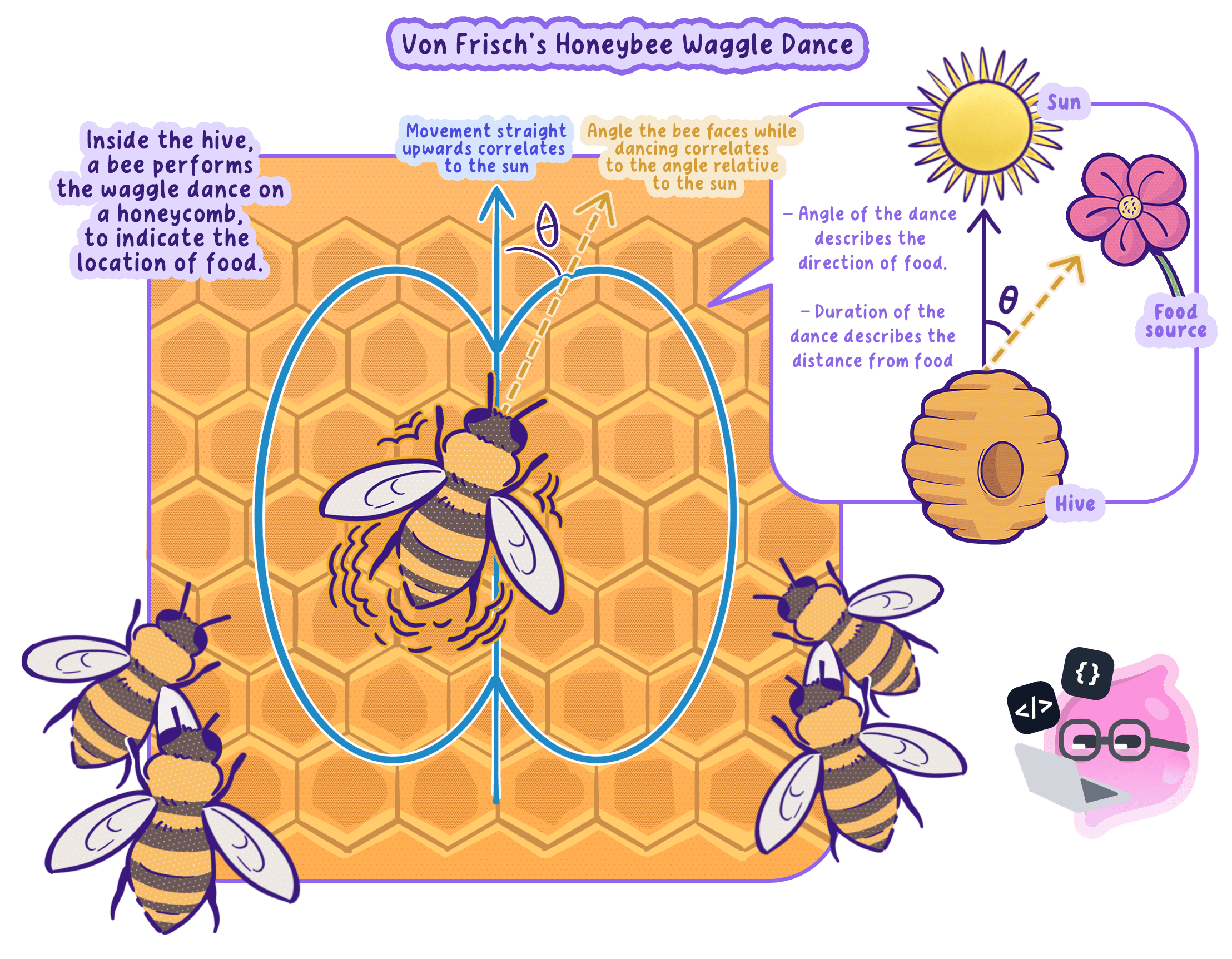
- For food further away, it did the waggle dance, a figure-of-eight with a straight waggling run in the middle.
- The angle of that waggle run away from straight up matched the angle of the food away from the sun.
- The longer the waggle run lasted, the further away the food was.
- Watching bees then flew off and found the food in the place the dance had pointed to.
Example
- A waggle run pointing straight up the comb tells the hive to fly directly towards the sun.
- A run tilted 60 degrees to the right means fly 60 degrees to the right of the sun.
- A long, drawn-out waggle means the flowers are a good distance off, not just over the garden fence.
Evaluation
- Strength
- The study was well controlled and repeatable, because he set food at known positions and could check the dance against them.
- It has high validity, because the bees were doing natural behaviour in the hive rather than an artificial lab task.
- Weakness
- The findings come from one insect species, so you cannot generalise them to other animals, still less to humans whose communication is far more flexible.
- The dance only ever communicates food location, so it cannot deal with the past, the future or abstract ideas the way language can.
Common Mistake
- Do not call the waggle dance a language.
- It is a fixed signal about one thing, food, and cannot be reshaped to say anything new the way words can.
Answering a Question on the Bee Study
- Describe what the dance signals, then how the angle gives direction and the waggle length gives distance.
- If asked to evaluate, do not stop at describing: pair a strength like the control with a weakness like the poor generalisability from one species.
- The mark most people drop is the conclusion, so end by saying the dance proves animal communication is clever but locked to the here and now.
Self review
- What two pieces of information does the waggle dance communicate?
- How does the dance show the direction of the food?
- Give one reason the findings are hard to generalise to humans.
- Why is the waggle dance still a limited form of communication?