Wave speed
Definition
Wave speed
The distance travelled by a wave each second.
- The wave speed is how fast the wave pattern, and the energy it carries, moves through the medium.
- Wave speed has the symbol vvv and is measured in metres per second, m/s\text{m/s}m/s.
- Exam questions often call this quantity the wave velocity, and for GCSE calculations the two terms give the same number.
- The speed of a wave is set by the medium it travels through, so waves of any frequency travel at the same speed in the same medium.
- Ripples in a shallow tray of water travel at only a few tens of centimetres per second, while sound in air travels at about 340 m/s340\ \text{m/s}340 m/s.
The wave equation
- Wave speed, frequency and wavelength are linked by the wave equation, v=fλv = f\lambdav=fλ.
- In words, wave speed=frequency×wavelength\text{wave speed} = \text{frequency} \times \text{wavelength}wave speed=frequency×wavelength, with speed in m/s\text{m/s}m/s, frequency in Hz\text{Hz}Hz and wavelength in m\text{m}m.
- You must learn this equation by heart, because you are expected to recall it rather than look it up.
- The equation works because each complete wave that leaves the source is exactly one wavelength long.
- If the source makes fff waves every second, then fff wavelengths of new wave are added to the wave train every second.
- The front of the wave therefore moves forward a distance of f×λf \times \lambdaf×λ each second, which is its speed.
- For example, a source making 5 waves per second, each 2 m2\ \text{m}2 m long, sends the front of the wave forward 10 m10\ \text{m}10 m every second.
How the quantities affect each other
- The frequency is fixed by the source and the speed is fixed by the medium, so the wavelength is the quantity that adjusts to fit the equation.
- In one medium, where the speed stays constant, frequency and wavelength are inversely proportional.
- Doubling the frequency of the source halves the wavelength, because twice as many waves must fit into the same distance each second.
- Lowering the frequency spreads the waves out, so the wavelength increases.
- If the frequency stays the same but the wave moves into a medium where it travels faster, the wavelength increases in direct proportion to the speed.
- Amplitude does not appear in the wave equation, so making a wave bigger does not change its speed, frequency or wavelength.
Waves in a ripple tank
Definition
Ripple tank
A shallow tank of water with a transparent base in which a vibrating dipper makes ripples that can be observed and measured.
Definition
Wavefront
A line joining points on a wave that are at the same stage of their oscillation, such as a line along one crest.
- A ripple tank lets you see water waves clearly enough to measure them.
- A motor-driven dipper, or a straight wooden bar, touches the water surface and vibrates at a steady frequency, sending out a regular train of ripples.
- A lamp above the tank shines through the water, and each crest acts like a lens, casting a bright line onto a white screen or sheet of paper below.
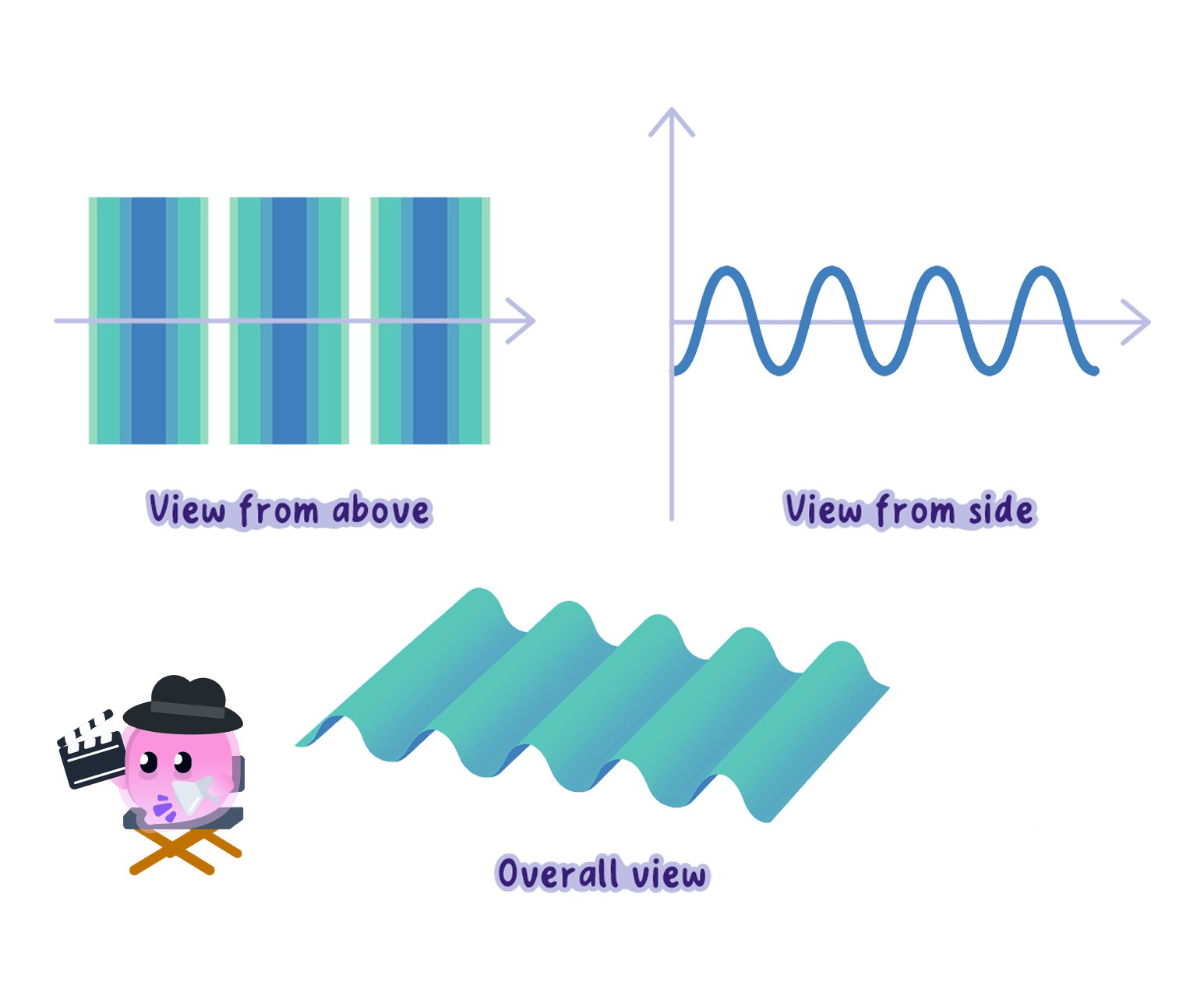
- Each bright line marks a wavefront, so the spacing between neighbouring bright lines is one wavelength.
- Straight wavefronts travel across the tank at right angles to a ray, which is an arrow drawn to show the direction the waves move.
- The top-down view is what you see on the screen, so you measure the wavelength as the gap between neighbouring bright lines along the direction of the ray.
Practical
Measuring waves in a ripple tank
- Aim: to measure the wavelength, frequency and speed of water waves in a ripple tank, and to observe how straight wavefronts reflect from a barrier.
- Apparatus: ripple tank on a level bench, water, a straight motor-driven dipper connected to a low-voltage power supply, a lamp above the tank, a large sheet of white paper below it, a metre ruler, a stopwatch, a mobile phone camera, a straight plastic barrier and a spirit level.
- Method, setting up:
- Pour water into the tank to a depth of about 5 mm5\ \text{mm}5 mm and use the spirit level to make the tank level, so the depth, and therefore the wave speed, is the same everywhere.
- Lower the dipper until it just touches the surface, switch on the lamp and dim the room lights so the bright lines on the paper are sharp.
- Switch on the motor and adjust it until a steady pattern of straight, evenly spaced ripples crosses the tank.
- Method, wavelength:
- Lay the metre ruler on the paper at right angles to the bright lines.
- Photograph the pattern with the ruler in view, so that the moving lines can be measured from a still image rather than by eye.
- On the photograph, measure the distance from the first bright line to the eleventh, which spans ten wavelengths.
- Divide this distance by ten to find one wavelength.
- Method, frequency:
- Choose a fixed mark on the ruler and start the stopwatch as one bright line passes it.
- Count the bright lines that pass the mark in 10 s10\ \text{s}10 s, and divide the count by 101010 to get the frequency in hertz.
- For a more reliable count, film the tank in slow motion and count the waves passing the mark frame by frame.
- Method, speed:
- Calculate the wave speed from your results using v=fλv = f\lambdav=fλ.
- As a check, time a single wavefront as it travels a measured distance across the tank, and divide the distance by the time.
- Repeat each measurement three times and calculate a mean, leaving out any anomalous result.
- Method, reflection:
- Stand the straight barrier in the water at an angle to the oncoming wavefronts.
- Mark the direction of the incoming and reflected wavefronts on the paper, and compare the angles each set makes with the barrier.
- Results: the wavelength is usually a few centimetres, the two values of speed agree within the uncertainty of the measurements, and the reflected wavefronts leave the barrier at the same angle as the incoming ones arrive with no change in wavelength.
- Variables: when you change the frequency of the motor to see how the wavelength changes, the frequency is the independent variable, the wavelength is the dependent variable and the water depth is a control variable.
- Watch out: the bright lines are too quick to measure by eye, so a photograph or slow-motion video is the single biggest improvement to accuracy.
- Safety: keep the power supply and lamp away from the water, wipe up spills at once so nobody slips, and use only a low-voltage supply for the motor.
Example
Doubling the frequency of a ripple tank
- A dipper vibrating at 8.0 Hz8.0\ \text{Hz}8.0 Hz makes ripples with a wavelength of 3.0 cm3.0\ \text{cm}3.0 cm.
- The wavelength is converted to metres before using the equation, so λ=0.030 m\lambda = 0.030\ \text{m}λ=0.030 m.
- The dipper frequency is then doubled to 16 Hz16\ \text{Hz}16 Hz while the water depth stays the same, so the speed stays at 0.24 m/s0.24\ \text{m/s}0.24 m/s.
- Doubling the frequency has halved the wavelength to 1.5 cm1.5\ \text{cm}1.5 cm, exactly as the inverse proportion predicts.
Common Mistake
- Do not assume that a higher frequency makes a wave travel faster, because in the same medium the speed stays the same and the wavelength gets shorter instead.
- Do not count the bright lines on the screen as wavelengths, because eleven lines mark out only ten wavelengths.
Exam technique
Describing the ripple tank method
- Name the measuring instrument for each quantity, such as a metre ruler for the wavelength and a stopwatch for the timing.
- Say that you measure across several waves and divide, and that you repeat readings and calculate a mean.
- Explain how you would freeze the moving pattern, for example with a photograph or slow-motion video, because this improvement is often credited.
- Finish by saying how you calculate the speed, using v=fλv = f\lambdav=fλ.
Self review
- What is the equation linking wave speed, frequency and wavelength?
- Why does each second of waves add a distance of fλf\lambdafλ to the wave train?
- What happens to the wavelength if the frequency of a source is tripled and the speed stays the same?
- Why is the depth of water in a ripple tank kept the same throughout the experiment?
- Why is it better to measure across ten wavelengths than across one?
