Representing a magnetic field
Definition
Magnetic field line
A line drawn to represent a magnetic field, whose arrow shows the direction of the force on a north pole placed at any point along it.
Definition
Plotting compass
A small compass whose magnetised needle lines up with the magnetic field at the point where it is placed, so it shows the direction of the field there.
- A magnet is surrounded by a magnetic field, the region in which another magnet or a piece of magnetic material experiences a force.
- The field cannot be seen, so it is represented by magnetic field lines, a model that shows two features of the field: its direction and its strength.
- Field lines are drawn as smooth, continuous curves with arrows on them.
- Field lines never cross, because the field can only point in one direction at any single point.
- The lines are a picture of the field rather than real objects, so the field is also present in the spaces between the lines.
- The field exists in three dimensions all around the magnet, even though a diagram shows only a flat slice of it.
Direction of the field
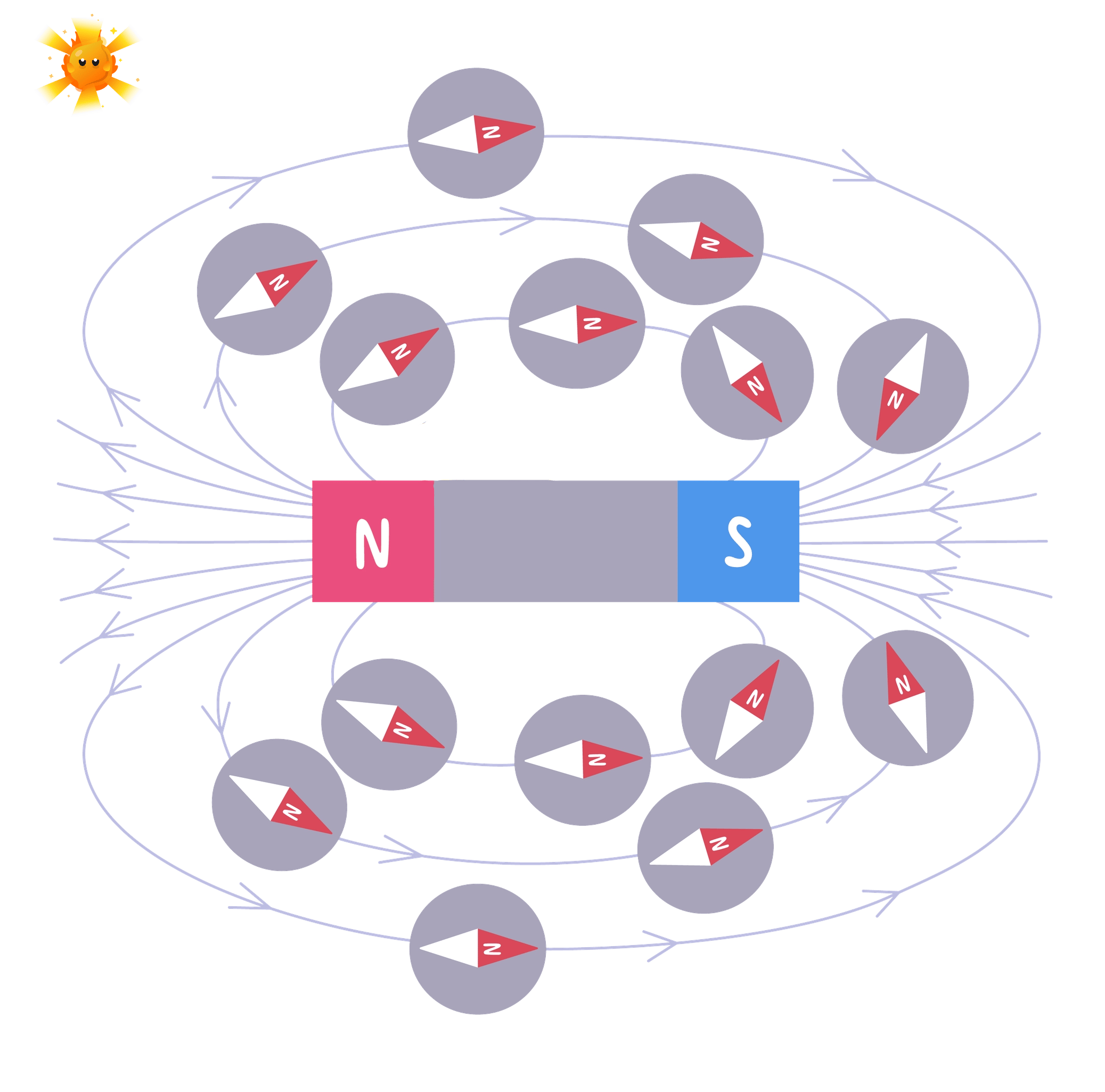
- The direction of a magnetic field at any point is the direction in which the north pole of a plotting compass points when it is placed there.
- Outside a bar magnet, the field lines run from the north pole to the south pole, leaving the north pole and curving round to enter the south pole.
- The lines curve, so the direction of the field changes from point to point around the magnet.
- Near the ends of the magnet, the field points straight out of the north pole and straight into the south pole.
- Alongside the middle of the magnet, the field runs roughly parallel to the magnet, pointing from the north end towards the south end.
- A ring of plotting compasses placed around a bar magnet shows this change, with each needle turning to follow the field line through its own position.
Strength of the field
Definition
Magnetic field strength
A measure of how large a force a magnet or magnetic material would experience at a particular point in a magnetic field.
- The strength of the field is shown by how close together the field lines are.
- Where the lines are closely packed the field is strong, and where they are spread out the field is weak.
- The lines are most crowded at the poles, so the field of a bar magnet is strongest at its poles.
- The lines spread further apart as they move away from the magnet, so the field becomes weaker with distance from the magnet.
- The field alongside the middle of the magnet is weaker than at the poles, which is why iron filings and paper clips cluster at the ends of a bar magnet and hardly gather at its centre.
- A stronger field exerts a larger force, so a paper clip is pulled harder close to a pole than it is further away.
Practical
Mapping the field of a bar magnet
- Aim: to map the shape and direction of the magnetic field around a bar magnet, and to compare the strength of the field at different points.
- Apparatus: a bar magnet, a sheet of plain A3 paper, sticky tape, a sharp pencil, a small plotting compass, a thin sheet of clear plastic, iron filings in a shaker, a clamp stand and a box of small steel paper clips.
- Method, plotting compass:
- Tape the paper to a bench well away from other magnets and steel objects, place the bar magnet in the centre, draw round it and label its N and S ends.
- Place the plotting compass close to the north pole and mark two dots on the paper, one at each end of the needle.
- Move the compass forward so that the tail of the needle sits exactly over the dot that marked its tip, then mark a new dot at the new tip.
- Keep stepping the compass forward in this way until the trail of dots reaches the south pole or runs off the paper.
- Join the dots with a smooth curve and add an arrow pointing from the north pole towards the south pole.
- Start again from different points around the north pole until eight to ten lines surround the whole magnet.
- Method, iron filings:
- Lay the clear plastic sheet over the magnet and sprinkle a thin, even layer of iron filings onto it from about 20 cm20\ \text{cm}20 cm above.
- Tap the sheet gently so that the filings can shuffle into line with the field, then sketch or photograph the pattern.
- Method, comparing strength:
- Clamp the magnet horizontally and hang a chain of paper clips from its north pole, adding clips one at a time until no more will hold.
- Repeat at the south pole and then at the middle of the magnet, recording the number of clips held at each position.
- Results: the compass trails and the filings both form curved lines that bunch together at the poles and spread out further away, the compass shows that the lines run from north to south, and each pole holds far more clips than the middle.
- Conclusion: the field is strongest at the poles and weakens with distance, and its direction outside the magnet is from the north pole to the south pole.
- Watch out: iron filings show the shape of the field but not its direction, so the compass is needed for the arrows, and far from the magnet the compass lines up with the Earth's field instead, so lines traced there are not reliable.
- Safety: keep the filings on the plastic sheet rather than on the bare magnet, as they are very hard to remove, keep them away from your eyes and wash your hands afterwards.
Example
Comparing the field at three points
- A field diagram of a bar magnet marks point P a short distance beyond the north pole, point Q beside the middle of the magnet and point R far out to one side.
- At P the field lines are packed closest together, so the field is strongest there.
- At Q the lines are further apart than at P, so the field is weaker.
- At R the lines are widely spread, so the field is the weakest of the three.
- The order of field strength from strongest to weakest is therefore P, Q, R.
- The field at P points straight away from the north pole, while the field at Q runs parallel to the magnet towards the south end, so the direction also differs between the points.
Example
Predicting where a compass points
- A plotting compass is placed a short distance beyond the south pole of a bar magnet, on the line through the centre of the magnet.
- Field lines point into a south pole, so at this position the field points towards the magnet.
- The north pole of the needle lines up with the field, so it points towards the south pole of the bar magnet.
- If the compass is moved round to sit beside the middle of the magnet, the needle turns to lie parallel to the magnet, pointing from the north end towards the south end.
Exam technique
Describing and drawing magnetic fields
- When describing a field, give both its direction and how its strength changes, because each usually earns a separate mark.
- Link strength to the diagram through the spacing of the lines, writing that the field is strongest where the lines are closest together.
- When drawing a field, use at least six smooth lines, add arrows from north to south, crowd the lines at the poles and never let them cross or touch.
- When asked how to investigate a field, describe the step-by-step plotting compass method, because iron filings alone cannot show direction.
Common Mistake
- Do not say that the field exists only along the drawn lines, because the lines are a model and the field fills all the space around the magnet.
- Do not draw arrows pointing from south to north outside a magnet, because the field outside a magnet runs from north to south.
- Do not say that the field is strongest in the middle of a bar magnet, because it is strongest at the poles.
Self review
- How is the direction of a magnetic field at a point found?
- In which direction do field lines run outside a bar magnet?
- How does a field line diagram show where the field is strongest?
- Where is the magnetic field of a bar magnet strongest?
- Why are iron filings not enough to show the full field of a magnet?
