Scale vector diagrams
Definition
Scale drawing
An accurate diagram in which every length represents a quantity according to a fixed scale.
- A vector diagram shows forces as arrows so that you can find their combined effect by drawing and measuring.
- Every arrow is drawn to scale, so its length represents the size of the force and its direction matches the direction of the force.
- Choose a scale that makes the diagram as large as the space allows, such as 1 cm1\ \text{cm}1 cm to 10 N10\ \text{N}10 N, because a large diagram gives more accurate measurements.
- Write the scale beside the diagram so that every length can be converted back into a force.
- Use a sharp pencil and a ruler for lengths, and a protractor for any angle.
Note
At GCSE, vector diagrams only involve forces that are parallel or perpendicular to each other.
Combining forces
Definition
Resultant force
The single force that has the same effect on an object as all of the forces acting on it combined.
- The resultant force found from a vector diagram is the single force with the same effect as all the forces acting together.
- To add forces on a vector diagram, use the tip-to-tail method.
- Draw the first force arrow to scale.
- Draw the second force arrow to scale, starting from the tip of the first arrow.
- Draw the resultant as a straight arrow from the tail of the first arrow to the tip of the last arrow.
- Measure the length of the resultant and convert it into newtons using the scale, then measure its angle if a direction is needed.
- For parallel forces, the arrows lie along one line.
- Two forces in the same direction give a resultant equal to their sum.
- Two forces in opposite directions give a resultant equal to their difference, in the direction of the larger force.
- For perpendicular forces, the two arrows form two sides of a right-angled triangle and the resultant is the third side.
- Because the triangle is right-angled, you can check a measured resultant with Pythagoras' theorem, FR=F1 2+F2 2F_{\text{R}}=\sqrt{F_1^{\,2}+F_2^{\,2}}FR=F12+F22.
- You can also draw both arrows from the same point, complete a rectangle and draw the diagonal, which gives the same resultant.
Example
Resultant of two perpendicular forces
- A boat is pushed east by its engine with a force of 300 N300\ \text{N}300 N while the wind pushes it north with a force of 400 N400\ \text{N}400 N.
- With a scale of 1 cm1\ \text{cm}1 cm to 100 N100\ \text{N}100 N, draw a 3.0 cm3.0\ \text{cm}3.0 cm arrow to the east, then a 4.0 cm4.0\ \text{cm}4.0 cm arrow to the north starting from its tip.
- Join the tail of the first arrow to the tip of the second arrow and measure the resultant as 5.0 cm5.0\ \text{cm}5.0 cm.
- The protractor shows the resultant at about 53∘53^\circ53∘ to the east direction, so the boat is pushed with 500 N500\ \text{N}500 N in a direction between east and north.
Resolving a force
Definition
Resolving a force
Replacing a single force with two perpendicular components that together have the same effect as the original force.
Definition
Component
One of the two perpendicular parts into which a force is split when it is resolved.
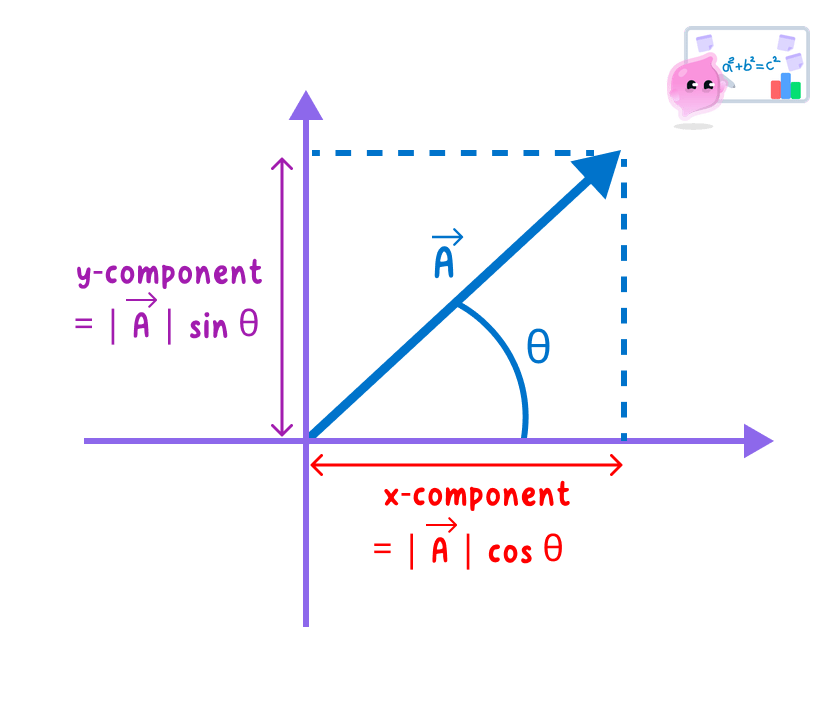
- Resolving a force means splitting it into two components that are perpendicular to each other.
- The two components are usually chosen to be horizontal and vertical, or along and at right angles to a slope.
- The two components together have exactly the same effect as the original force, so they replace it in a calculation rather than being added to it.
- Resolving is useful because forces along each perpendicular direction can then be combined separately.
- To resolve a force by scale drawing, follow a fixed set of steps.
- Draw the force to scale at the correct angle, starting from one corner of your diagram.
- Draw a horizontal line and a vertical line from the start of the arrow.
- From the tip of the arrow, draw lines at right angles back to the horizontal and vertical lines to complete a rectangle.
- Measure the horizontal and vertical sides of the rectangle and convert each length into newtons with the scale.
- The horizontal component is the part of the force that moves an object along the ground, and the vertical component is the part that lifts it or presses it down.
Example
Resolving the pull on a sledge
- A child pulls a sledge across snow with a rope that makes an angle of 40∘40^\circ40∘ above the horizontal, and the tension in the rope is 60 N60\ \text{N}60 N.
- With a scale of 1 cm1\ \text{cm}1 cm to 10 N10\ \text{N}10 N, draw a 6.0 cm6.0\ \text{cm}6.0 cm arrow at 40∘40^\circ40∘ above the horizontal.
- Complete the rectangle and measure the horizontal side as 4.6 cm4.6\ \text{cm}4.6 cm and the vertical side as 3.9 cm3.9\ \text{cm}3.9 cm.
- Only the 46 N46\ \text{N}46 N horizontal component pulls the sledge forwards, while the 39 N39\ \text{N}39 N vertical component lifts the front of the sledge slightly.
Equilibrium
Definition
Equilibrium
The state of an object when the resultant force acting on it is zero.
- An object is in equilibrium when the resultant force on it is zero.
- An object in equilibrium either stays at rest or moves at a constant velocity.
- When the forces on an object in equilibrium are drawn tip to tail, the last arrow finishes exactly where the first arrow started, so the arrows form a closed shape.
- Two forces in equilibrium form a closed shape only if they are equal in size and opposite in direction.
- Three forces in equilibrium form a closed triangle.
- If a vector diagram does not close, the gap between the start and the finish is the resultant force, so the object is not in equilibrium.
- To find the force needed for equilibrium, find the resultant of the other forces and add a force of the same size in the opposite direction.
- Resolving gives a second test for equilibrium, because the horizontal components must cancel and the vertical components must cancel.
Example
Finding the force that keeps a crate in equilibrium
- Two ropes pull a crate on a smooth floor, one with 80 N80\ \text{N}80 N to the east and one with 60 N60\ \text{N}60 N to the north.
- Drawn tip to tail with a scale of 1 cm1\ \text{cm}1 cm to 20 N20\ \text{N}20 N, the arrows are 4.0 cm4.0\ \text{cm}4.0 cm and 3.0 cm3.0\ \text{cm}3.0 cm long and the gap that closes the triangle is 5.0 cm5.0\ \text{cm}5.0 cm.
- A third rope must pull with 100 N100\ \text{N}100 N in the direction that closes the triangle, which points between west and south.
- With this third force, the three arrows form a closed triangle and the crate is in equilibrium.
Common Mistake
- Do not draw the components and the original force on the same diagram as if they were three separate forces, because the components replace the original force.
- Do not start the second arrow from the tail of the first arrow when you use the tip-to-tail method, because this gives the wrong resultant.
- Do not assume that an object in equilibrium must be stationary, because it may be moving at a constant velocity.
Exam technique
Scale diagram questions
- State your scale and use the whole of the space provided, because a small diagram loses accuracy.
- Draw the resultant with a double arrowhead or label it clearly so that it is not confused with the original forces.
- Give the resultant with its unit and its direction, as both are usually needed for full marks.
- Expect your measured answer to be accepted within a small range, so measure carefully rather than rounding early.
Self review
- Describe the tip-to-tail method for adding two forces.
- Find the resultant of a 5 N5\ \text{N}5 N force to the east and a 12 N12\ \text{N}12 N force to the north.
- What does it mean to resolve a force?
- Why should the components not be added to the original force?
- What shape do three forces in equilibrium make when drawn tip to tail?
