Isolated objects and systems
Definition
Isolated system
An object, or a group of objects, that is considered separately from its surroundings so that the external forces acting on it can be identified.
Definition
External force
A force exerted on a system by an object outside the system.
- To analyse the forces on something, you first draw an imaginary boundary around it and treat it as an isolated object or system.
- A system can be a single object, such as a ball bearing, or a group of objects that move together, such as a skydiver and her parachute.
- Only external forces, which are exerted on the system by objects outside the boundary, affect how the whole system moves.
- Forces between parts of the system are internal forces, and they cancel out in pairs, so they do not change the motion of the system as a whole.
- The choice of boundary decides which forces count as external.
- If the system is the skydiver alone, the tension in the parachute harness is an external force pulling her upwards.
- If the system is the skydiver and parachute together, the harness tension is internal and the external forces are the total weight and the air resistance on the whole system.
- For each external force, you should be able to name the object that exerts it, such as the Earth for weight or the air for air resistance.
Forces on a falling object
Definition
Drag
The resistive force that acts on an object moving through a fluid, in the opposite direction to its motion.
Definition
Terminal velocity
The constant velocity reached by a falling object when the resistive forces acting on it balance its weight.
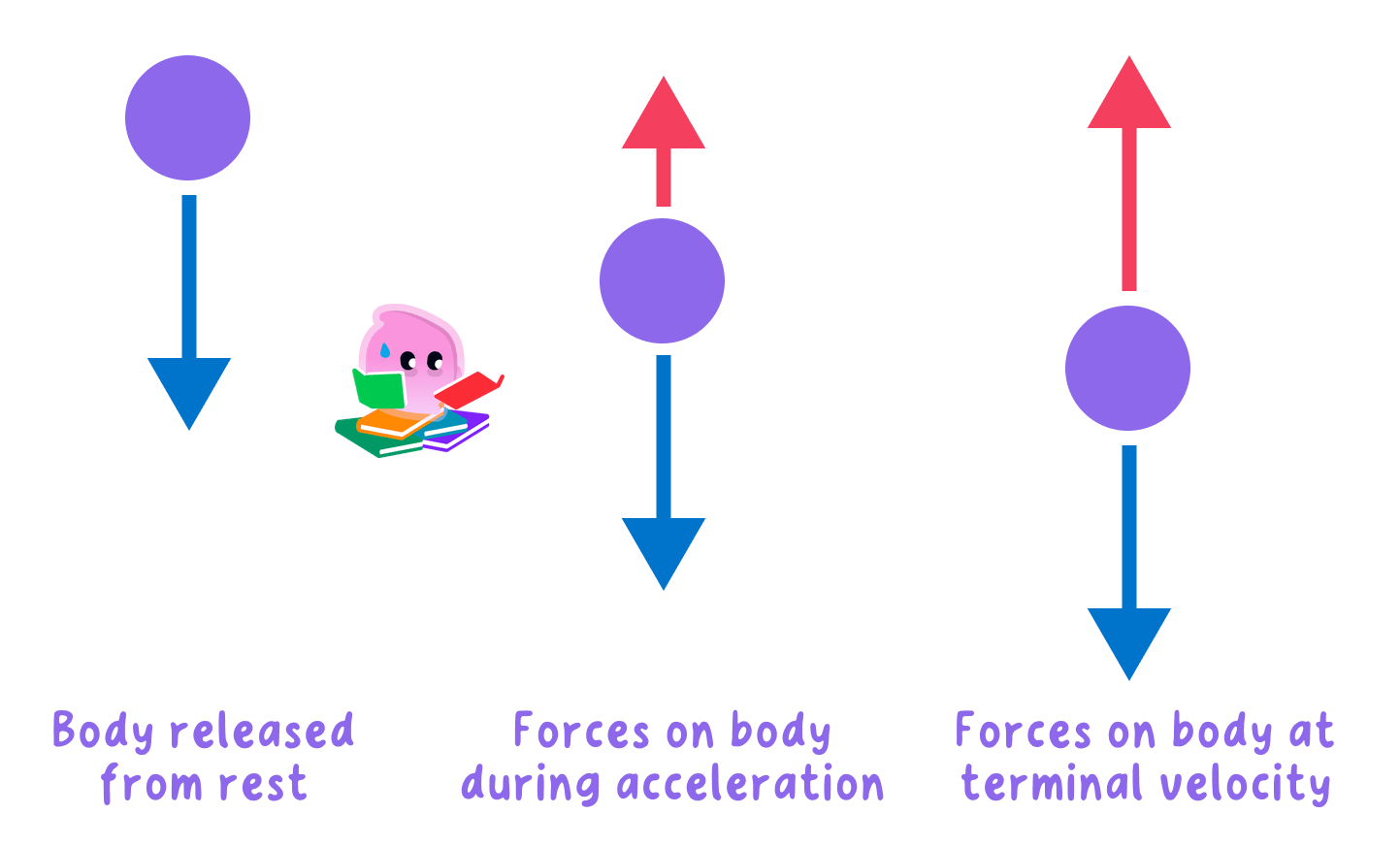
- An object falling through air or a liquid has two main forces acting on it.
- Its weight, from the Earth, acts downwards and stays the same throughout the fall.
- Drag from the fluid acts upwards, opposite to the motion, and increases as the speed increases.
- An object in a liquid also feels a small upthrust, which acts upwards alongside the drag.
- The motion of the falling object follows a fixed sequence of stages.
- At the moment of release the speed is zero, so the drag is zero and the resultant force is the weight, which gives the largest acceleration.
- As the object speeds up, the drag increases, so the resultant downward force gets smaller and the acceleration decreases.
- Eventually the drag grows until it equals the weight, so the forces are balanced and the resultant force is zero.
- With a resultant force of zero, the acceleration is zero and the object falls at a constant speed called its terminal velocity.
- Terminal velocity depends on the size and shape of the object as well as its weight.
- A larger surface area facing the direction of motion produces more drag at a given speed, so terminal velocity is reached at a lower speed.
- A heavier object needs more drag to balance its weight, so it has a higher terminal velocity than a lighter object of the same shape.
- A more viscous fluid, such as cold syrup or glycerol, produces more drag at a given speed than a runny fluid, so the terminal velocity is lower.
The skydiver
- A skydiver jumping from a plane shows every stage of falling motion.
- Just after jumping, her weight is much larger than the air resistance, so she accelerates downwards.
- As she falls faster, the air resistance increases until it equals her weight, and she reaches a terminal velocity of roughly 55 m/s55\ \text{m/s}55 m/s.
- When she opens her parachute, the surface area increases greatly, so the air resistance suddenly becomes much larger than her weight.
- The resultant force now acts upwards, so she decelerates while still moving downwards.
- As she slows down, the air resistance decreases until it equals her weight again.
- She then falls at a new, much lower terminal velocity of about 5 m/s5\ \text{m/s}5 m/s, which is slow enough for a safe landing.
Vehicles and top speed
- The same ideas apply to a vehicle moving horizontally, where the driving force takes the place of weight.
- When a car pulls away, the driving force is larger than the resistive forces of air resistance and friction, so the car accelerates.
- As the car speeds up, air resistance increases, so the resultant force and the acceleration both decrease.
- When the resistive forces equal the maximum driving force, the resultant force is zero and the car has reached its top speed.
- A car with a more streamlined shape has less air resistance at each speed, so it can reach a higher top speed with the same driving force.
- Adding a roof box increases the air resistance, so the top speed falls and more fuel is used at motorway speeds.
Example
Stages in the fall of a ball bearing through glycerol
- A steel ball bearing is released from rest at the surface of glycerol in a tall tube.
- At first the drag is zero, so the resultant force is the weight minus the small upthrust, and the ball accelerates downwards.
- As the speed rises, the drag increases, so the resultant force and the acceleration decrease.
- When the drag plus the upthrust equals the weight, the resultant force is zero.
- From this point the ball falls at its terminal velocity, covering equal distances in equal times.
Example
Calculating a terminal velocity from measurements
- A model parachute falls the last 1.50 m1.50\ \text{m}1.50 m of its drop at a steady speed in a mean time of 2.50 s2.50\ \text{s}2.50 s.
- The terminal velocity of the model parachute is 0.60 m/s0.60\ \text{m/s}0.60 m/s.
Practical
Terminal velocity of a model parachute
- Aim: to design and build a parachute for a fixed mass, measure its terminal velocity and investigate how the canopy area affects it.
- Apparatus: squares of thin plastic bin bag with sides of 20 cm20\ \text{cm}20 cm, 30 cm30\ \text{cm}30 cm, 40 cm40\ \text{cm}40 cm, 50 cm50\ \text{cm}50 cm and 60 cm60\ \text{cm}60 cm, cotton thread, sticky tape, a 20 g20\ \text{g}20 g lump of modelling clay, scissors, a metre rule, a tape measure, masking tape, a stopwatch and a phone to film the fall.
- Method:
- Tape four equal 30 cm30\ \text{cm}30 cm lengths of thread to the corners of a canopy and tie their free ends to the modelling clay so that the mass hangs centrally.
- Choose a safe drop point at least 3 m3\ \text{m}3 m high, such as a stairwell balcony supervised by your teacher, and measure the drop height with a tape measure.
- Mark a measured section of 1.50 m1.50\ \text{m}1.50 m at the bottom of the drop with masking tape on the wall behind the parachute.
- Hold the parachute open by the top of the canopy and release it without pushing it.
- Film the fall against the wall, then use the video to find the time taken to fall through the marked section.
- Check that the parachute takes the same time to fall through the top half and the bottom half of the section, as this shows it has reached terminal velocity.
- Repeat the drop three times, discard any anomalous time and calculate a mean.
- Calculate the terminal velocity by dividing the length of the section by the mean time.
- Repeat the whole process for each canopy size, keeping the same mass, thread and drop height.
- Variables: the canopy area is the independent variable, the terminal velocity is the dependent variable, and the mass, the thread length, the canopy material and the drop height are control variables.
- Results: larger canopies take longer to fall through the marked section, so they give a lower terminal velocity.
- Conclusion: increasing the canopy area increases the air resistance at a given speed, so the air resistance balances the weight at a lower speed.
- Watch out: draughts from open windows or doors push the parachute sideways and change the fall time, so close them and avoid drops where the canopy swings.
- Safety: never stand on chairs or desks to release the parachute, and keep the landing area clear of other people.
Practical
Ball bearings falling through glycerol
- Aim: to measure the terminal velocity of ball bearings falling through glycerol and investigate how it depends on the size of the ball bearing or the temperature of the glycerol.
- Apparatus: a 1 dm31\ \text{dm}^31 dm3 measuring cylinder filled with glycerol, steel ball bearings of different diameters, a micrometer or vernier callipers, three rubber bands, a metre rule, a stopwatch, a strong magnet, paper towels, a thermometer and a large beaker of hot water for a water bath.
- Method:
- Measure the diameter of each ball bearing with the micrometer.
- Place one rubber band about 10 cm10\ \text{cm}10 cm below the surface of the glycerol, and two more bands 10 cm10\ \text{cm}10 cm and 20 cm20\ \text{cm}20 cm below the first.
- Hold a ball bearing just above the centre of the glycerol surface and let it go so that it falls down the middle of the cylinder, away from the walls.
- Start the stopwatch as the ball passes the first band and record the times at which it passes the second and third bands.
- Check that the ball takes the same time to fall between each pair of bands, which shows it is travelling at terminal velocity.
- Collect the ball by sliding the magnet up the outside of the cylinder.
- Repeat three times for each size of ball bearing and calculate the mean time for the 20 cm20\ \text{cm}20 cm section.
- To test temperature instead, stand the cylinder in the water bath, record the glycerol temperature with the thermometer and repeat with one size of ball bearing at several temperatures.
- Variables: the ball bearing diameter or the glycerol temperature is the independent variable, the terminal velocity is the dependent variable, and the distance between the bands, the release point and the material of the balls are control variables.
- Results: larger ball bearings fall faster through the measured section, and every ball falls faster through warmer glycerol.
- Conclusion: a larger ball bearing has a weight that increases more than its drag, so it reaches a higher terminal velocity, while warmer glycerol is less viscous, so it produces less drag and gives a higher terminal velocity.
- Watch out: a ball released near the wall of the cylinder is slowed by the wall, and parallax error when reading the bands makes the times less accurate, so view each band at eye level.
- Safety: wipe up any spilled glycerol straight away because it makes the floor slippery, and handle the hot water bath with care.
Common Mistake
- Do not say that there is "no force" at terminal velocity, because the weight and the drag are both still acting but are balanced.
- Do not say that a skydiver moves upwards when the parachute opens, because she is still moving downwards but is slowing down.
- Do not say that drag stays constant during a fall, because drag increases as the speed increases.
Exam technique
Explaining terminal velocity
- Name both forces and say which is larger at each stage, using "weight" and "air resistance" or "drag".
- Include the key link that air resistance increases with speed, as this is usually a separate mark.
- At terminal velocity, write "air resistance equals weight, so the resultant force is zero and there is no acceleration".
- For the parachute opening, explain that the larger area increases air resistance, giving an upward resultant force and a deceleration.
Self review
- What is meant by an external force on a system?
- Why does the acceleration of a falling object decrease as it falls?
- State the condition for an object to reach terminal velocity.
- Explain why a skydiver slows down when she opens her parachute.
- Why do ball bearings fall faster through warm glycerol than through cold glycerol?
