Revision notes for OCR GCSE Physics Pressure. Open the guide for explanations and worked examples. Written against the OCR GCSE Physics (J249) specification, so the content matches what's examinable rather than general Physics background.
Pressure
What you'll learn
- What pressure means, and why it depends on both force and area.
- How moving gas molecules create pressure in a closed container.
- How changing temperature or volume changes gas pressure.
- Why liquid pressure increases with depth, and how pressure differences cause upthrust.
Pressure: force spread over an area
Pressure is about how concentrated a force is. The same force can have a very different effect depending on the area it acts over: a drawing pin is easy to push into a board because the force is concentrated over a tiny tip.
Definition
Pressure
Pressure, ppp, is the force per unit area acting normal to a surface. “Normal” means at right angles to the surface.
p=FAp = \frac{F}{A}p=AF- FFF is the force in newtons (N).
- AAA is the area in square metres (m2\text{m}^2m2).
- ppp is pressure in pascals (Pa), where 1 Pa=1 N/m21\ \text{Pa} = 1\ \text{N}/\text{m}^21 Pa=1 N/m2.
Example
Finding pressure from force and area
A force of 80 N acts normally on an area of 0.0040 m². Calculate the pressure.
-
Choose the pressure equation because you know the force and area: p=FAp = \frac{F}{A}p=AF.
-
Substitute the values with units: p=80 N0.0040 m2p = \frac{80\ \text{N}}{0.0040\ \text{m}^2}p=0.0040 m280 N.
-
Calculate the pressure: p=20000 Pap = 20000\ \text{Pa}p=20000 Pa.
Gas pressure comes from particle collisions
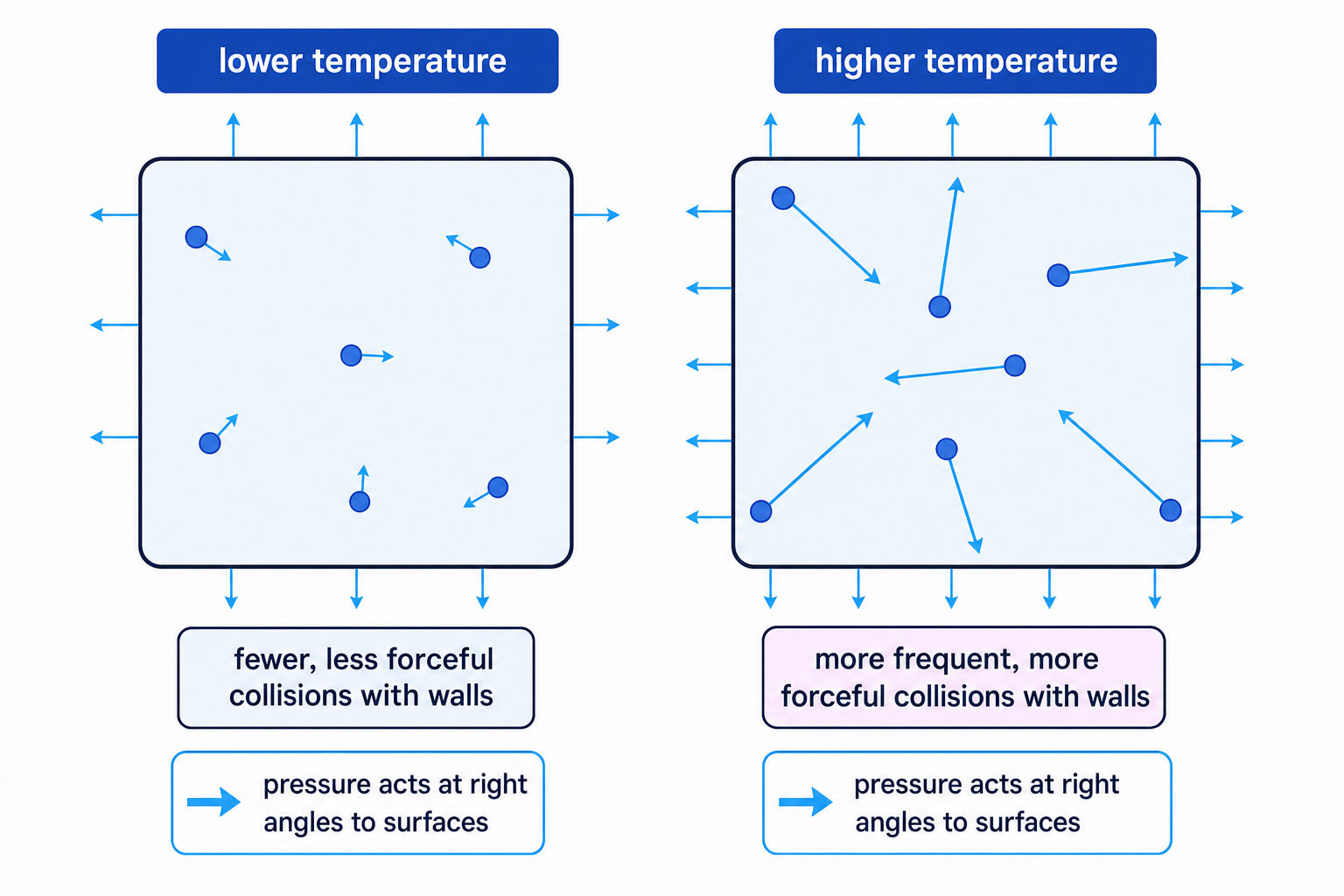
A gas is made of tiny particles, often molecules, moving randomly in all directions. When these particles collide with the walls of a container, they exert tiny forces on the walls. Lots of tiny collisions add up to a measurable pressure.
A closed system is a system where no particles enter or leave. For GCSE gas pressure explanations, you usually describe what happens to a fixed amount of gas in a closed container.
Temperature is linked to the average kinetic energy of the particles. Kinetic energy is the energy an object has because it is moving. If a gas is hotter, its molecules move faster on average.
Key Idea
Gas pressure in a rigid container
In a closed, rigid container, increasing the temperature increases the pressure because gas molecules hit the walls more often and more forcefully.
Example
Heating a sealed gas container
A sealed rigid metal can is heated. Explain why the gas pressure inside increases.
-
The can is sealed, so the number of gas molecules stays the same, and it is rigid, so the volume cannot increase.
-
Heating transfers energy to the molecules, increasing their average kinetic energy, so they move faster.
-
Faster molecules collide with the walls more often and with greater force, so the force per unit area on the walls increases.
Tip
Use collision language
For gas pressure explanations, use phrases like molecules move faster, more frequent collisions, more forceful collisions, and greater force per unit area.
Changing gas volume at constant temperature
A gas can be compressed by decreasing its volume, or expanded by increasing its volume. This happens because gas particles are far apart, so there is space between them.
At constant temperature, the particles’ average speed stays the same. If the volume increases, the same particles have more space, so they collide with the container walls less often. This decreases the pressure.
For separate Physics J249, you should be able to use the gas pressure-volume relationship. Treat this as a relationship to know and recognise in questions, especially the conditions for using it.
pV=constantpV = \text{constant}pV=constantFor two situations involving the same fixed mass of gas at constant temperature:
p1V1=p2V2p_1V_1 = p_2V_2p1V1=p2V2Example
Compressing gas at constant temperature
A fixed mass of gas has a pressure of 120000 Pa and a volume of 0.050 m³. It is compressed at constant temperature to a volume of 0.020 m³. Calculate the new pressure.
-
The gas has a fixed mass and constant temperature, so use p1V1=p2V2p_1V_1 = p_2V_2p1V1=p2V2.
-
Rearrange for the final pressure: p2=p1V1V2p_2 = \frac{p_1V_1}{V_2}p2=V2p1V1.
-
Substitute and calculate: p2=120000 Pa×0.050 m30.020 m3=300000 Pap_2 = \frac{120000\ \text{Pa} \times 0.050\ \text{m}^3}{0.020\ \text{m}^3} = 300000\ \text{Pa}p2=0.020 m3120000 Pa×0.050 m3=300000 Pa.
Common Mistake
Constant temperature matters
Only use p1V1=p2V2p_1V_1 = p_2V_2p1V1=p2V2 when the temperature stays constant and the amount of gas is fixed. If the gas is heated, cooled, added, or allowed to escape, this relationship may not apply.
Doing work on a gas can heat it
This next idea is Higher Tier only. When you push on a gas and compress it, you do work on the gas. Doing work means transferring energy by a force moving through a distance.
In a bicycle pump, your hand pushes the piston, compressing the air. Some energy is transferred to the gas’s internal energy, so the gas temperature rises. That is why a pump can feel warm after use.
Example
Why a bicycle pump warms up
Explain why the air in a bicycle pump gets hotter when the pump is used quickly.
-
Your hand exerts a force on the piston and moves it, so work is done on the gas inside the pump.
-
The gas is compressed, so energy is transferred to the gas particles.
-
The particles have more kinetic energy on average, so the temperature of the gas increases.
Atmospheric pressure
The atmosphere is the layer of gases around the Earth. Atmospheric pressure is caused by the weight of air above a surface.
A simple GCSE model treats the atmosphere like a huge column of air pressing down. Near sea level, there is a lot of air above you, so atmospheric pressure is relatively high. Higher up a mountain, there is less air above you, so atmospheric pressure is lower.
You do not need to know named layers of the atmosphere for this section.
Common Mistake
Suction is not a pulling force
In GCSE Physics, avoid saying “suction pulls it in.” A better explanation is that a pressure difference causes a net force. For example, when the pressure inside a can is reduced, the larger atmospheric pressure outside can crush it.
Pressure in liquids
This liquid pressure section and the calculations below are Higher Tier only.
A liquid has weight. The deeper you go in a liquid, the more liquid there is above you, so the pressure is greater. A denser liquid also produces more pressure at the same depth because the liquid above has more mass.
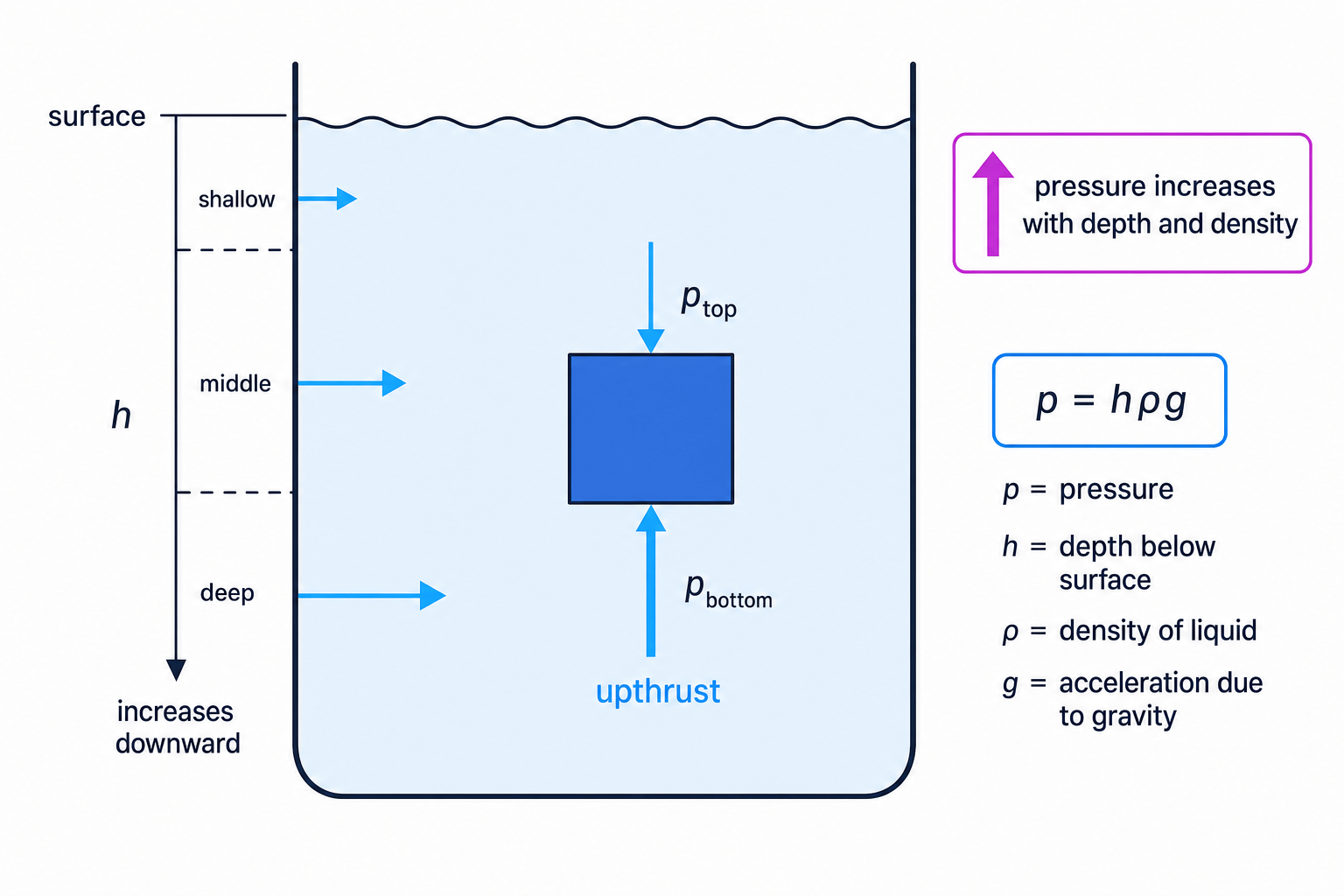
For pressure due to a column of liquid:
p=hρgp = h\rho gp=hρg- ppp is pressure due to the liquid column in pascals (Pa).
- hhh is the depth below the surface in metres (m).
- ρ\rhoρ is the density of the liquid in kilograms per cubic metre (kg/m³).
- ggg is gravitational field strength, taken as 10 N/kg near the Earth’s surface unless the question gives another value.
This equation is for separate Physics J249 Higher Tier content. Learn when to use it, and make sure all quantities are in SI units.
Example
Pressure difference between two depths
Two points in water are at depths of 0.25 m and 0.80 m. The density of water is 1000 kg/m³. Calculate the pressure difference between the two points.
-
Find the difference in depth: Δh=0.80 m−0.25 m=0.55 m\Delta h = 0.80\ \text{m} - 0.25\ \text{m} = 0.55\ \text{m}Δh=0.80 m−0.25 m=0.55 m.
-
Use the liquid pressure relationship for a difference in depth: Δp=Δhρg\Delta p = \Delta h \rho gΔp=Δhρg.
-
Substitute and calculate: Δp=0.55 m×1000 kg/m3×10 N/kg=5500 Pa\Delta p = 0.55\ \text{m} \times 1000\ \text{kg/m}^3 \times 10\ \text{N/kg} = 5500\ \text{Pa}Δp=0.55 m×1000 kg/m3×10 N/kg=5500 Pa.
Common Mistake
Pressure due to liquid is not always total pressure
In an open liquid, the total pressure at a depth includes atmospheric pressure plus the pressure due to the liquid. If a question asks for a difference in pressure, the atmospheric pressure usually cancels out.
Floating, sinking, and upthrust
This is also Higher Tier only.
An object in a liquid experiences its weight downward. It may also experience upthrust, an upward force caused by the pressure difference between the bottom and top of the object.
The bottom of the object is deeper than the top, so the liquid pressure on the bottom is greater. This creates a larger upward force than the downward force from liquid pressure on the top, giving a resultant upward force: upthrust.
Key Idea
Floating and sinking
An object floats if the upthrust can balance its weight. It sinks if its weight is greater than the maximum upthrust the liquid can provide.
Example
Deciding whether an object floats
A block has a weight of 12 N. When fully submerged in water, the maximum upthrust on it would be 15 N. Decide what happens.
-
Compare the maximum upthrust with the weight: 15 N is greater than 12 N.
-
If the block were fully submerged, the resultant force would be upward, so it would rise.
-
The block settles partly submerged, where the upthrust becomes 12 N and balances its weight, so it floats.
Common Mistake
Small does not mean floats
Floating is not decided just by whether something is small or light. A small steel ball can sink, while a huge ship can float, because floating depends on weight, upthrust, density, and the volume of liquid displaced.
Exam technique
In the exam
-
Before using p1V1=p2V2p_1V_1 = p_2V_2p1V1=p2V2, check the gas has a fixed mass and constant temperature.
-
For liquid pressure, use SI units: depth in metres, density in kg/m³, and g=10 N/kgg = 10\ \text{N/kg}g=10 N/kg near Earth.
-
In explanations, write about particle collisions or pressure differences — not vague “suction” or “air pulling”.
Self review
Check yourself
- Why does heating a gas in a sealed rigid container increase its pressure?
- A gas at 80000 Pa and 0.030 m³ is compressed to 0.010 m³ at constant temperature. What is its new pressure?
- Why is the pressure force on the bottom of a submerged object larger than the pressure force on the top?

Recap questions
Test yourself with 5 quick questions on this guide. Answer them all correctly to complete it.
Matter
Guide 3 of 3
You've reached the end
Test yourself on this topic, or move on to the next guide.
How was this guide?