Question 1
FThe Earth is surrounded by a layer of air called the atmosphere.
Scientists use a simple model of the atmosphere. In this model, the density of the air is the same at all heights.
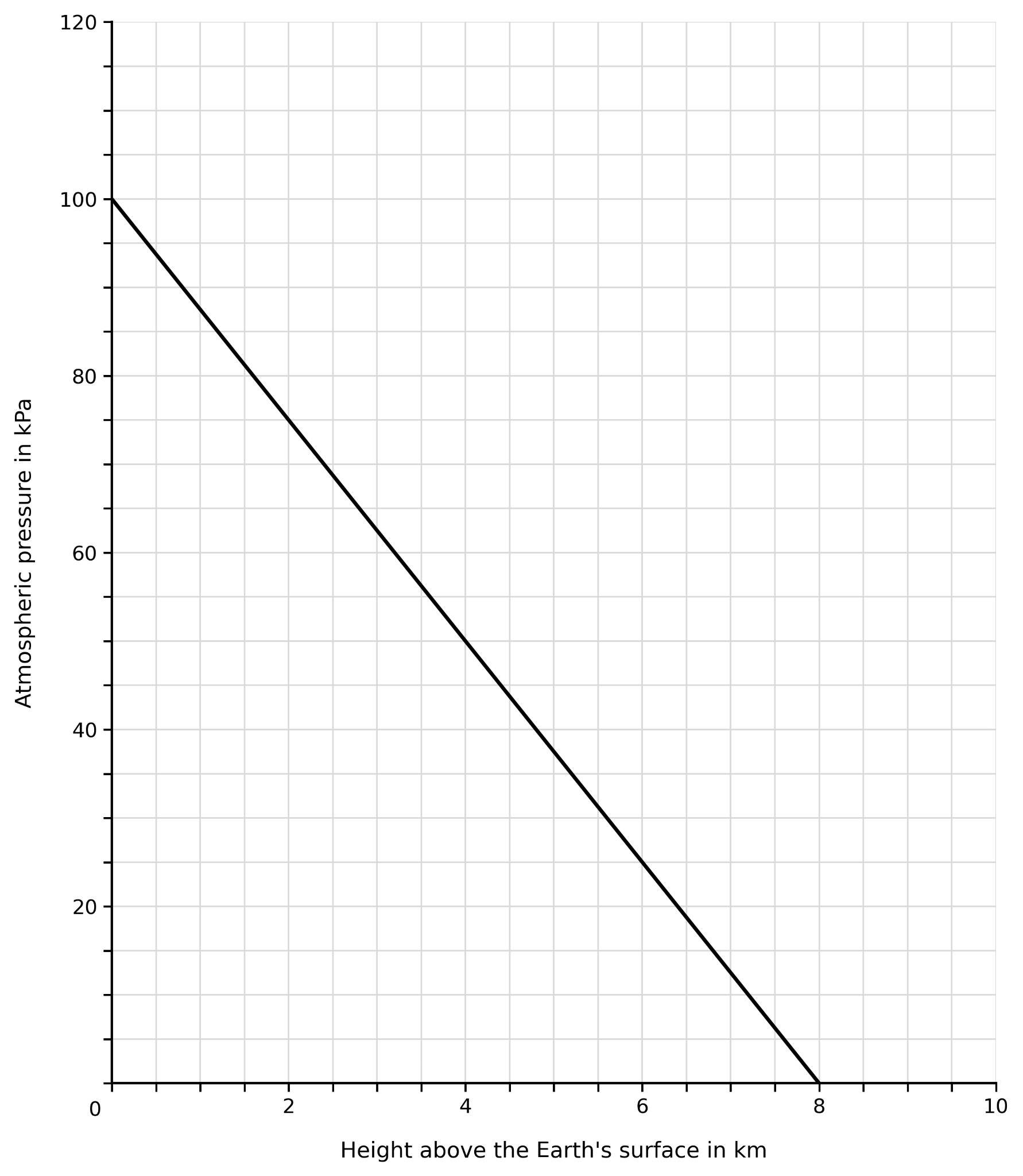
The Figure shows how atmospheric pressure changes with height above the Earth's surface in this model.
Figure
a.[1]
Use the Figure to determine the atmospheric pressure at a height of 2.0 km in this model.
b.[2]
Explain why atmospheric pressure decreases as the height above the Earth's surface increases.
c.[2]
Measurements show that the real atmospheric pressure at a height of 8.0 km is about 36 kPa.
Suggest why the simple model gives a value that is too low at this height.
1.3 Pressure Questions
50 exam-style questions on OCR GCSE Physics 1.3 Pressure, covering 1.3.1 Molecular motion, temperature and gas pressure, 1.3.2 Gas pressure at constant volume, 1.3.3 Compressing and expanding gases, 1.3.4 Gas volume and pressure at constant temperature, 1.3.5 Doing work on a gas, 1.3.6 The Earth's atmosphere and atmospheric pressure, 1.3.7 Atmospheric pressure and height, 1.3.8 Floating and sinking, 1.3.9 Pressure in liquids and upthrust, and 1.3.10 Pressure differences with depth. Each one has a worked solution and a mark scheme showing where the marks go.