Question 9
HA wooden block floats in a tank of water.
The Figure shows the block.
Figure
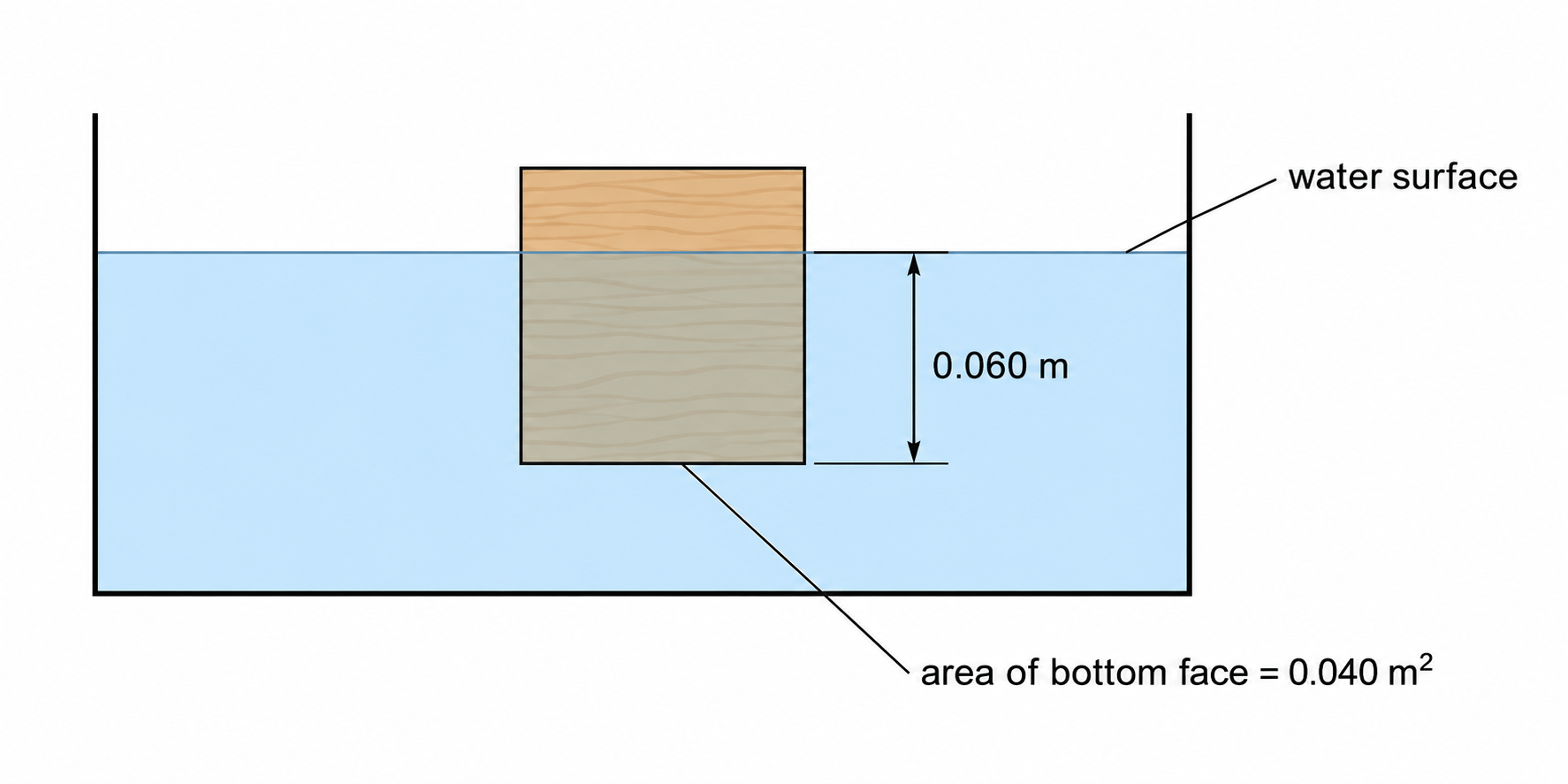 The bottom face of the block is 0.060 m below the surface of the water.
The area of the bottom face of the block is 0.040 m2.
Density of water = 1000 kg/m3
Gravitational field strength g=10 N/kgg = 10\ \text{N/kg}g=10 N/kg
Use the equation: pressure due to a column of liquid=height of column×density of liquid×g\text{pressure due to a column of liquid} = \text{height of column} \times \text{density of liquid} \times gpressure due to a column of liquid=height of column×density of liquid×g
a.[2]
Explain why the water exerts an upward force on the block.
b.[2]
Calculate the pressure due to the water at the bottom face of the block.
c.[2]
Calculate the upward force of the water on the block.
d.[2]
Calculate the mass of the block.
e.[3]
A 1.0 N weight is placed on top of the block. The block still floats.
Calculate how much further the block sinks into the water.
1.3 Pressure Questions
50 exam-style questions on OCR GCSE Physics 1.3 Pressure, covering 1.3.1 Molecular motion, temperature and gas pressure, 1.3.2 Gas pressure at constant volume, 1.3.3 Compressing and expanding gases, 1.3.4 Gas volume and pressure at constant temperature, 1.3.5 Doing work on a gas, 1.3.6 The Earth's atmosphere and atmospheric pressure, 1.3.7 Atmospheric pressure and height, 1.3.8 Floating and sinking, 1.3.9 Pressure in liquids and upthrust, and 1.3.10 Pressure differences with depth. Each one has a worked solution and a mark scheme showing where the marks go.