Pressure increases with depth
Definition
Liquid pressure
The pressure at a point in a liquid caused by the weight of the liquid above that point.
Definition
Depth
The vertical distance of a point below the surface of a liquid.
- A liquid has weight, so it presses on everything beneath it and on the walls of its container.
- A point deep in a liquid has a taller column of liquid above it than a point near the surface.
- A taller column has more mass and so a greater weight pressing on each square metre beneath it.
- The pressure in a liquid therefore increases with depth.
- Doubling the depth doubles the height of the liquid column above a point, so it doubles the pressure caused by the liquid.
- At any one depth, the pressure acts equally in all directions: upwards, downwards and sideways.
- The force caused by liquid pressure always acts at right angles to the surface it presses on.
- The pressure depends only on the vertical depth, not on the width or shape of the container.
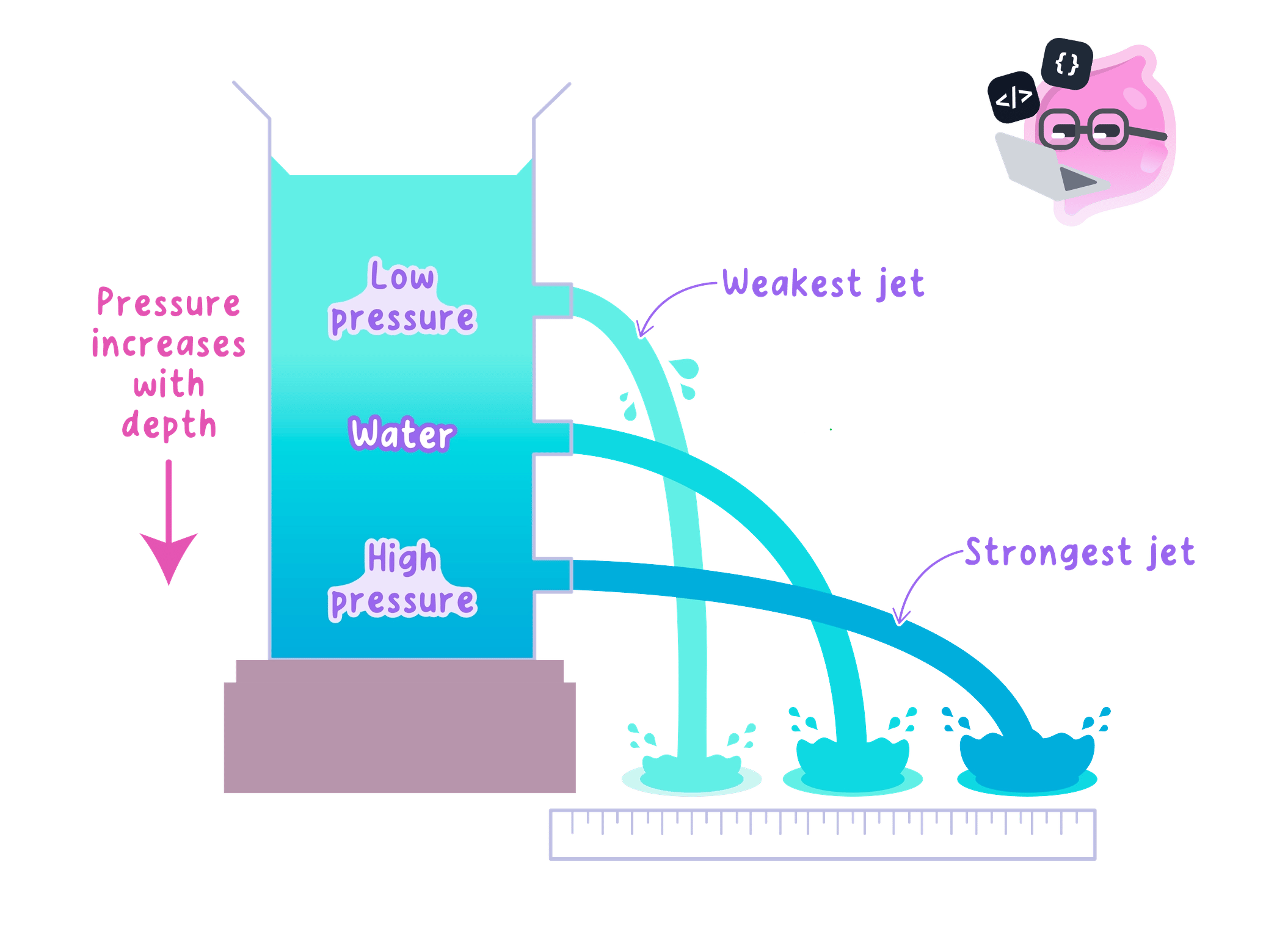
- This is why water spurts out hardest from the lowest hole in a tall container, and why a dam is built much thicker at its base than at its top.
- Divers feel the pressure on their ears grow as they swim down, because the water pushing on the outside of each eardrum presses harder with depth.
Pressure increases with density
Definition
Density
The mass per unit volume of a material.
- A denser liquid has more mass in every cubic metre.
- At the same depth, a column of a denser liquid is heavier, so it presses with a greater force on each square metre.
- The pressure in a liquid therefore increases with density.
- At the same depth, sea water at about 1030 kg/m31030\ \text{kg/m}^31030 kg/m3 exerts a slightly greater pressure than fresh water at 1000 kg/m31000\ \text{kg/m}^31000 kg/m3.
- Mercury is 13.613.613.6 times denser than water, so at the same depth it exerts 13.613.613.6 times the pressure.
How pressure produces upthrust
Definition
Upthrust
The upward force that a fluid exerts on an object that is partly or fully submerged in it.
- A partially submerged object has its bottom surface under the liquid and its top surface in the air.
- The liquid presses upwards on the bottom surface, because liquid pressure acts in all directions, including upwards.
- The air presses down on the top of the object, but it also presses on the surface of the liquid, which adds the same amount of pressure underneath, so the effect of the air cancels out.
- The liquid also presses sideways on the vertical sides of the object, but the forces on opposite sides are equal and opposite, so they cancel.
- The upward push of the liquid on the bottom surface is left unbalanced, giving a resultant force upwards, and this force is the upthrust.
- Pushing the object further down makes its bottom surface deeper, so the pressure there increases and the upthrust grows.
- For a fully submerged object, liquid presses down on the top surface as well, but the bottom surface is always deeper, so the upward force on the bottom is larger than the downward force on the top.
- The difference between these two forces is the upthrust, and it stays the same however deep the object goes, because the difference in depth between its top and bottom does not change.
- A denser liquid gives a bigger pressure difference between the top and bottom of an object, so the upthrust is greater, which is why objects float higher in sea water.
Example
Lowering a block into water
- A wooden block hangs from a newton meter and is lowered slowly into a tank of water, bottom face first.
- When the bottom face is 2 cm2\ \text{cm}2 cm below the surface, the water pushes up on it with a small pressure, so there is a small upthrust and the newton meter reading falls slightly.
- At 4 cm4\ \text{cm}4 cm the bottom face is twice as deep, so the pressure on it and therefore the upthrust have both doubled.
- If the block is free to float, it settles at the depth where the upthrust on its bottom face exactly balances its weight.
- If the block is held fully under the water, the water also presses down on its top face, and the upthrust is the difference between the upward force on the bottom and the downward force on the top.
Practical
Water jets at different depths
- Aim: to show how the pressure in a liquid changes with depth.
- Apparatus: a tall 222 litre plastic bottle, a drawing pin, a ruler, a marker pen, a strip of sticky tape, a jug of water, a large tray or sink, and a metre rule.
- Method:
- Mark three points in a vertical line on the side of the bottle at 5 cm5\ \text{cm}5 cm, 15 cm15\ \text{cm}15 cm and 25 cm25\ \text{cm}25 cm above the base.
- Push the drawing pin through at each mark to make three holes of the same size, then cover all three with one strip of sticky tape.
- Stand the bottle at the edge of the tray and fill it with water to just below the neck.
- Pull the tape off in one movement while a partner tops up the water from the jug, so that the water level stays the same throughout.
- Observe the three jets and use the metre rule to measure how far from the bottle each one lands.
- Results: the jet from the lowest hole leaves the bottle fastest and travels furthest outwards, while the jet from the top hole leaves slowly and drops close to the bottle.
- Explanation: the lowest hole has the deepest water above it, so the pressure pushing water out through it is the greatest.
- Watch out: the jets start at different heights above the tray, so judge how hard each jet leaves its hole as well as where it lands.
- Watch out: holes of different sizes give an unfair comparison, and if the water level falls during the test, the pressure at every hole falls too.
- Safety: take care when pushing the drawing pin through the plastic, and wipe up any spilt water straight away so that no one slips.
Common Mistake
- Do not say liquid pressure acts only downwards, because at any point it acts equally in all directions.
- Do not say upthrust happens because the liquid "wants" to push objects out, because it is caused by the pressure on the bottom of the object being greater than the pressure on the top.
- Do not say the pressure depends on the total volume of liquid in the container, because only the vertical depth and the density matter.
Exam technique
Explaining upthrust
- Begin with the cause: pressure in a liquid increases with depth because of the weight of liquid above.
- Compare the surfaces: the bottom of the object is deeper than the top, so the pressure on it is greater.
- Turn pressure into force: the greater pressure on the bottom gives a greater upward force than any downward force on the top.
- End with the result, which is a resultant upward force called upthrust.
Self review
- Explain why the pressure in a liquid increases with depth.
- State how the pressure at a given depth changes if the liquid is replaced by a denser one.
- Describe the directions in which liquid pressure acts at a point.
- Explain how liquid pressure produces an upward force on a partially submerged object.
- Explain why water spurts out hardest from the lowest hole in a tall container.
