The liquid pressure equation
Definition
Liquid pressure
The pressure at a point in a liquid caused by the weight of the liquid above that point.
Definition
Gravitational field strength
The gravitational force acting on each kilogram of mass, which is 10 N/kg10\ \text{N/kg}10 N/kg near the Earth's surface.
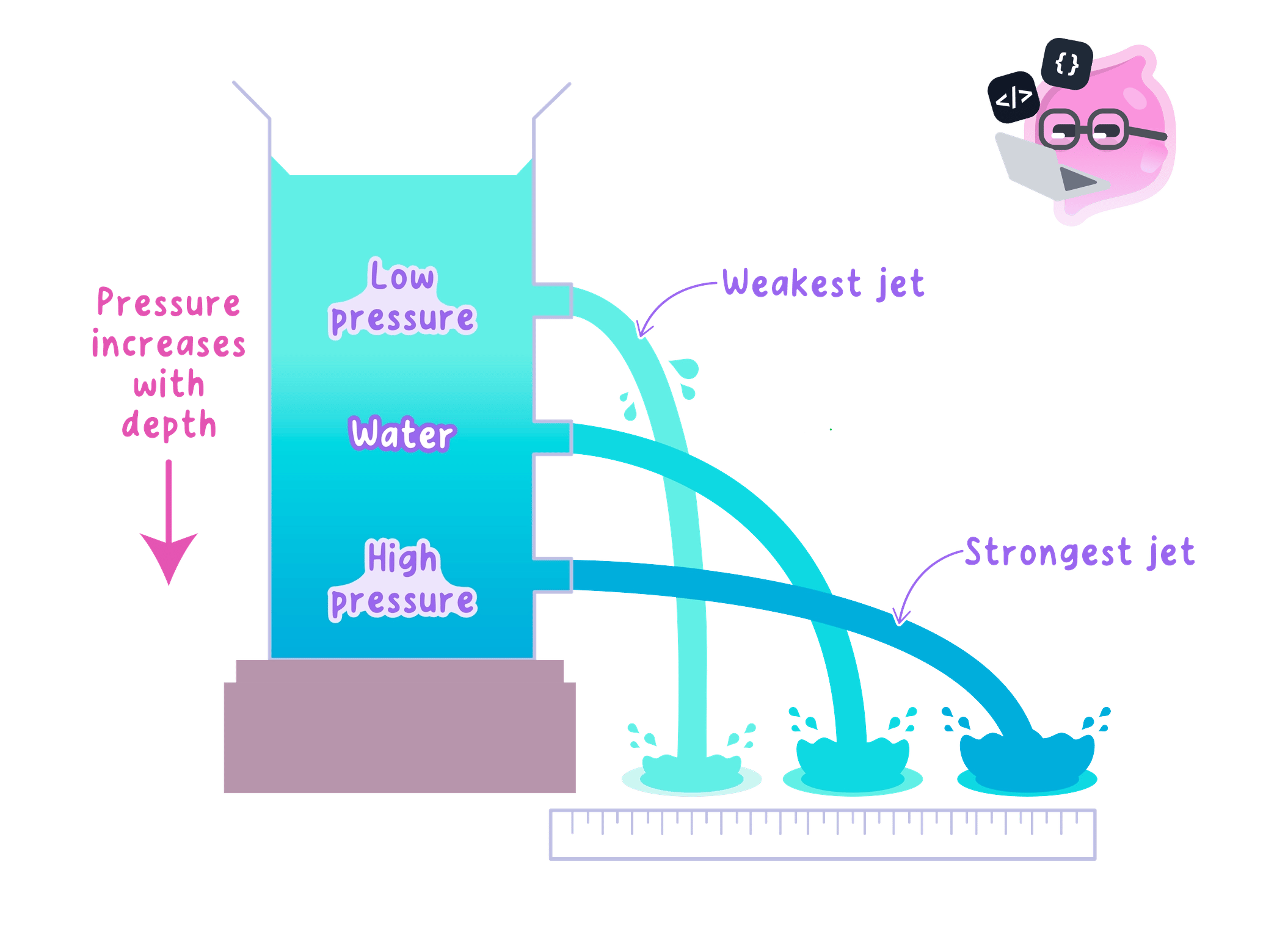
- The pressure caused by a column of liquid depends on its height, the density of the liquid and the gravitational field strength.
- The equation is pressure due to a column of liquid=height of column×density of liquid×gravitational field strength\text{pressure due to a column of liquid} = \text{height of column} \times \text{density of liquid} \times \text{gravitational field strength}pressure due to a column of liquid=height of column×density of liquid×gravitational field strength.
- In symbols, this is p=hρgp = h\rho gp=hρg.
- ppp is the pressure due to the liquid in pascals, Pa\text{Pa}Pa.
- hhh is the height of the liquid column, or the depth, in metres, m\text{m}m.
- ρ\rhoρ is the density of the liquid in kilograms per cubic metre, kg/m3\text{kg/m}^3kg/m3.
- ggg is the gravitational field strength in newtons per kilogram, N/kg\text{N/kg}N/kg.
- Near the Earth's surface, g=10 N/kgg = 10\ \text{N/kg}g=10 N/kg.
- You do not need to memorise this equation, but you must be able to choose it from a list of equations and use it.
- The equation comes from the weight of the liquid column: a column of height hhh standing on an area AAA has a volume of hAhAhA, a mass of hAρhA\rhohAρ and a weight of hAρghA\rho ghAρg.
- Dividing this weight by the area AAA that it rests on gives the pressure, p=hρgp = h\rho gp=hρg, so the area cancels out.
- This is why the pressure depends only on depth and density, not on the width or shape of the container.
- The equation gives the pressure due to the liquid alone, because the total pressure on a submerged object also includes the atmospheric pressure acting on the liquid surface.
Pressure differences between depths
Definition
Depth
The vertical distance of a point below the surface of a liquid.
Definition
Pressure difference
The difference between the pressures on the two sides of a surface, which produces a net force on the surface towards the side at lower pressure.
- The difference in pressure between two points in the same liquid depends only on the vertical distance between them.
- For a difference in depth Δh\Delta hΔh, the difference in pressure is Δp=Δh ρ g\Delta p = \Delta h\,\rho\,gΔp=Δhρg.
- The pressure difference does not depend on how far below the surface the two points are, only on how far apart they are vertically.
- In fresh water, the pressure increases by 10 000 Pa10\,000\ \text{Pa}10000 Pa for every extra metre of depth, because 1×1000×10=10 0001 \times 1000 \times 10 = 10\,0001×1000×10=10000.
- A diver 10 m10\ \text{m}10 m down therefore feels an extra 100 000 Pa100\,000\ \text{Pa}100000 Pa from the water, which is about the same as the whole of atmospheric pressure.
- Always convert depths to metres before substituting, because a depth in centimetres gives an answer 100100100 times too large.
- Large pressures are often given in kilopascals, where 1 kPa=1000 Pa1\ \text{kPa} = 1000\ \text{Pa}1 kPa=1000 Pa.
- Rearranging the equation gives Δh=Δpρg\Delta h = \dfrac{\Delta p}{\rho g}Δh=ρgΔp for a difference in depth and ρ=ΔpΔh g\rho = \dfrac{\Delta p}{\Delta h\,g}ρ=ΔhgΔp for a density.
Example
Pressure at the bottom of a pool
- A swimming pool is 2.5 m2.5\ \text{m}2.5 m deep and is filled with water of density 1000 kg/m31000\ \text{kg/m}^31000 kg/m3.
- The water adds 25 000 Pa25\,000\ \text{Pa}25000 Pa, or 25 kPa25\ \text{kPa}25 kPa, to the atmospheric pressure acting on the surface of the pool.
Example
Difference between two depths
- A diver swims down from 3.0 m3.0\ \text{m}3.0 m to 12.0 m12.0\ \text{m}12.0 m below the surface of sea water of density 1030 kg/m31030\ \text{kg/m}^31030 kg/m3.
- Find the difference in depth first.
- The pressure on the diver increases by 92 700 Pa92\,700\ \text{Pa}92700 Pa.
Example
Finding a depth
- The pressure difference between the top and the bottom of a water tank is 18 kPa18\ \text{kPa}18 kPa, and the water has a density of 1000 kg/m31000\ \text{kg/m}^31000 kg/m3.
- Convert the pressure difference into pascals.
- Rearrange the equation to make the depth the subject.
- The water in the tank is 1.8 m1.8\ \text{m}1.8 m deep.
Common Mistake
- Do not substitute a depth in centimetres, because the equation needs the depth in metres.
- Do not use the depth of only one point when a question asks for a pressure difference, because you must subtract the two depths first.
- Do not add atmospheric pressure unless the question asks for the total pressure.
- Do not use the mass of the liquid in place of its density.
Exam technique
Liquid pressure calculations
- Write p=hρgp = h\rho gp=hρg before you substitute, because the equation and the substitution can each earn credit even if the arithmetic slips.
- Show the difference in depth on its own line, because skipping it is a common way to lose a mark.
- Give the final answer with its unit, Pa\text{Pa}Pa or kPa\text{kPa}kPa, and check that its size is sensible at about 10 kPa10\ \text{kPa}10 kPa for each metre of water.
- If a later part of a question uses your answer, carry it forward even if you think it may be wrong, because the method marks can still be awarded.
Self review
- Write the equation that links pressure due to a column of liquid, height, density and gravitational field strength.
- Calculate the pressure due to the water at a depth of 4.0 m4.0\ \text{m}4.0 m in fresh water of density 1000 kg/m31000\ \text{kg/m}^31000 kg/m3.
- Explain why the pressure due to a liquid does not depend on the width of its container.
- Calculate the pressure difference between depths of 2.0 m2.0\ \text{m}2.0 m and 7.0 m7.0\ \text{m}7.0 m in sea water of density 1030 kg/m31030\ \text{kg/m}^31030 kg/m3.
- State the value of ggg to use near the Earth's surface.
