Practical skills
What you'll learn
- How OCR J249 practical work is organised through PAGs.
- How to plan a fair, safe investigation using variables.
- How to measure carefully, process results, and use graphs.
- How to evaluate a method and suggest useful improvements.
Why practical skills matter
Practical work is not just “the experiment bit” of Physics. It is how you test ideas using evidence. In OCR GCSE Physics A J249, practical skills are assessed in the written exams, so you need to understand methods, apparatus, measurements, graphs, and evaluation even when you are not physically in the lab.
OCR expects your centre to give you opportunities to complete at least eight practical activities. These are organised into Practical Activity Groups, often called PAGs.
Practical Activity Group (PAG)
A PAG is a group of required practical skills and apparatus techniques. In Physics, the eight PAG areas include materials, forces, motion, waves, energy, circuit components, series and parallel circuits, and wave interactions.
Your teacher or school chooses the exact practicals, but across the course you should meet the required apparatus and techniques: measuring length, mass, time, volume, temperature, current, potential difference, resistance, motion, waves, forces, and energy changes.
A good investigation follows a cycle: plan, measure, process, conclude, and improve.
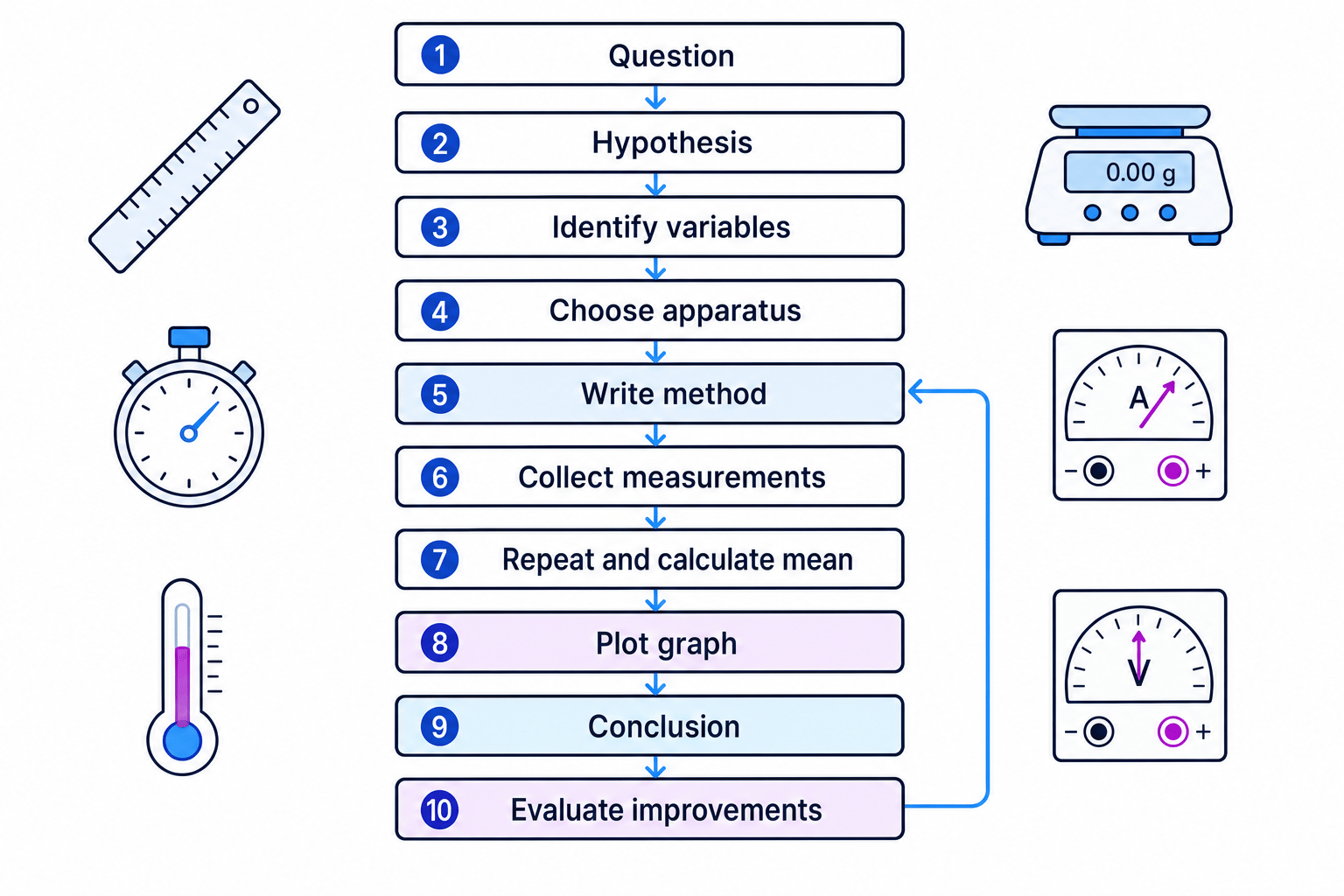
Planning an investigation
Before you collect data, you need to know what you are testing.
Hypothesis
A hypothesis is a testable prediction, often written as “if one variable changes, then another variable will change because…”.
A variable is something that can change in an investigation. There are three main types:
- The independent variable is the variable you deliberately change.
- The dependent variable is the variable you measure.
- Control variables are kept the same so the test is fair.
Fair testing
A fair test changes only the independent variable and measures its effect on the dependent variable, while keeping important control variables the same.
Choosing variables in a spring investigation
-
If the question is “How does force affect extension?”, choose force as the independent variable because you deliberately change the load added to the spring.
-
Choose extension as the dependent variable because this is what you measure after each load is added.
-
Keep the same spring, measure from the same reference point, and wait until the spring stops moving. These controls reduce the chance that something other than force changes the extension.
Choosing apparatus
Apparatus means the equipment used in an experiment. The best apparatus depends on what you need to measure and how precise the measurement must be.
Common GCSE Physics apparatus includes:
- ruler or metre rule for length
- balance for mass
- stopwatch or light gate for time
- measuring cylinder for volume
- thermometer or temperature probe for temperature
- ammeter for current
- voltmeter for potential difference
- ohmmeter or circuit measurements for resistance
- ripple tank or signal generator for waves
A scientific diagram shows how apparatus is arranged. It should be simple, labelled, and useful. For circuits, use standard circuit symbols rather than pictures of the components.
Choosing better apparatus
If human reaction time would be a big source of error, electronic timing such as light gates is usually better than a hand-held stopwatch.
Making measurements
A measurement is a numerical value with a unit, such as 2.40 metres or 0.35 amperes. Always include units.
Resolution
The resolution of an instrument is the smallest change it can show. For example, a ruler marked in millimetres has a resolution of 1 mm.
Two important words are often confused:
- Accuracy means how close a result is to the true value.
- Precision means how close repeated measurements are to each other.
A set of results can be precise but not accurate. For example, a balance that always reads 0.50 g too high might give very similar repeated readings, but they are all shifted away from the true value.
Uncertainty
Uncertainty is the range within which the true value is expected to lie. It tells you how much doubt there is in a measurement.
For GCSE questions, you may be told the uncertainty. If not, a common estimate is about half the smallest division for an analogue scale, or one smallest step for a digital reading, depending on the instrument and question wording.
Estimating percentage uncertainty
A student measures a mass as 42.50 g using a digital balance with resolution 0.01 g. Estimate the percentage uncertainty.
-
Use the resolution as the uncertainty because the digital balance changes in steps of 0.01 g.
-
Substitute into the percentage uncertainty calculation:
- Calculate:
Unit-free answers
A number without a unit is usually incomplete in Physics. Writing 0.024 is not the same as writing 0.024%.
Repeats, means, and anomalous results
Repeating measurements helps you judge whether the results are reliable.
Anomalous result
An anomalous result is a result that does not fit the pattern of the other results and may have been caused by a mistake, random error, or a problem with the apparatus.
A mean is an average found by adding values and dividing by the number of values. If a result is clearly anomalous, you may exclude it, but you should be able to justify why.
Calculating a mean time
A student measures the time for a trolley to travel down a ramp: 1.82 s, 1.79 s, 2.45 s, and 1.81 s. Calculate a suitable mean.
-
Compare the values. The time 2.45 s is much higher than the other three, which are all close to 1.8 s, so treat 2.45 s as anomalous.
-
Use only the consistent readings:
- Calculate the mean:
Deleting awkward data
Do not remove a result just because it disagrees with your hypothesis. Only exclude it if there is evidence that it is anomalous compared with the repeat readings.
Graphs and patterns
Graphs help you see relationships between variables.
The independent variable usually goes on the horizontal x-axis. The dependent variable usually goes on the vertical y-axis.
A line of best fit is a smooth line or curve that follows the overall pattern of the points. It should not be a dot-to-dot line.
Gradient
The gradient of a graph is its steepness. For a straight-line graph, it is calculated using “change in y divided by change in x”. The symbol Δ\DeltaΔ means “change in”.
For example, on a distance-time graph, the gradient gives speed.
Finding speed from a distance-time graph
A distance-time graph has a straight line of best fit. Two points on the line are 1.0 m at 2.0 s and 3.0 m at 6.0 s. Find the speed.
- Use the gradient rule because speed is the gradient of a distance-time graph:
- Substitute the two points:
- Calculate with units:
Graph scale check
Choose a scale that uses most of the graph paper and is easy to read, such as 1, 2, 5, or 10 units per large square.
Conclusions
A conclusion is a statement that answers the investigation question using evidence from the results.
A strong conclusion should:
- describe the pattern or relationship
- quote data or refer to the graph
- say whether the results support the hypothesis
- avoid claiming more than the data shows
For example, “As force increased, extension increased” is better if you add evidence: “doubling the force from 1.0 N to 2.0 N doubled the extension from 2.1 cm to 4.2 cm”.
Evaluation and improvements
Evaluation means judging the quality of the method and results. You are not just saying “it went well”; you are identifying limitations and suggesting improvements.
Validity and reliability
A method is valid if it really tests what it is meant to test. Results are reliable if repeats are consistent and another person could repeat the method and get similar results.
Good improvements are specific. “Use better equipment” is too vague. Say what equipment and why it improves the data.
Improving a motion experiment
A student times a trolley down a ramp using a stopwatch. The repeat times vary a lot. Suggest and explain an improvement.
-
Identify the weakness: the stopwatch depends on human reaction time, so the start and stop times may not be consistent.
-
Choose a more suitable apparatus: use light gates connected to a timer to measure when the trolley passes fixed points.
-
Explain the improvement: electronic timing reduces reaction-time error, so the measurements should be more precise and the calculated speed or acceleration should be more reliable.
Safety comes first
A hazard is something that could cause harm, and a risk is the chance and seriousness of that harm. Practical work must follow safety instructions, including eye protection, careful handling of hot objects, and safe use of electrical equipment.
Records and the practical science statement
Your centre must provide a practical science statement confirming that students were given reasonable opportunities to complete the required practical work.
You should also keep a contemporaneous record, which means a record made at the time of the practical. This might include your method, results table, graph, calculations, conclusion, and evaluation.
Practical skills in written papers
Even though practical work happens in lessons, your understanding of practical methods, apparatus, graphs, uncertainty, safety, and evaluation is tested in the written GCSE Physics exams.
In the exam
-
Identify the independent, dependent, and control variables before describing a method.
-
When asked for an improvement, name the apparatus or method change and explain how it improves accuracy, precision, validity, or reliability.
-
For calculations from results, carry units through, show substitutions, and check whether anomalous results should be excluded before finding a mean.
Check yourself
- What is the difference between accuracy and precision?
- In a practical measuring resistance, which instruments measure current and potential difference?
- Why is “repeat the experiment” usually not enough as a full evaluation answer?