Revision notes for OCR GCSE Physics Beyond Earth. Open the guide for explanations and worked examples. Written against the OCR GCSE Physics (J249) specification, so the content matches what's examinable rather than general Physics background.
Beyond Earth
What you'll learn
- How planets, moons and artificial satellites move in stable orbits.
- How the Sun formed, why stars shine, and what happens during a star’s life cycle.
- How radiation, temperature and Earth’s atmosphere are linked.
- How red-shift and cosmic microwave background radiation support the Big Bang model.
This P8.3 sub-topic is for OCR Gateway separate Physics J249 rather than Combined Science. Some parts below are Higher Tier only, and they are marked gently in the notes.
Starting point: what is in our solar system?
Our solar system contains the Sun and the objects held in orbit around it by gravity. The Sun is a star: a hot object that emits light and other electromagnetic radiation because of nuclear fusion in its core.
Common Mistake
The Sun is a star
The Sun is not a different kind of object from stars — it is our nearest star, so it looks much brighter and larger than other stars in the night sky.
The 8 planets, in order from the Sun, are:
- Mercury
- Venus
- Earth
- Mars
- Jupiter
- Saturn
- Uranus
- Neptune
The inner planets are smaller and rocky. The outer planets are much larger and mostly made of gas or ice. Minor planets include smaller bodies such as dwarf planets like Pluto and Ceres.
Definition
Satellite
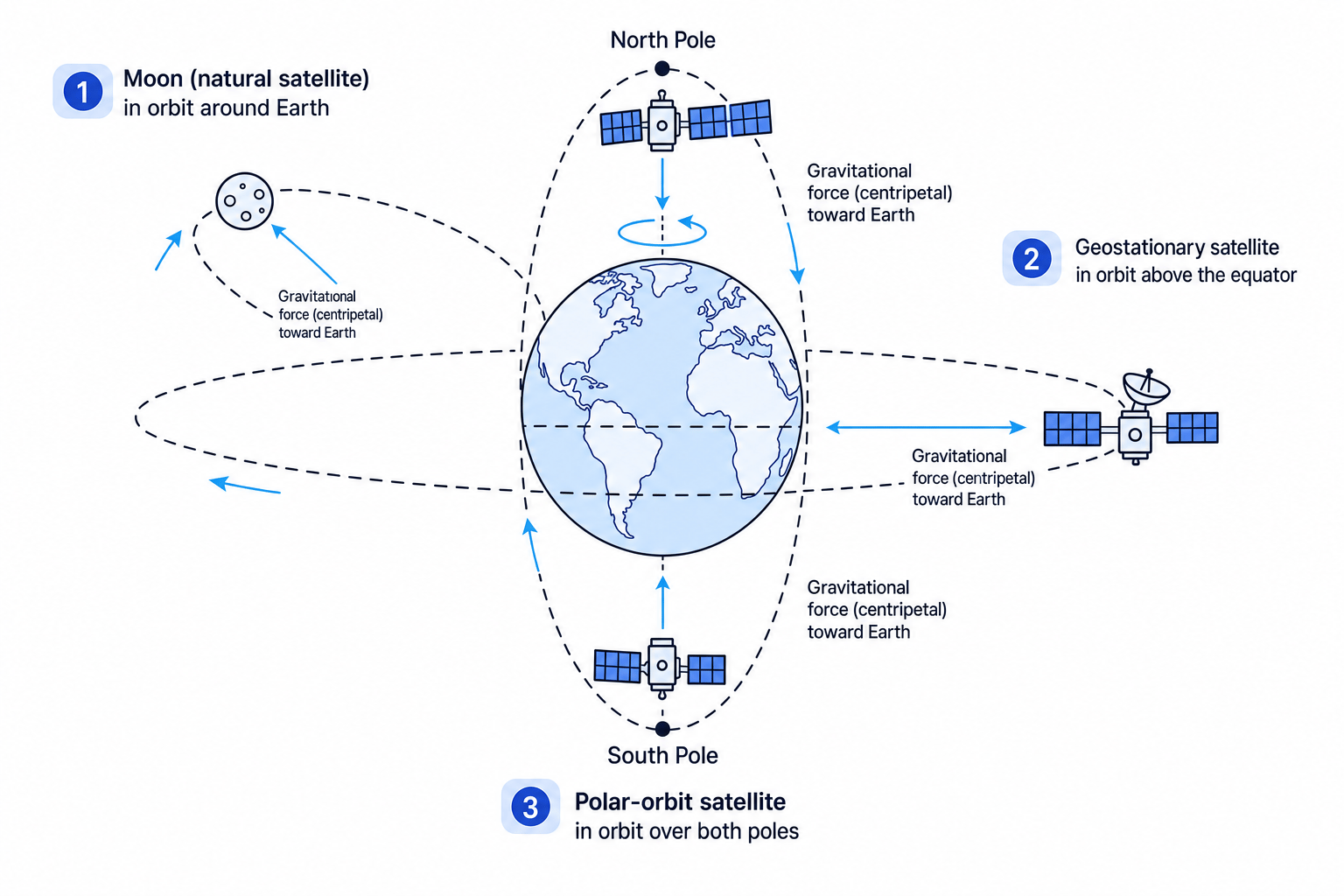
A satellite is any object that orbits a larger body. A natural satellite forms naturally, such as the Moon orbiting Earth. An artificial satellite is made by humans and placed into orbit.
Natural and artificial satellites
Moons and artificial satellites are similar because both are kept in orbit by gravity. The difference is mainly their origin and purpose: moons are natural, while artificial satellites are designed for tasks such as communications, weather monitoring, navigation or imaging Earth.
Two important artificial satellite orbits are:
- Geostationary orbit: the satellite orbits above the equator with a period of 24 hours, so it stays above the same point on Earth’s surface. This is useful for communications.
- Polar orbit: the satellite passes over the north and south poles while Earth rotates underneath. This is useful for mapping, weather and monitoring the whole planet.
Circular orbits: speed can stay the same while velocity changes
Speed tells you how fast something is moving. Velocity means speed in a particular direction, so velocity changes if the direction changes.
In a circular orbit, gravity always acts towards the centre of the orbit. This inward force is called a centripetal force, meaning a force towards the centre of a circular path.
Key Idea
Gravity keeps changing the direction
For a planet or satellite in a circular orbit, gravity changes the direction of its velocity continuously. Its speed can stay constant, but its velocity is changing all the time.
For a stable circular orbit around the same planet or star:
- a lower radius orbit needs a higher speed
- a higher radius orbit has a lower speed
This is qualitative only in this topic — you do not need to calculate orbital speeds.
Example
Predicting the effect of changing orbit radius
A satellite moves from a high stable orbit to a lower stable orbit around Earth. What happens to its speed?
- Compare the orbit radii: the new orbit has a smaller radius, so the satellite is closer to Earth.
- In a stable circular orbit closer to Earth, the satellite needs a greater change in direction each second to keep moving around the tighter circle.
- Therefore its stable orbital speed must be higher in the lower orbit.
Common Mistake
Thinking there is no gravity in space
Astronauts and satellites are not floating because gravity is zero. They are in continuous free fall around Earth: gravity is still the force keeping them in orbit.
How stars form and shine
A star begins in a nebula, which is a cloud of dust and gas in space. Gravity pulls this material together. As the material collapses, the centre gets hotter and denser, forming a protostar.
When the core becomes hot enough, nuclear fusion begins. Fusion is when small atomic nuclei join to form larger nuclei, releasing energy. In most of a star’s life, hydrogen nuclei fuse to form helium.
Definition
Main sequence star
A main sequence star is a stable star where inward gravitational collapse is balanced by outward pressure caused by the energy released in fusion.
This balance is called equilibrium. Our Sun is currently a main sequence star.
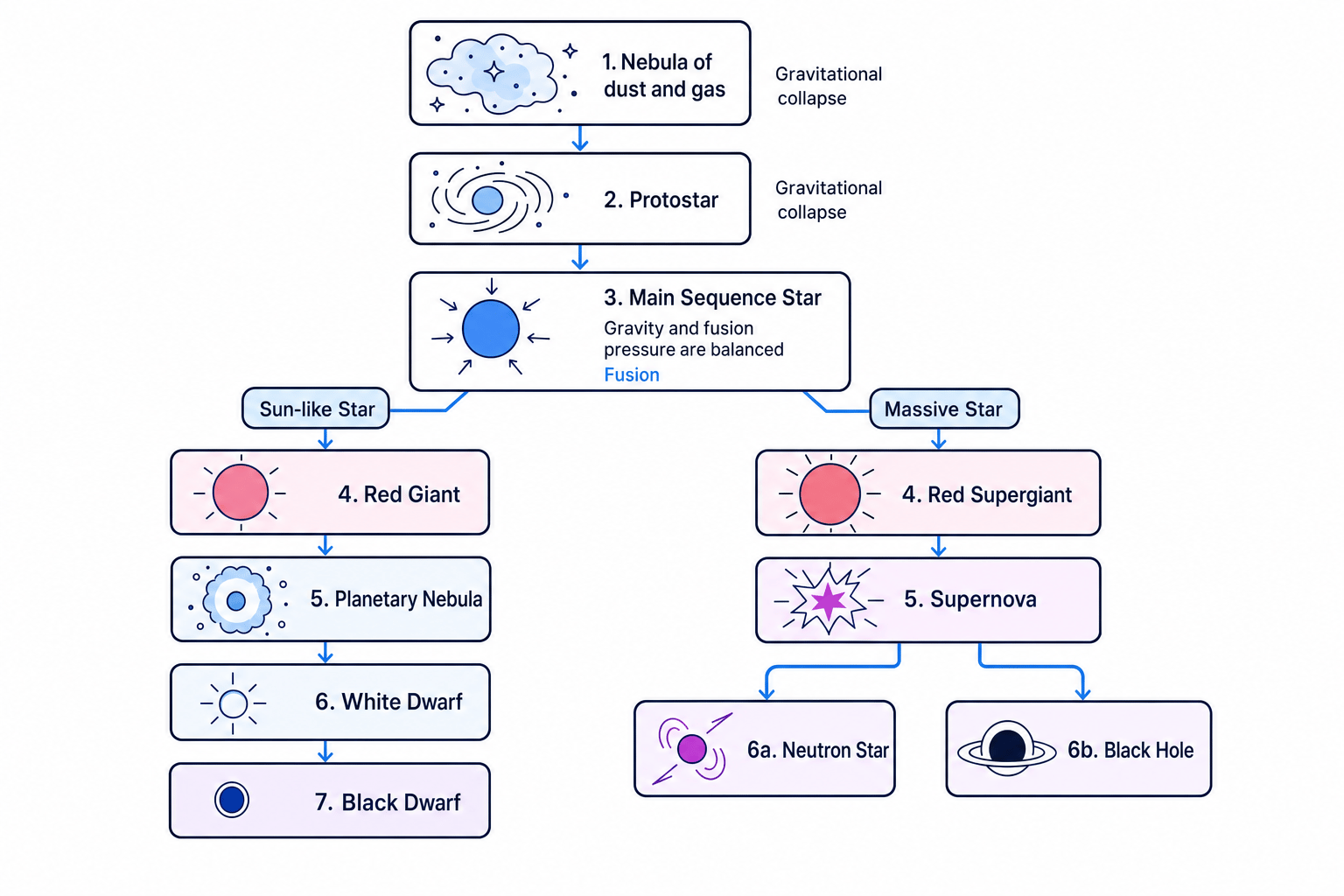
The life cycle depends on the star’s mass:
- A Sun-like star becomes a red giant, then forms a planetary nebula, leaving a white dwarf which eventually cools.
- A much more massive star becomes a red supergiant, then explodes as a supernova, leaving a neutron star or a black hole.
Example
Choosing a star’s final stage
A star is much more massive than the Sun. What possible final stages could it have?
- Use the star’s mass to choose the correct pathway: a very massive star follows the massive-star route, not the Sun-like route.
- After the main sequence, it becomes a red supergiant and then explodes as a supernova.
- The remaining core becomes either a neutron star or, if massive enough, a black hole.
Radiation from hot and cold objects
All objects emit electromagnetic radiation. At ordinary temperatures, objects mainly emit infrared radiation. Hotter objects emit radiation with greater intensity and a different spread of wavelengths.
Definition
Black body radiation
A black body is an ideal object that absorbs all radiation reaching it and is also a perfect emitter. Real objects are not perfect black bodies, but the idea helps us understand how temperature affects radiation.
As temperature increases:
- the total intensity of emitted radiation increases
- the peak wavelength becomes shorter
- the radiation has higher average frequency and energy
So a cool object may mainly emit infrared, while a very hot object can glow red, yellow or white.
Temperature balance and Earth’s atmosphere
This part is Higher Tier only.
An object’s temperature depends on the balance between incoming radiation absorbed and outgoing radiation emitted.
Key Idea
Radiation balance
If an object absorbs radiation faster than it emits radiation, its temperature rises. If it emits radiation faster than it absorbs radiation, its temperature falls. At constant temperature, the two rates are balanced.
Earth absorbs radiation from the Sun, mainly visible light and infrared. Earth also emits infrared radiation back into space. The atmosphere affects this balance: some gases allow much of the Sun’s radiation through but absorb and re-emit some infrared from Earth’s surface.
This is linked to the greenhouse effect, which helps keep Earth warm enough for life. Increasing greenhouse gas concentrations can change the balance, causing Earth’s average temperature to rise.
Example
Deciding whether an object warms or cools
A planet absorbs more energy from its star each second than it emits into space. What happens to its temperature?
- Compare the two rates: incoming absorbed radiation is greater than outgoing emitted radiation.
- There is a net energy gain, so the planet’s internal energy increases.
- The planet’s temperature rises until the emitted radiation increases enough to balance the absorbed radiation.
Common Mistake
Greenhouse gases do not simply block all heat
Greenhouse gases do not stop all infrared escaping. They absorb and re-emit some infrared radiation, changing the balance between incoming and outgoing energy.
Red-shift and the expanding universe
To understand red-shift, remember two wave terms:
- Wavelength is the distance between matching points on neighbouring waves.
- Frequency is the number of waves passing a point each second, measured in hertz.
Definition
Red-shift
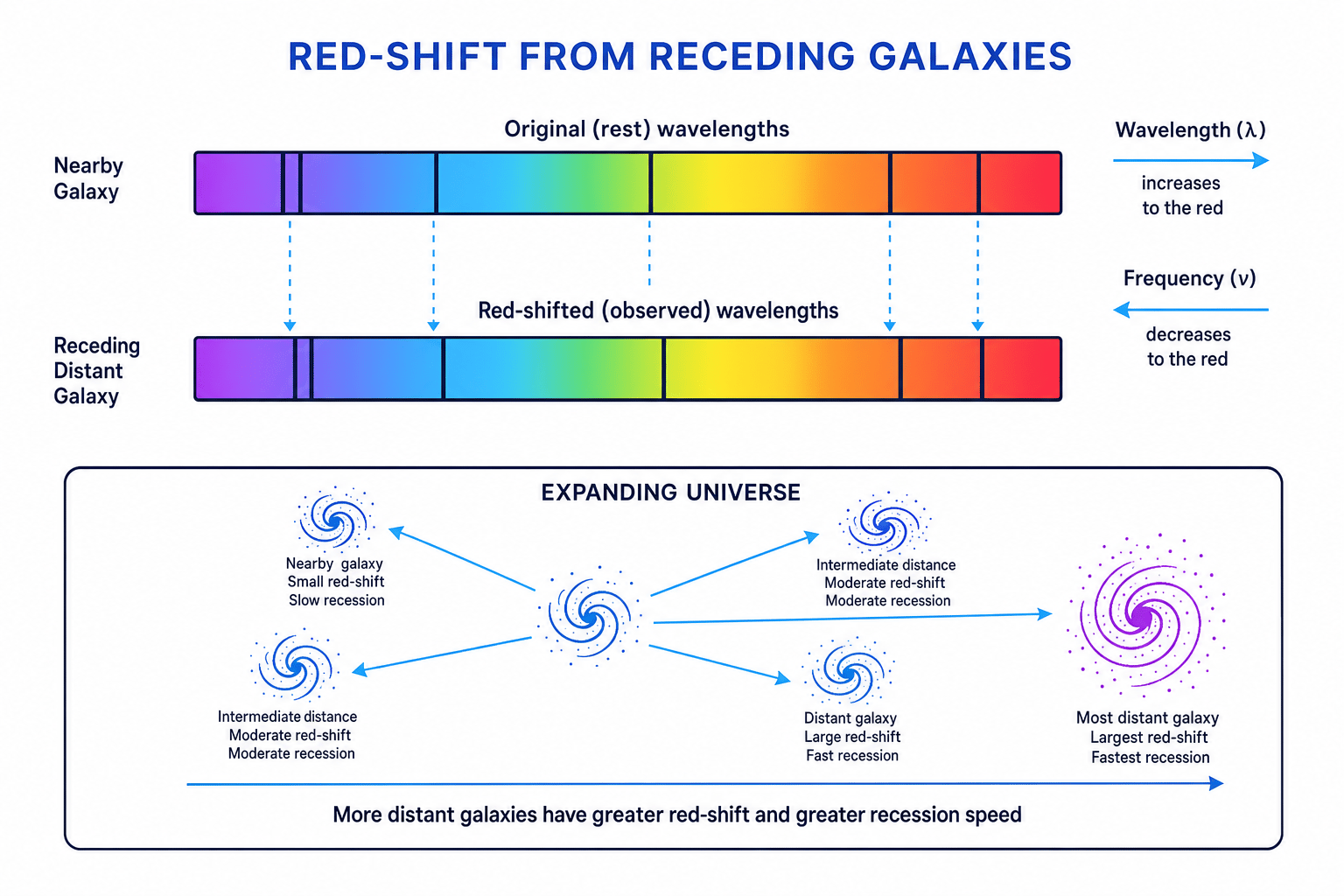
Red-shift is the increase in wavelength, and decrease in frequency, of light from a galaxy that is moving away from us. Spectral lines are shifted towards the red end of the visible spectrum.
For galaxies, observations show that more distant galaxies usually have greater red-shift. This means they are receding faster. This is evidence that the universe is expanding.
Example
Interpreting red-shift evidence
Two galaxies are observed. Galaxy A has a small red-shift. Galaxy B has a much larger red-shift. What can you infer?
- Red-shift means the light waves have been stretched, so both galaxies are moving away from us.
- A larger red-shift means a greater increase in wavelength, so Galaxy B is receding faster than Galaxy A.
- Since recession speed increases with distance, Galaxy B is likely to be further away.
Tip
Red means stretched
Red light has a longer wavelength than blue light, so a shift towards red means the light has been stretched as the galaxy recedes.
The Big Bang model
The Big Bang model says that the universe began in a very hot, dense state and has been expanding and cooling ever since. It was not an ordinary explosion into empty space; it is the expansion of space itself.
Two key pieces of evidence are:
- Red-shift of galaxies: distant galaxies are moving away, and more distant galaxies move away faster.
- Cosmic microwave background radiation, often shortened to CMBR: microwave radiation detected from all directions in space, understood as cooled leftover radiation from the early universe.
Key Idea
Why red-shift supports the Big Bang
If the universe is expanding now, then in the past galaxies were closer together. This supports the idea that the universe started from a much hotter, denser state.
Using waves to explore hidden structures
This section is Higher Tier only.
Some structures cannot be observed directly, such as Earth’s deep interior or the seabed in deep water. Waves help because they can be reflected, absorbed or slowed by different materials.
Definition
Reflection and absorption
Reflection happens when a wave bounces off a boundary. Absorption happens when wave energy is transferred to the material, making the wave weaker.
For earthquakes, scientists study seismic waves:
- P waves are longitudinal waves. They travel through solids and liquids, and are usually faster.
- S waves are transverse waves. They travel through solids but not liquids.
The fact that S waves do not pass through the outer core gives evidence that Earth’s outer core is liquid. Changes in P wave speed and direction give evidence about boundaries and layers inside Earth.
Sonar uses sound waves, often ultrasound, to explore underwater. A pulse is sent out and the echo is detected after reflection from the seabed or an object.
Example
Calculating depth using sonar
A sonar pulse travels through seawater at 1500 m/s. The echo returns after 0.12 s. Find the depth of the seabed.
- The time is for the pulse to travel down to the seabed and back up, so the one-way time is half of 0.12 s: 0.06 s.
- Use distance = speed multiplied by time for the one-way journey:
s=vt=1500 m/s×0.06 ss = vt = 1500 \ \text{m/s} \times 0.06 \ \text{s}s=vt=1500 m/s×0.06 s. - Calculate the depth:
s=90 ms = 90 \ \text{m}s=90 m.
Common Mistake
Forgetting the echo travels both ways
In sonar, the measured time is usually the journey to the object and back. Divide the time by 2 before finding the one-way distance.
Exam technique
In the exam
- For red-shift questions, link the chain clearly: larger wavelength → lower frequency → galaxy receding → expanding universe.
- For orbit questions, use the words velocity, direction, gravity and centripetal force carefully.
- For Higher Tier radiation questions, compare absorbed radiation with emitted radiation before deciding whether temperature rises, falls or stays constant.
Self review
Check yourself
- Why can a satellite in a circular orbit have constant speed but changing velocity?
- What evidence links red-shift to the Big Bang model?
- How do P waves and S waves provide evidence about Earth’s core?

Recap questions
Test yourself with 5 quick questions on this guide. Answer them all correctly to complete it.
You've reached the end
Test yourself on this topic, or move on to the next guide.
How was this guide?