Question 13
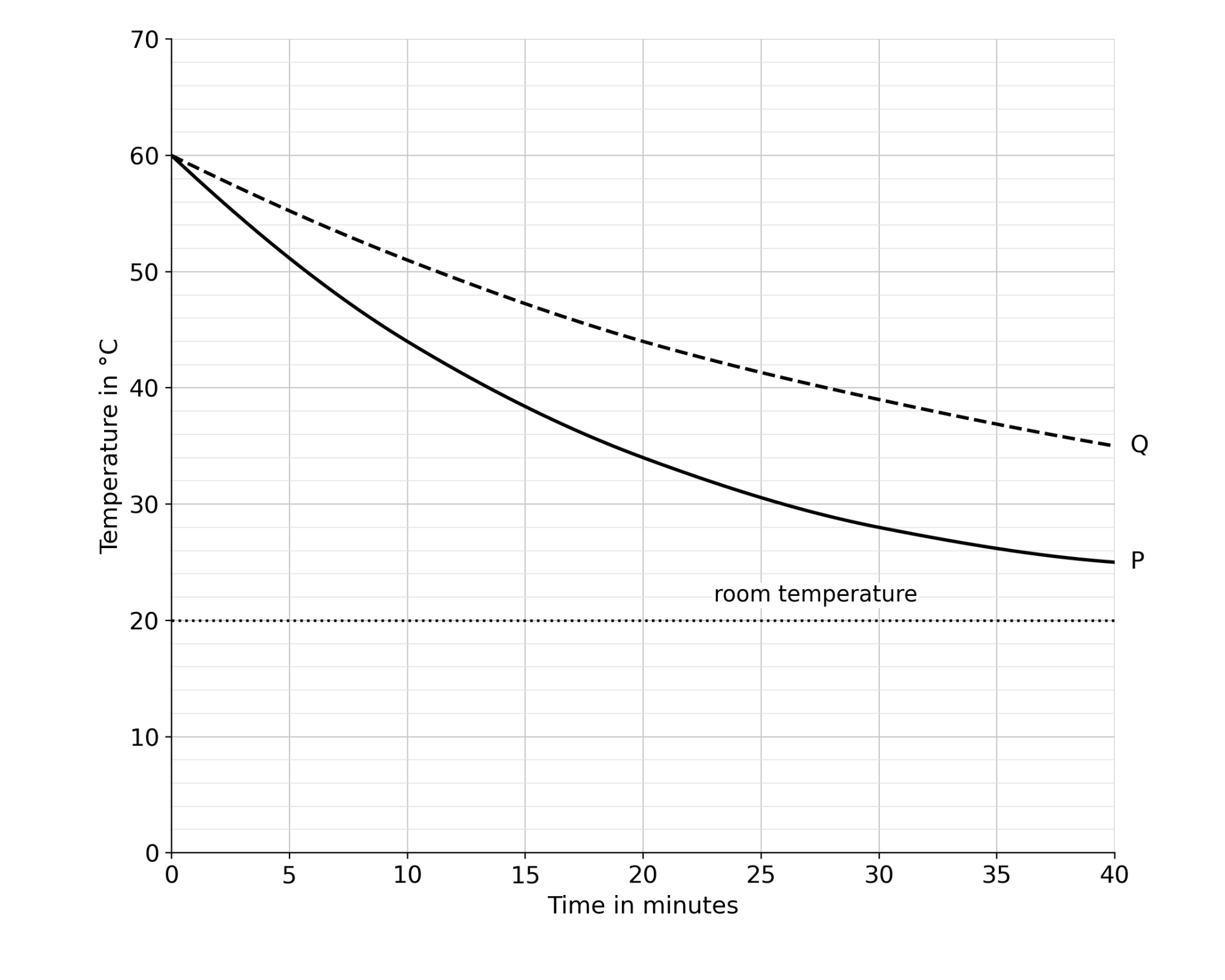
HA student builds two model houses, P and Q, from the same material. The walls of house Q are thicker than the walls of house P.
She places a beaker of water at 60 ∘C60\ ^\circ\text{C}60 ∘C inside each house and measures the temperature of the water for 40 minutes. The room temperature is 20 ∘C20\ ^\circ\text{C}20 ∘C.
The Figure shows her results.
Figure
a.[1]
Use the Figure to determine the temperature drop of the water in house Q in the first 20 minutes.
b.[2]
Describe how the temperature of the water in house P changes during the 40 minutes.
c.[2]
Explain why the water in house Q cools more slowly than the water in house P.
d.[2]
A third house, R, has walls with the same thickness as house P. The walls of house R are made from a material with a lower thermal conductivity.
Predict how the cooling curve for house R compares with the curve for house P. Give a reason for your answer.
e.[2]
Suggest why the rate of cooling of the water in both houses decreases with time.
7.2 Power and efficiency Questions
50 exam-style questions on OCR GCSE Physics 7.2 Power and efficiency, covering 7.2.1 Dissipation of energy, 7.2.2 Energy transfers in domestic devices, 7.2.3 Power ratings of domestic appliances, 7.2.4 Efficiency of energy transfers, 7.2.5 Ways to increase efficiency, 7.2.6 Reducing unwanted energy transfers, and 7.2.7 Thermal conductivity and the cooling of buildings. Each one has a worked solution and a mark scheme showing where the marks go.