Physics on the move
What you'll learn
- Estimate everyday speeds and accelerations for people, vehicles, wind and sound.
- Convert between common speed units and SI units.
- Measure human reaction time and link it to road safety.
- Explain stopping distance, large decelerations and the forces involved in emergencies.
Describing motion: speed and rates
A rate tells you how quickly one quantity changes compared with another. In this topic, the main rates are speed and acceleration.
Speed
Speed is the distance travelled per unit time. It tells you how fast something is moving, usually in metres per second (m/s).
For speed calculations, use:
v=distancetimev = \frac{\text{distance}}{\text{time}}v=timedistancewhere vvv is speed.
Typical speeds to remember
These values are approximate, but they are useful for estimates and “is this answer sensible?” checks.
| Situation | Typical speed |
|---|---|
| Walking | about 1.5 m/s |
| Running | about 3 m/s for ordinary running |
| Cycling | about 5 to 7 m/s |
| Car in a 30 mph area | about 13 m/s |
| Car on a motorway at 70 mph | about 31 m/s |
| Fast train | about 55 m/s |
| Passenger aircraft | about 250 m/s |
| Sound in air | about 330 m/s |
| Wind | about 5 m/s for a breeze; 15 m/s or more for strong wind |
Speed estimate shortcuts
To convert from kilometres per hour to metres per second, divide by 3.6. To convert from miles per hour to metres per second, multiply by about 0.45.
Converting units and computing rates
GCSE questions often give speeds in non-SI units, such as kilometres per hour or miles per hour. SI units are the standard physics units, such as metres, seconds and metres per second.
A ratio is a comparison by division. Proportional reasoning means scaling quantities by the same factor: if the time doubles at the same speed, the distance doubles too.
Converting speed and finding time
A cyclist travels at 72 km/h. Estimate the time taken to travel 100 m.
- Convert kilometres to metres and hours to seconds: 72 km/h means 72,000 m in 3,600 s.
- Divide to get the speed in SI units: v=72 0003 600=20 m/sv = \frac{72\,000}{3\,600} = 20\ \text{m/s}v=360072000=20 m/s.
- Use v=stv = \frac{s}{t}v=ts rearranged to t=svt = \frac{s}{v}t=vs, so t=10020=5.0 st = \frac{100}{20} = 5.0\ \text{s}t=20100=5.0 s.
Acceleration and deceleration
Acceleration
Acceleration is the rate of change of velocity. Velocity means speed in a particular direction.
For motion in a straight line, you can usually think of acceleration as “how quickly the speed changes”.
a=Δvta = \frac{\Delta v}{t}a=tΔvwhere aaa is acceleration, Δv\Delta vΔv is the change in velocity, and ttt is the time taken. The unit is metres per second squared, written m/s².
Deceleration
Deceleration is acceleration in the opposite direction to the motion. In everyday language, it means slowing down.
Everyday acceleration estimates
| Situation | Typical acceleration magnitude |
|---|---|
| Starting to walk | about 0.5 m/s² |
| Bicycle setting off | about 1 m/s² |
| Car accelerating normally | about 1 to 3 m/s² |
| Hard braking in a car | about 6 to 10 m/s² |
| Falling near Earth, ignoring air resistance | about 10 m/s² |
Magnitude means size only, ignoring direction. So a car slowing down at 8 m/s² has a deceleration magnitude of 8 m/s².
Estimating acceleration
A car speeds up from rest to 24 m/s in 8.0 s. Estimate its acceleration.
- Identify the change in velocity: Δv=24−0=24 m/s\Delta v = 24 - 0 = 24\ \text{m/s}Δv=24−0=24 m/s.
- Substitute into a=Δvta = \frac{\Delta v}{t}a=tΔv: a=248.0a = \frac{24}{8.0}a=8.024.
- Calculate the acceleration: a=3.0 m/s2a = 3.0\ \text{m/s}^2a=3.0 m/s2, which is a reasonable value for a car accelerating quite strongly.
Speed is not acceleration
A vehicle travelling fast at a steady speed has zero acceleration, because its velocity is not changing.
Human reaction time
Reaction time
Reaction time is the time between noticing a stimulus and starting your response.
A common method is the ruler-drop experiment, often used as a PAG P3-style practical. One person holds a ruler vertically, with the zero mark level with the other person’s fingers. The ruler is released without warning, and the other person catches it as quickly as possible. The distance the ruler falls is used to estimate reaction time: a larger distance means a longer reaction time.
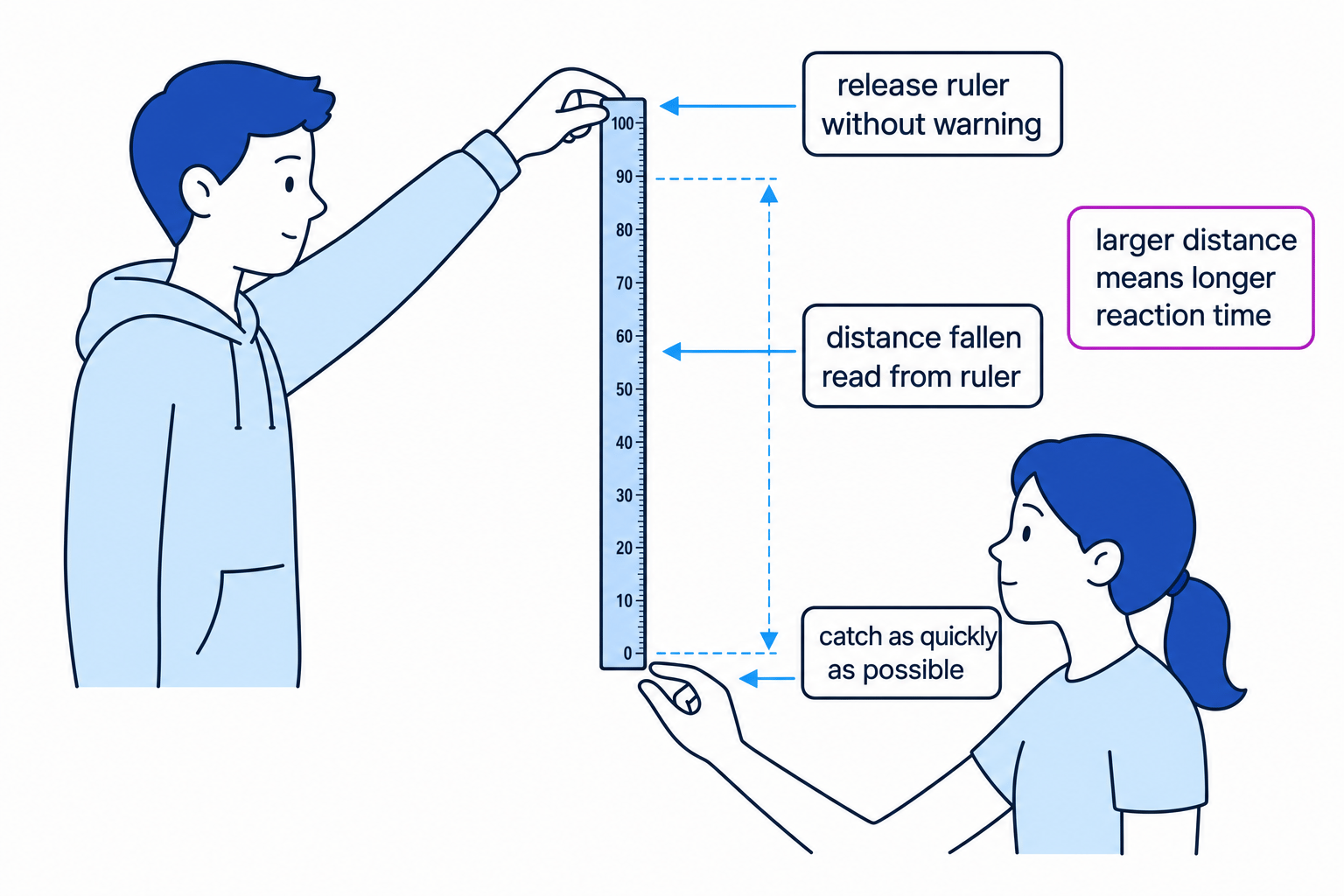
Typical simple reaction times are about 0.2 to 0.3 s. In real driving, the total “thinking time” can be longer because the driver must notice the hazard, decide what to do, and move their foot to the brake.
To improve the experiment:
- repeat several times and calculate a mean;
- release the ruler at random times, not after a countdown;
- keep the starting position the same;
- ignore obvious anomalous results if there is a good reason.
Averaging reaction-time results
A student records reaction times of 0.21 s, 0.24 s, 0.22 s, 0.61 s and 0.23 s. The 0.61 s result happened because they laughed and missed the ruler.
- Treat 0.61 s as anomalous because there is a clear experimental reason for it.
- Add the reliable values: 0.21+0.24+0.22+0.23=0.90 s0.21 + 0.24 + 0.22 + 0.23 = 0.90\ \text{s}0.21+0.24+0.22+0.23=0.90 s.
- Divide by the four reliable repeats: 0.904=0.225 s\frac{0.90}{4} = 0.225\ \text{s}40.90=0.225 s, so the mean reaction time is about 0.23 s.
Stopping distance
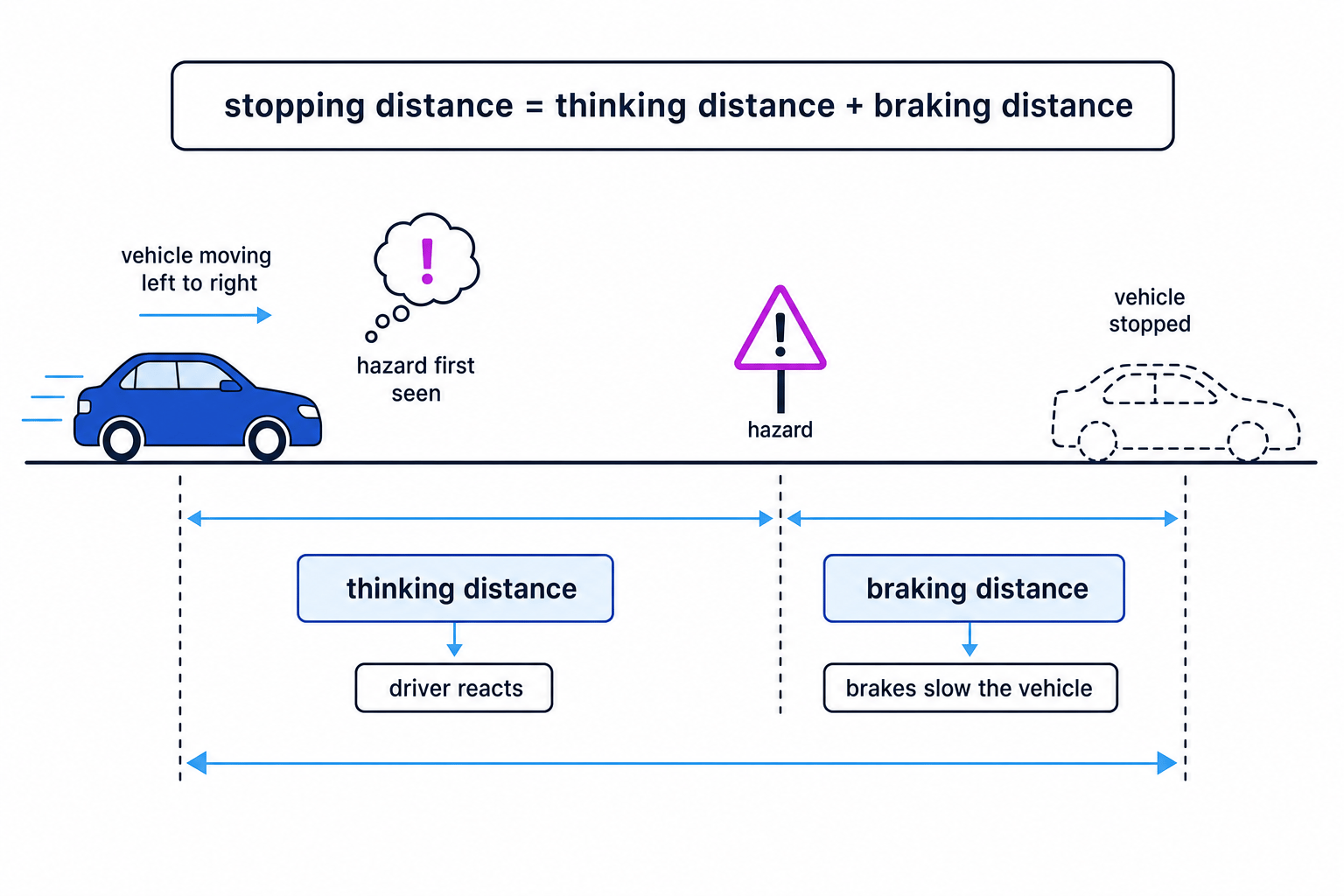
When a driver sees a hazard, the vehicle does not stop instantly. The total distance needed is called the stopping distance.
Stopping distance
Stopping distance = thinking distance + braking distance.
Thinking distance and braking distance
Thinking distance is the distance travelled while the driver reacts. Braking distance is the distance travelled after the brakes are applied until the vehicle stops.
Factors affecting thinking distance
Thinking distance increases if the vehicle is moving faster or if the driver’s reaction time is longer.
Reaction time can be increased by:
- alcohol;
- drugs;
- tiredness;
- distractions, such as phones or passengers;
- poor visibility, because the hazard may take longer to notice.
Factors affecting braking distance
Braking distance depends on the vehicle and the conditions after the brakes have been applied.
It can be increased by:
- higher speed;
- wet, icy or loose road surfaces;
- worn tyres;
- poor brakes;
- larger load or mass;
- travelling downhill.
Mixing up thinking and braking
Alcohol, drugs, tiredness and distractions mainly increase thinking distance, not braking distance. Braking distance is about the vehicle, road surface, tyres, brakes and speed after braking begins.
How stopping distance changes with speed
This next estimating skill is for separate Physics J249, not Combined Science. You may be asked to estimate stopping distances over typical road speeds.
For the same driver, thinking distance is roughly proportional to speed: double the speed, double the thinking distance.
Braking distance increases much more sharply. A vehicle moving twice as fast has about four times the kinetic energy, so the brakes must remove much more energy before it stops.
Typical Highway Code stopping distances for a car in good conditions are:
| Speed | Thinking distance | Braking distance | Total stopping distance |
|---|---|---|---|
| 20 mph | 6 m | 6 m | 12 m |
| 30 mph | 9 m | 14 m | 23 m |
| 40 mph | 12 m | 24 m | 36 m |
| 50 mph | 15 m | 38 m | 53 m |
| 60 mph | 18 m | 55 m | 73 m |
| 70 mph | 21 m | 75 m | 96 m |
Estimating stopping distance when speed doubles
A car’s stopping distance at 20 mph is about 12 m, made from 6 m thinking distance and 6 m braking distance. Estimate the stopping distance at 40 mph in similar conditions.
- The speed has doubled, so estimate the thinking distance doubles: 6 m becomes 12 m.
- The braking distance is roughly proportional to speed squared, so doubling the speed makes it about four times bigger: 6 m becomes 24 m.
- Add the two parts: 12 m + 24 m = 36 m, matching the typical Highway Code estimate.
Large decelerations and safety
A moving vehicle and its passengers have momentum, meaning mass times velocity. To stop, that momentum must be reduced to zero. If this happens in a very short time, the deceleration is large.
Large decelerations are dangerous because they cause large forces on the body. This can damage organs, bones and tissues.
Safety features reduce the force by increasing the time or distance over which the person stops:
- seat belts stretch slightly and spread the force over stronger parts of the body;
- airbags increase stopping time for the head and chest;
- crumple zones deform, increasing the collision time;
- helmets use padding to increase stopping time for the skull.
This force-estimation work is separate Physics only, and the public-road force estimates in P8.1h are Higher Tier only.
Estimating a collision force
A 70 kg passenger is brought from 13 m/s to rest in 0.10 s during a collision. Estimate the average force on the passenger.
- Find the size of the velocity change: the speed changes from 13 m/s to 0 m/s, so the magnitude of Δv\Delta vΔv is 13 m/s.
- Calculate the deceleration magnitude: a=130.10=130 m/s2a = \frac{13}{0.10} = 130\ \text{m/s}^2a=0.1013=130 m/s2.
- Use F=maF = maF=ma: F=70×130=9 100 NF = 70 \times 130 = 9\,100\ \text{N}F=70×130=9100 N.
- If safety features increased the stopping time to 0.50 s, the deceleration would be five times smaller, so the average force would also be about five times smaller.
In the exam
- Keep thinking distance and braking distance separate, then add them for stopping distance.
- Convert speeds into metres per second before using equations, unless the question clearly wants an estimate in mph.
- Check whether the question asks for a magnitude: if it does, give the positive size of the acceleration or force.
- For safety explanations, always link the feature to “increases stopping time or distance” and therefore “reduces deceleration and force”.
Check yourself
- Why does doubling speed more than double the total stopping distance?
- Which factors affect thinking distance, and which affect braking distance?
- How would you estimate the force on a passenger during sudden braking?