Powering Earth
What you'll learn
- How to compare renewable and non-renewable energy sources used on Earth.
- Why energy-resource use changes over time.
- How the National Grid transfers electrical energy efficiently using transformers.
- What a.c. mains electricity is, and how live, neutral and earth wires keep homes safe.
First: energy and power are not the same
Energy is transferred when something happens: a kettle heats water, a turbine turns, or a lamp gives out light. Energy is measured in joules (J).
Power tells you how quickly energy is transferred. Power is measured in watts (W), where 1 watt means 1 joule per second.
Power
Power is the rate of energy transfer:
P=EtP = \frac{E}{t}P=tEwhere PPP is power in watts (W), EEE is energy transferred in joules (J), and ttt is time in seconds (s).
Calculating power
A device transfers 120 000 J of energy in 60 s. Calculate its power.
- Choose the power equation because the question gives energy transferred and time: P=EtP = \frac{E}{t}P=tE.
- Substitute the values with units: P=120 000 J60 sP = \frac{120\,000\ \text{J}}{60\ \text{s}}P=60 s120000 J.
- Calculate the result: P=2000 WP = 2000\ \text{W}P=2000 W, so the device has a power of 2000 W, or 2.0 kW.
Energy is not power
Phrases like “solar power” are everyday language. In physics, the Sun is an energy source; power is the rate at which energy is transferred.
Energy sources available on Earth
An energy source is something we can use to transfer energy for useful purposes, such as generating electricity, heating buildings, or transport.
Renewable and non-renewable
A renewable energy source is naturally replaced on a timescale humans can use. A non-renewable energy source will run out, or is replaced so slowly that it cannot be replaced within human timescales.
Main sources you need to know
| Energy source | Renewable? | How it is often used | Key advantages | Main issues |
|---|---|---|---|---|
| Fossil fuels: coal, oil, natural gas | Non-renewable | Burned to heat water, make steam, turn turbines and generators | Reliable, high power output, controllable | Releases carbon dioxide; pollution; finite supply |
| Nuclear fuel | Non-renewable | Nuclear reactions heat water, making steam for turbines | Very high output; low carbon dioxide during operation | Radioactive waste; expensive; slow to build |
| Biofuel | Renewable if replanted sustainably | Burned for heating, transport fuel, or electricity | Can use waste materials; can be regrown | Land use; may still release pollutants |
| Wind | Renewable | Wind turns turbine blades connected to generators | No fuel cost; no direct emissions | Intermittent; depends on location and weather |
| Hydroelectricity | Renewable | Falling water turns turbines | Reliable where suitable; can respond quickly | Flooding valleys; habitat impact; limited sites |
| Tides | Renewable | Moving seawater turns turbines | Predictable | Expensive; limited coastal locations; habitat impact |
| The Sun | Renewable | Solar cells generate electricity; solar thermal panels heat water | No fuel; useful on roofs and remote sites | Output changes with daylight, weather and season |
Comparing energy sources
No energy source is perfect. Good answers compare reliability, cost, environmental impact, location, and whether the source is renewable.
Patterns and trends in energy use
Energy use changes over time. In the UK, electricity generation has generally moved away from coal and towards more natural gas, renewables and some nuclear generation.
Reasons include:
- environmental concerns, especially reducing carbon dioxide emissions;
- laws and government targets on climate change and air pollution;
- technology improvements, making wind and solar cheaper and more efficient;
- fuel cost and availability;
- reliability, because some sources are easier to turn up or down quickly.
Explaining a change in energy-resource use
A graph shows coal use falling while wind and solar use increase over several decades. Explain the trend.
- Identify the pattern: coal is decreasing, while renewable sources such as wind and solar are increasing.
- Link the change to causes: coal releases carbon dioxide and air pollutants, while renewable technology has become cheaper and is supported by climate targets.
- Add a balanced point: wind and solar are intermittent, so the electricity system still needs backup, storage, or other sources to meet demand when output is low.
The National Grid
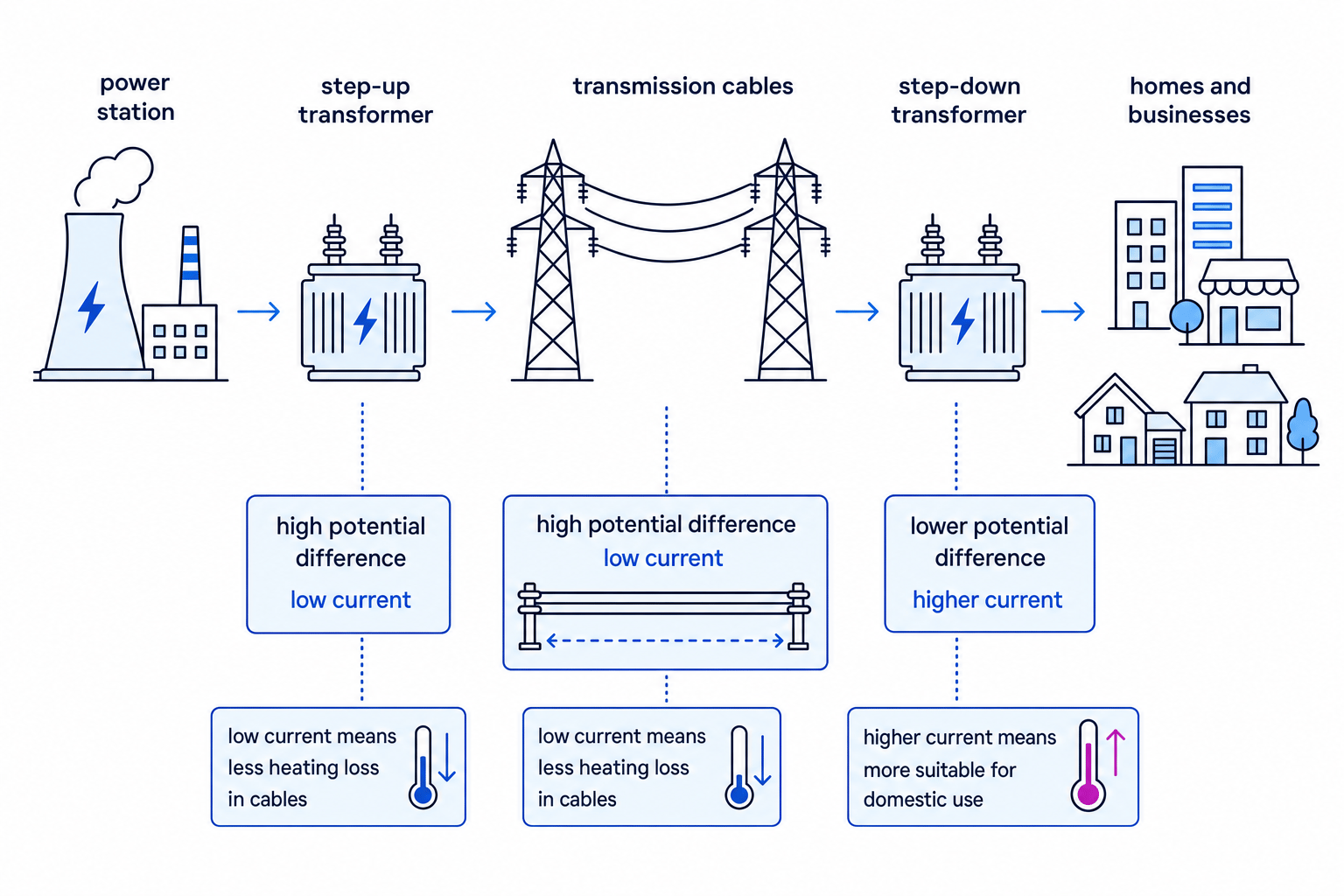
The National Grid is the network of cables, transformers and substations that transfers electrical energy from power stations and renewable generators to homes, businesses and industry.
Electricity often has to travel long distances. Cables have some resistance, so when current flows through them, energy is transferred to the surroundings by heating. This is wasted energy.
The National Grid reduces this waste by transferring electrical power at high potential difference and low current over long distances, then reducing the potential difference for local and domestic use.
Potential difference and current
Potential difference, often called voltage, is the energy transferred per unit charge between two points. It is measured in volts (V). Current is the rate of flow of charge, measured in amperes (A).
Why high voltage helps
For the same power transfer, increasing the potential difference means the current can be smaller. A smaller current causes less heating in the transmission cables, so less energy is wasted.
Voltage is across, current is along
A high potential difference is applied between conductors, not “along” one wire. Current flows along the cables when there is a complete circuit.
Transformers: changing the potential difference
A transformer is a device that changes the potential difference of an alternating supply. It has a primary coil connected to the input and a secondary coil connected to the output.
- A step-up transformer increases potential difference.
- A step-down transformer decreases potential difference.
In the National Grid:
- Step-up transformers increase the potential difference after generation.
- Electricity is transferred across the country at high potential difference and low current.
- Step-down transformers reduce the potential difference for local distribution and domestic use.
This next transformer calculation work is Higher Tier only and, because it is marked for separate Physics in the spec, it is for J249 separate Physics, not OCR Gateway Combined Science.
For an ideal transformer, the power transferred to the primary coil is approximately equal to the power transferred from the secondary coil:
VpIp=VsIsV_p I_p = V_s I_sVpIp=VsIswhere VpV_pVp and IpI_pIp are the primary potential difference and current, and VsV_sVs and IsI_sIs are the secondary potential difference and current.
The voltage also depends on the number of turns on each coil:
VsVp=NsNp\frac{V_s}{V_p} = \frac{N_s}{N_p}VpVs=NpNswhere NpN_pNp and NsN_sNs are the numbers of turns on the primary and secondary coils.
Equation-sheet note: OCR lists the transformer power relationship as something you must be able to apply. In revision, learn it and practise rearranging it; do not rely on it being explained in the question.
Using a step-up transformer
A transformer has 500 turns on the primary coil and 8000 turns on the secondary coil. The primary potential difference is 25 V and the primary current is 2.0 A. Calculate the secondary potential difference and secondary current.
-
Use the turns ratio because the numbers of turns are given:
Vs25=8000500\frac{V_s}{25} = \frac{8000}{500}25Vs=5008000 -
Calculate the secondary potential difference:
Vs=25×16=400 VV_s = 25 \times 16 = 400\ \text{V}Vs=25×16=400 V -
Use conservation of power in an ideal transformer:
VpIp=VsIsV_p I_p = V_s I_sVpIp=VsIs -
Substitute and rearrange for IsI_sIs:
Is=25×2.0400=0.125 AI_s = \frac{25 \times 2.0}{400} = 0.125\ \text{A}Is=40025×2.0=0.125 A -
Compare input and output: the transformer has increased the potential difference from 25 V to 400 V, and the current has decreased from 2.0 A to 0.125 A.
Alternating and direct voltage
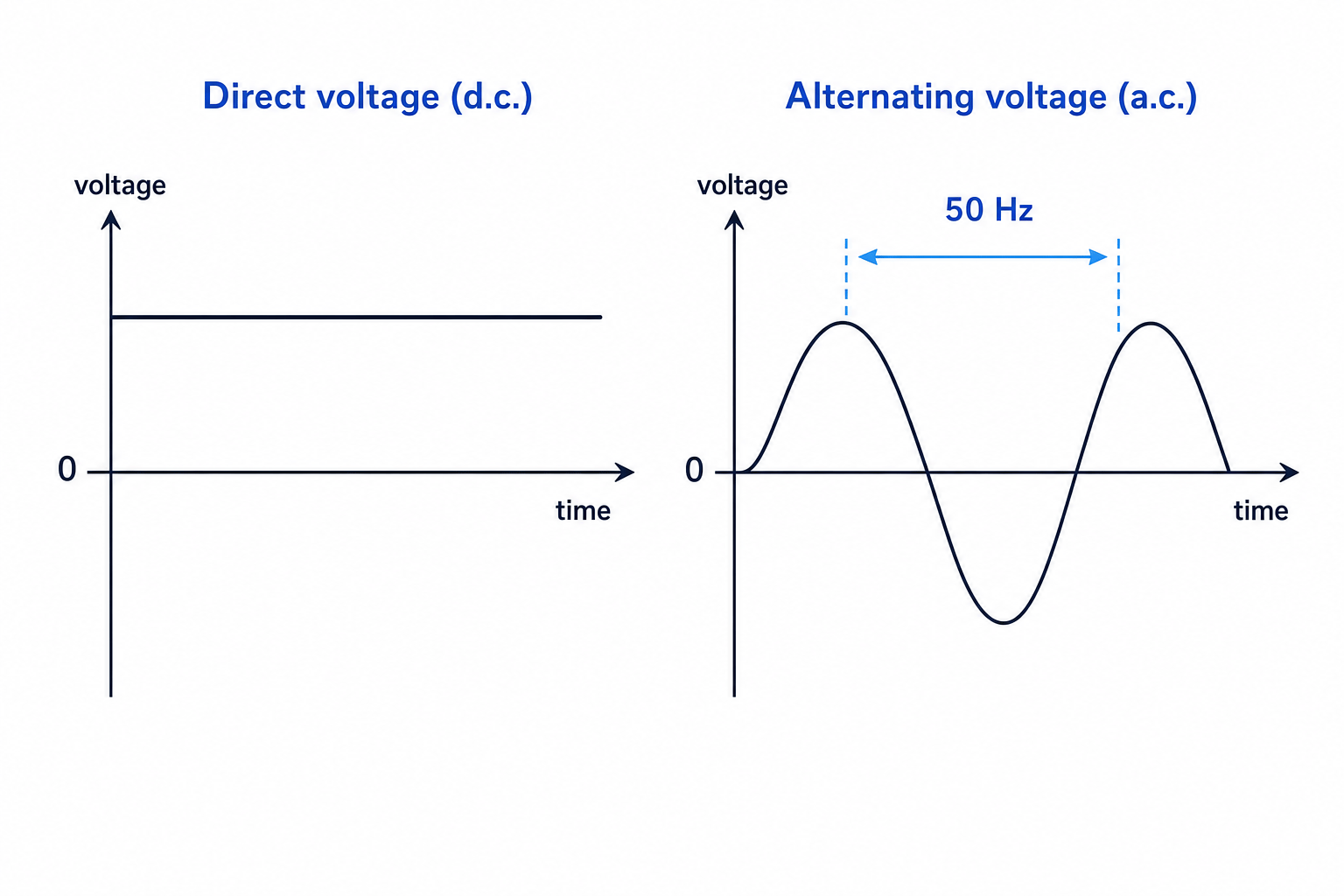
The UK domestic mains supply is a.c. at 50 Hz and about 230 V.
Direct voltage, or d.c., stays the same direction. A battery provides d.c., so in a simple circuit the current flows in one direction.
Alternating voltage, or a.c., repeatedly changes direction. In the UK mains supply, 50 Hz means 50 complete cycles every second, so the current reverses direction many times each second.
Recognising a.c. and d.c. traces
On a voltage-time graph, d.c. is a steady line. A.c. repeatedly goes positive and negative, crossing zero each cycle.
Mains wires in the home
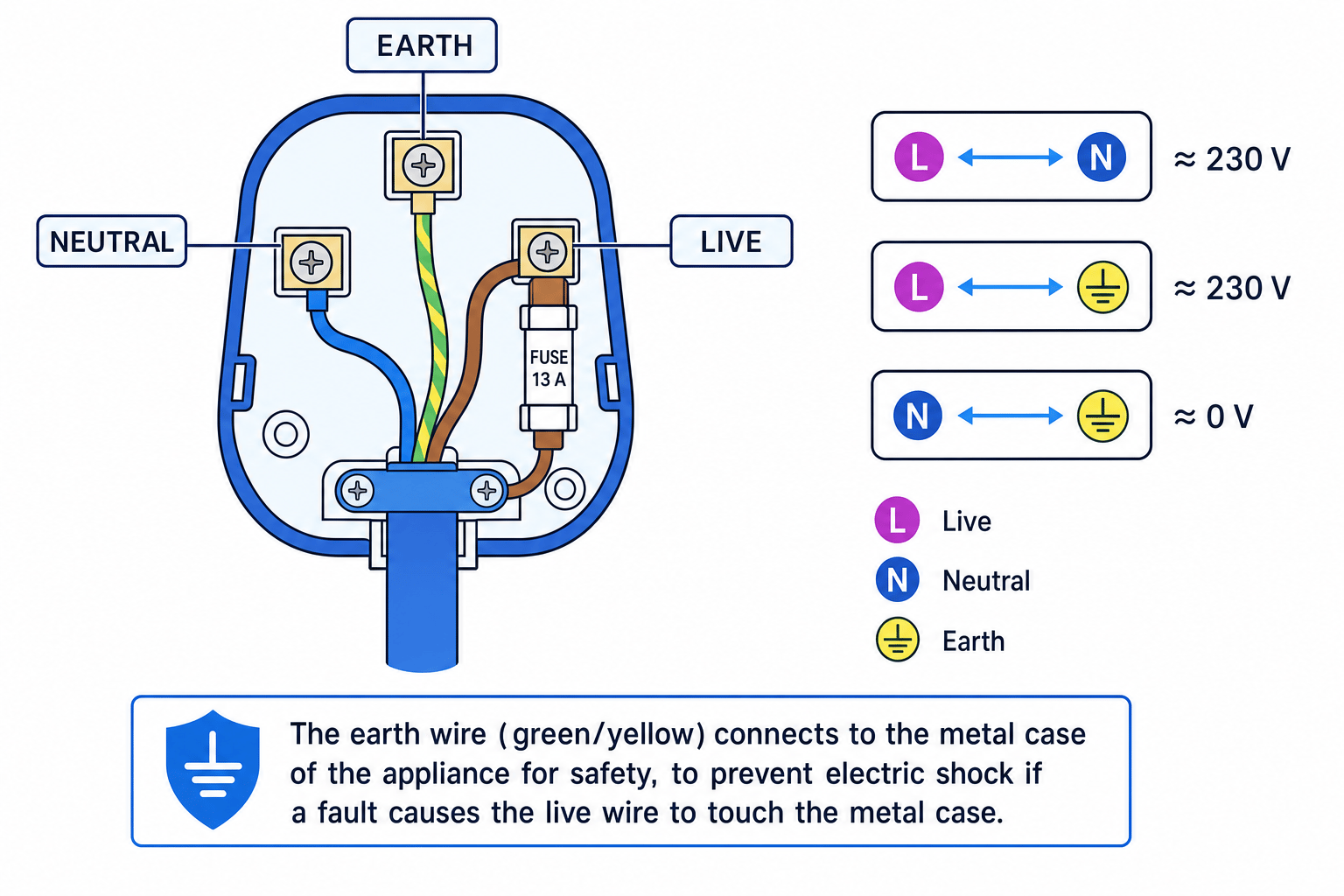
A UK mains cable normally contains three wires: live, neutral and earth.
| Wire | Usual colour | Function | Potential difference |
|---|---|---|---|
| Live | Brown | Carries the alternating potential difference from the supply | About 230 V relative to neutral or earth |
| Neutral | Blue | Completes the circuit back to the supply | About 0 V relative to earth |
| Earth | Green/yellow | Safety wire connected to metal cases | Normally 0 V; only carries current during a fault |
The live wire is dangerous because it has a large potential difference compared with you and the Earth. If you touch the live wire while also connected to Earth, a current can pass through your body.
The earth wire provides a low-resistance path for current if a fault makes the metal case of an appliance live. This large fault current should make the fuse melt or the circuit breaker switch off, disconnecting the supply.
Insulation is non-conducting material, such as plastic, placed around conductors to stop people touching live parts. Some appliances are double-insulated and do not need an earth wire because the user cannot touch any metal part that could become live.
Sockets do not store current
A wall socket does not contain “current waiting to escape”. It provides a potential difference. Current flows only when there is a complete conducting path.
Explaining why an open switch can still be dangerous
A lamp is switched off, but part of its live wire before the switch is exposed. Explain why it can still be dangerous.
- Decide which wire is hazardous: the exposed wire is live, so it is at about 230 V relative to Earth.
- Apply the circuit idea: even though the switch is open, the live wire before the switch can still have a potential difference.
- Explain the danger: if a person touches the live wire while also connected to Earth, their body can complete a path to Earth, so current may flow through them and cause an electric shock.
Live-to-earth connections
Any connection between live and earth is dangerous because it can produce a very large current. Safety devices should disconnect the supply, but you must never rely on touching or shorting live parts.
In the exam
- When comparing energy resources, use paired comparisons: reliability, cost, renewability, emissions and location.
- For National Grid questions, link the chain clearly: high potential difference means lower current for the same power, so less heating loss in cables.
- For mains safety, always name the wire, state its potential difference, and explain the path current would take.
Check yourself
- Why does the National Grid use step-up transformers before long-distance transmission?
- What is the difference between direct voltage and alternating voltage?
- What are the functions of the live, neutral and earth wires in a UK plug?