Revision notes for OCR GCSE Physics Newton’s laws. Open the guide for explanations and worked examples. Written against the OCR GCSE Physics (J249) specification, so the content matches what's examinable rather than general Physics background.
Newton’s laws
What you'll learn
- How forces are interactions between objects, and how to show them with arrows.
- How resultant force links to motion using Newton’s first and second laws.
- How momentum, work done and power are calculated.
- How Newton’s third law and circular motion fit into the same force ideas.
Forces start with interactions
A force is a push or pull. Forces only happen because objects interact with other objects.
Some forces need touching:
- Normal contact force: a surface pushes back on an object touching it.
- Friction: a contact force that opposes motion, or attempted motion.
- Air resistance: friction from moving through air.
Some forces act without touching:
- Gravity: attraction between masses.
- Magnetism: forces between magnets or magnetic materials.
- Electrostatics: forces between charged objects.
Definition
Force
A force is a push or pull caused by an interaction between objects. Force is measured in newtons (N).
Whenever two objects interact, each object feels a force. For example, Earth pulls a falling ball down, and the ball pulls Earth up. The forces are on different objects.
Forces are vectors
A scalar has size only, such as mass or temperature. A vector has size and direction. Force is a vector, so you must include direction.
A force arrow shows:
- direction: which way the force acts
- length: the size of the force, if drawn to scale
- label: what type of force it is
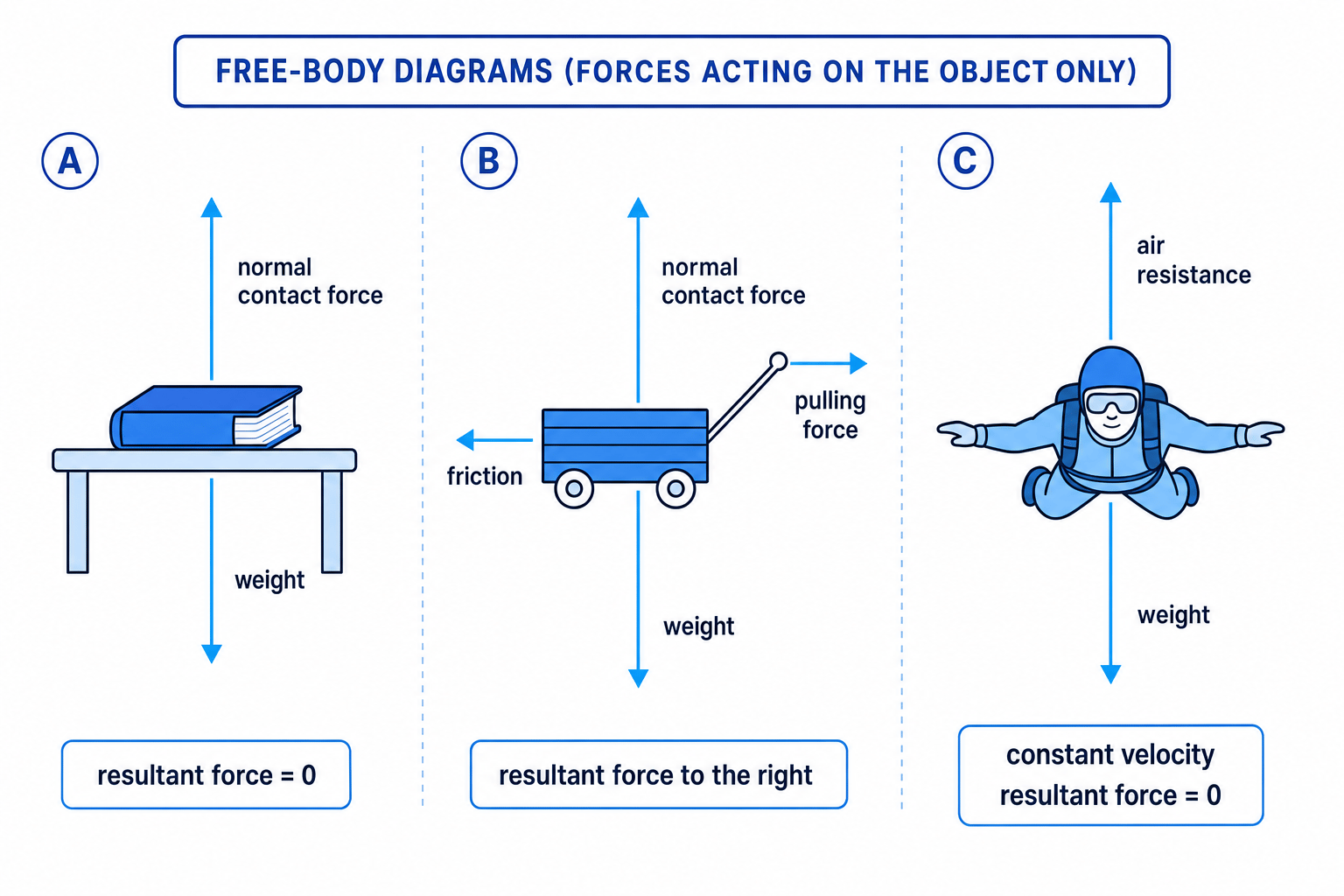
A free-body diagram shows just the object you are analysing, with the forces acting on that object only.
Definition
Resultant force
The resultant force is the single overall force that has the same effect as all the forces acting together.
If forces balance, the resultant force is zero. This is called equilibrium.
Example
Finding a resultant force
A trolley has a 12 N pulling force to the right and 5 N friction to the left. Its weight and normal contact force are balanced.
- Work horizontally because the vertical forces cancel, so they do not affect the horizontal resultant.
- Opposite horizontal forces subtract: 12 N−5 N=7 N12\ \text{N} - 5\ \text{N} = 7\ \text{N}12 N−5 N=7 N.
- The larger force is to the right, so the resultant force is 7 N to the right.
Common Mistake
Putting forces on the wrong object
In a free-body diagram, only draw forces acting on the chosen object. Do not draw the force that the object exerts on something else.
Resolving forces
Resolving a force means splitting one force into components, usually horizontal and vertical parts. In this spec, scale drawings are limited to parallel and perpendicular vectors.
For parallel forces, add forces in the same direction and subtract forces in opposite directions. For perpendicular forces, draw the arrows to scale and use the diagonal to show the resultant.
Newton’s first law
Newton’s first law is about what happens when the resultant force is zero.
Key Idea
Newton’s first law
If the resultant force on an object is zero, a stationary object stays stationary, and a moving object continues with uniform velocity.
Uniform velocity means constant speed in a straight line. If speed changes or direction changes, velocity has changed, so there must be a non-zero resultant force.
This is a big idea: an object does not need a resultant force to keep moving steadily. It only needs a resultant force to change its motion.
Common Mistake
Thinking moving objects need a forward resultant force
A car moving at constant velocity has balanced forces. The driving force forwards equals the resistive forces backwards, so the resultant force is zero.
Terminal velocity
An object falling through air has weight downwards and air resistance upwards. At first, weight is bigger, so it accelerates downwards. As speed increases, air resistance increases. Eventually air resistance equals weight, so the resultant force becomes zero. The object then falls at constant velocity: this is terminal velocity.
The same idea can apply to vehicles: when driving force equals resistive forces, the vehicle moves at constant velocity.
Newton’s second law
Newton’s second law links resultant force, mass and acceleration.
Definition
Acceleration
Acceleration is the rate of change of velocity. It is measured in metres per second squared, written as m/s².
The equation is:
F=maF = maF=mawhere FFF is resultant force in newtons, mmm is mass in kilograms, and aaa is acceleration in m/s².
OCR lists this equation as recall and apply, so learn it rather than relying on it being given.
Example
Calculating acceleration
A 1200 kg car has a resultant force of 2400 N forwards. Calculate its acceleration.
- Choose Newton’s second law and rearrange for acceleration: a=Fma = \frac{F}{m}a=mF.
- Substitute the values: a=2400 N1200 kg=2 m/s2a = \frac{2400\ \text{N}}{1200\ \text{kg}} = 2\ \text{m/s}^2a=1200 kg2400 N=2 m/s2.
- The acceleration is 2 m/s² forwards, in the direction of the resultant force.
Definition
Inertia and inertial mass
Inertia is how difficult it is to change an object’s velocity. Inertial mass is defined by m=Fam = \frac{F}{a}m=aF, using the resultant force and the acceleration it produces.
A larger mass has more inertia. For the same resultant force, a larger mass has a smaller acceleration.
This linking of force, mass, velocity and acceleration is included in separate Physics J249. It is not part of OCR Gateway Combined Science J250.
Momentum and collisions
Momentum describes how much motion an object has. A more massive object, or a faster object, has more momentum.
Definition
Momentum
Momentum is given by p=mvp = mvp=mv, where ppp is momentum, mmm is mass, and vvv is velocity. Momentum is measured in kg m/s.
The calculation p=mvp = mvp=mv is Higher Tier only and is listed as recall and apply. Momentum is a vector because velocity is a vector.
In a collision, if there is no external resultant force on the system, total momentum is conserved. This means total momentum before the collision equals total momentum after the collision.
Example
Using conservation of momentum
A 2 kg trolley moving at 3 m/s collides with a stationary 1 kg trolley. They stick together. Calculate their shared velocity after the collision.
- Find total momentum before: p=(2 kg)(3 m/s)+(1 kg)(0 m/s)=6 kg m/sp = (2\ \text{kg})(3\ \text{m/s}) + (1\ \text{kg})(0\ \text{m/s}) = 6\ \text{kg m/s}p=(2 kg)(3 m/s)+(1 kg)(0 m/s)=6 kg m/s.
- Momentum is conserved, so after the collision the combined 3 kg mass still has total momentum 6 kg m/s: 6 kg m/s=(3 kg)v6\ \text{kg m/s} = (3\ \text{kg})v6 kg m/s=(3 kg)v.
- Solve for velocity: v=63=2 m/sv = \frac{6}{3} = 2\ \text{m/s}v=36=2 m/s, in the original direction of motion.
Work done and energy transfer
Work done means energy transferred by a force moving an object through a distance. The distance must be along the line of action of the force, meaning in the direction the force acts.
The equation is:
work done=Fd\text{work done} = Fdwork done=FdWork done is measured in joules (J). A newton-metre is the same as a joule: 1 N m = 1 J.
OCR lists this as recall and apply.
Common Mistake
Distance must match the force direction
If a force acts horizontally but the object moves vertically, that force does not do work in the vertical direction. Use the distance moved along the line of action of the force.
Power
Power is the rate at which energy is transferred, or the rate at which work is done.
P=work donetP = \frac{\text{work done}}{t}P=twork donePower is measured in watts (W). One watt means one joule per second. This equation is also recall and apply.
Example
Calculating work done and power
A student lifts a box with weight 100 N through a vertical height of 1.5 m in 3 s.
- The force and movement are both vertical, so use work done=Fd\text{work done} = Fdwork done=Fd.
- Substitute: work done=100 N×1.5 m=150 J\text{work done} = 100\ \text{N} \times 1.5\ \text{m} = 150\ \text{J}work done=100 N×1.5 m=150 J.
- Calculate power: P=150 J3 s=50 WP = \frac{150\ \text{J}}{3\ \text{s}} = 50\ \text{W}P=3 s150 J=50 W.
Newton’s third law
Newton’s third law describes force pairs.
Key Idea
Newton’s third law
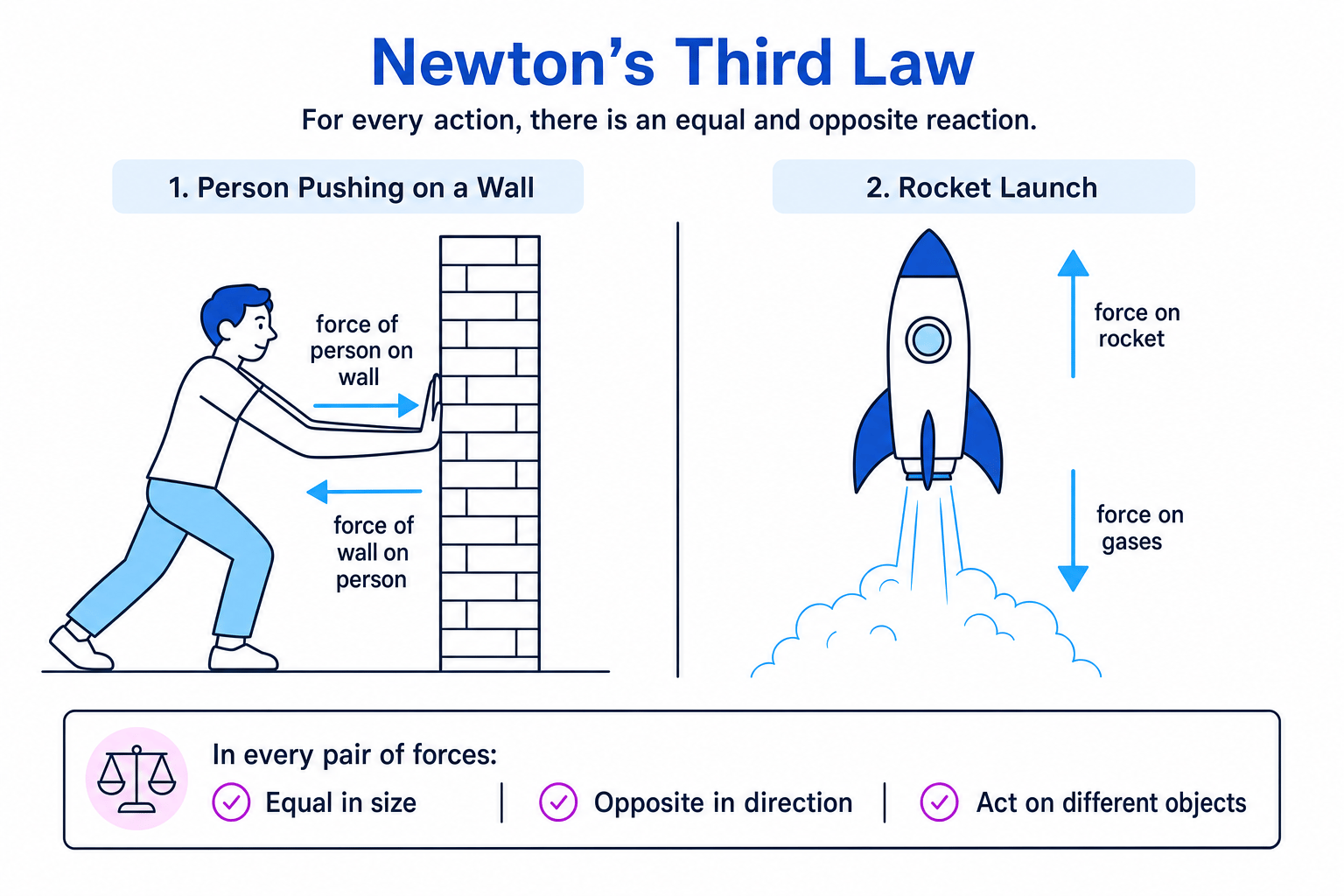
When two objects interact, they exert equal and opposite forces on each other. These forces act on different objects.
This applies whether the objects are in equilibrium or accelerating. The pair of forces does not cancel because the forces are not acting on the same object.
Example
Identifying a third-law force pair
A swimmer pushes water backwards and moves forwards.
- Identify one force: the swimmer pushes the water backwards.
- The paired force is the water pushing the swimmer forwards.
- The forces are equal and opposite, but they act on different objects, so the swimmer can still accelerate forwards.
Constant speed in a circle
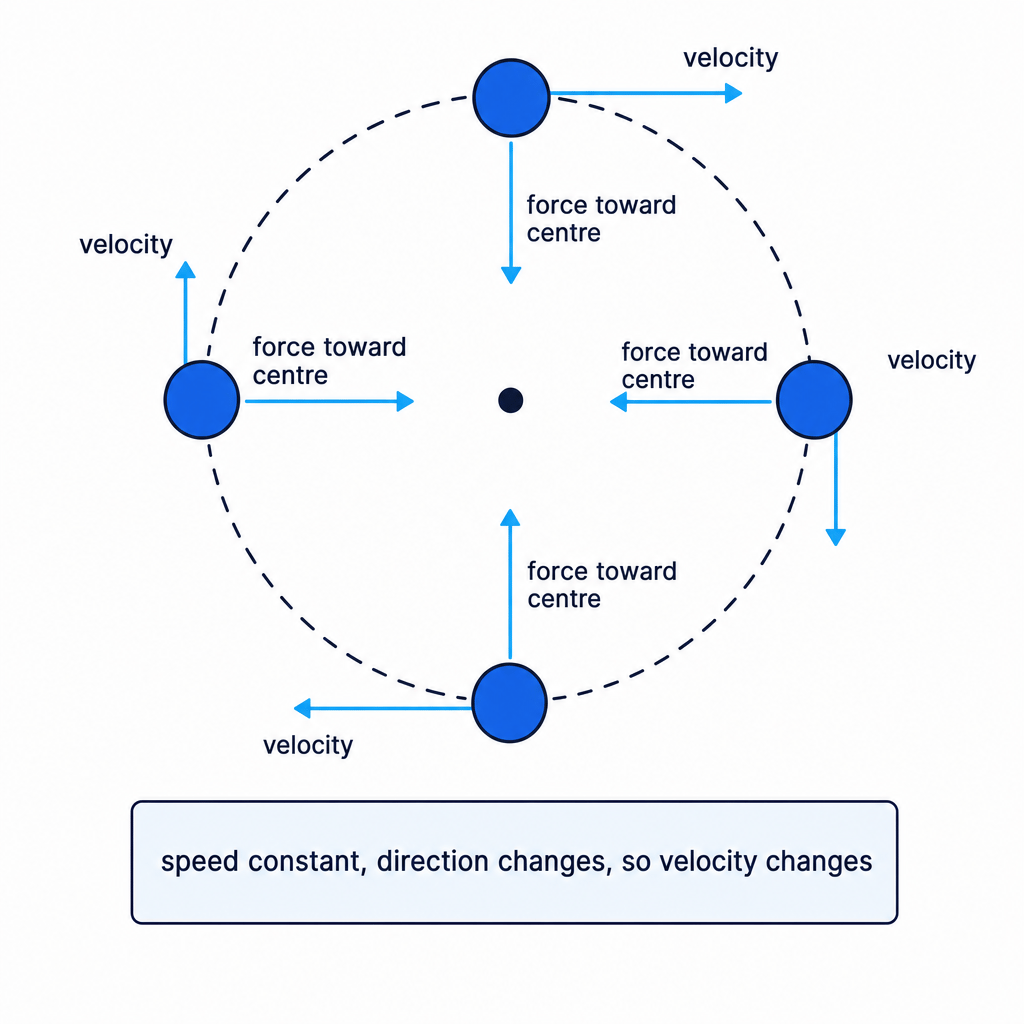
Velocity is a vector, so direction matters. An object moving in a circle may have constant speed, but its direction keeps changing. Therefore its velocity is changing.
By Newton’s first law, a changing velocity needs a non-zero resultant force. For circular motion, this resultant force acts towards the centre of the circle.
Tip
Speed vs velocity
Constant speed does not always mean constant velocity. If direction changes, velocity changes.
Exam technique
In the exam
- Draw a free-body diagram before calculating: include only forces acting on the object named in the question.
- For F=maF = maF=ma, use the resultant force, not just any force mentioned.
- State both size and direction for vector answers, especially resultant force, velocity and momentum.
Self review
Check yourself
- A cyclist moves at constant velocity. What must be true about the resultant force?
- Why do Newton’s third-law force pairs not cancel each other?
- A force of 80 N moves an object 2.5 m in the same direction. What work is done?

Recap questions
Test yourself with 5 quick questions on this guide. Answer them all correctly to complete it.
Forces
Guide 2 of 3
You've reached the end
Test yourself on this topic, or move on to the next guide.
How was this guide?