Revision notes for OCR GCSE Physics Forces in action. Open the guide for explanations and worked examples. Written against the OCR GCSE Physics (J249) specification, so the content matches what's examinable rather than general Physics background.
Forces in action
When forces act on an object, they don't just change its motion—they can also change its shape. In this topic, we will explore how materials behave when stretched, the invisible pulling power of gravity, and how forces can be multiplied using levers, gears, and fluids.
What you'll learn
- How forces deform materials, and the difference between elastic and plastic behaviour.
- How to use Hooke's Law and calculate the work done when stretching a spring.
- The difference between mass and weight, and how to calculate gravitational potential energy.
- Separate Physics Only: How to calculate the turning effect of a force (moments) and understand how gears and levers transmit rotational forces.
- Separate Physics Only: How pressure acts in fluids and how hydraulic systems multiply forces.
1. Deforming Materials
To change the shape of an object, you cannot just apply a single force. If you push a free-floating spring with only one force, it will simply accelerate away from you.
Key Idea
Forces in pairs
To stretch, bend, or compress an object, you must apply at least two forces in opposite directions.
Elastic vs Plastic Deformation
When you apply forces to stretch or compress an object, the material will undergo one of two types of deformation (distortion):
- Elastic deformation: The object will return to its original shape and length once the forces are removed. A rubber band or a metal spring (under normal loads) behaves elastically.
- Plastic deformation: The object remains permanently deformed and will not return to its original shape even after the forces are removed. If you pull a metal paperclip open, it undergoes plastic deformation.
2. Hooke's Law and Spring Constants
For many materials, especially metal springs, there is a simple relationship between the force applied and how much the spring stretches.
Definition
Extension
Extension (xxx) is the change in length of an object when a stretching force is applied. It is calculated as:
Extension=Stretched length−Original length \text{Extension} = \text{Stretched length} - \text{Original length} Extension=Stretched length−Original lengthThe standard unit of extension is the metre (m).
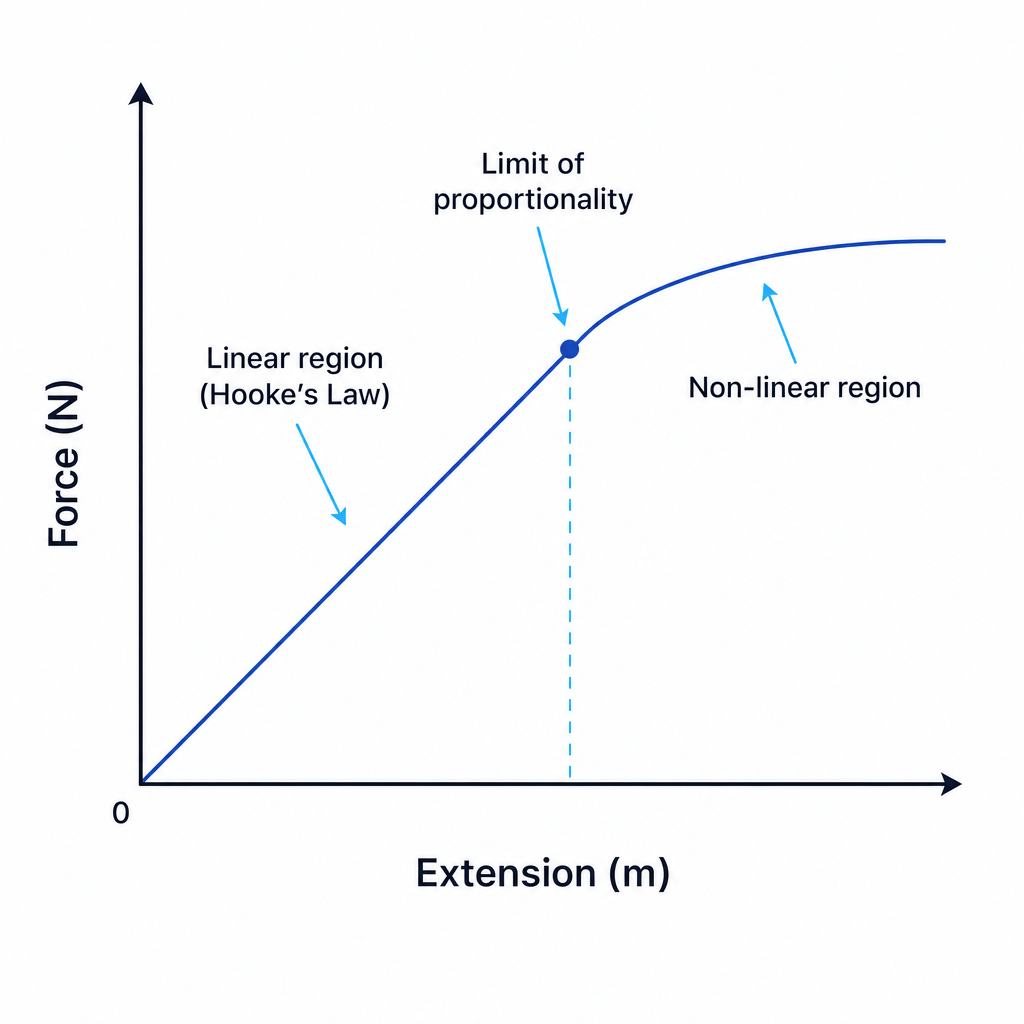
For a spring, the extension is directly proportional to the force applied, provided it has not been stretched past its limit of proportionality. This relationship is known as Hooke's Law.
Key Idea
Hooke's Law Equation
Force exerted by a spring (N)=spring constant (N/m)×extension (m)
\text{Force exerted by a spring (N)} = \text{spring constant (N/m)} \times \text{extension (m)}
Force exerted by a spring (N)=spring constant (N/m)×extension (m)
F=kx
F = kx
F=kx
You must recall and apply this equation in your exam.
The spring constant (kkk) is a measure of the stiffness of the spring. A high spring constant means the spring is very stiff and requires a large force to stretch it.
Linear vs Non-Linear Relationships
If you plot a graph of force against extension for a spring:
- Linear region: The graph starts as a straight line passing through the origin. This shows a linear relationship where force and extension are directly proportional (F∝xF \propto xF∝x). The gradient of this straight line is equal to the spring constant, kkk.
- Limit of proportionality: This is the point beyond which the line begins to curve.
- Non-linear region: Beyond this limit, the relationship becomes non-linear (the graph is curved). The spring is no longer obeying Hooke's Law, and it will likely undergo plastic deformation, meaning it won't return to its original shape.
Common Mistake
Confusing Length and Extension
In calculation questions, exam papers often give you the "original length" and the "new length" of a spring. Do not plug the new length directly into the formula! You must subtract the original length from the new length first to find the extension (xxx).
Example
Calculating the spring constant
A spring has an unstretched length of 12 cm. When a force of 6.0 N is hung from it, its length increases to 15 cm. Calculate the spring constant of the spring.
- Calculate the extension in centimetres:
- Convert the extension to the standard SI unit (metres):
- Rearrange Hooke's Law (F=kxF = kxF=kx) to solve for the spring constant (kkk):
- Substitute the values and calculate:
3. Work Done in Stretching
When you stretch a spring, you do work on it. This work transfers energy to the spring's elastic potential energy store.
As long as the spring has not gone past its limit of proportionality (meaning it is still in its linear region), you can calculate the energy stored using this formula:
Key Idea
Energy Transferred in Stretching
Energy transferred (J)=12×spring constant (N/m)×(extension (m))2
\text{Energy transferred (J)} = \frac{1}{2} \times \text{spring constant (N/m)} \times (\text{extension (m)})^2
Energy transferred (J)=21×spring constant (N/m)×(extension (m))2
E=12kx2
E = \frac{1}{2}kx^2
E=21kx2
This formula is provided on the equation sheet, but you must know how to apply it.
Common Mistake
Squaring the Extension
A very common mathematical error is forgetting to square the extension (x2x^2x2) or squaring the entire term. Remember that only xxx is squared!
Example
Calculating elastic energy stored
A suspension spring in a car has a spring constant of 40,000 N/m. How much energy is stored in the spring when it is compressed by 5.0 cm?
- Convert the compression (extension) to metres:
- State the formula for energy stored:
- Substitute the values into the equation:
- Perform the calculation:
4. Gravity, Mass, and Weight
Gravity is a non-contact force that acts over a distance.
- All matter has a gravitational field that attracts other matter.
- The strength of this field depends on the mass of the object: massive objects like planets and stars have incredibly strong gravitational fields, whereas your own gravitational field is far too weak to notice.
- Gravitational field strength (ggg) is measured in newtons per kilogram (N/kg). At the Earth's surface, g≈10 N/kgg \approx 10\text{ N/kg}g≈10 N/kg.
Mass vs Weight
It is vital to distinguish between these two terms:
Definition
Mass
Mass is the quantity of matter in an object. It is measured in kilograms (kg) and does not change depending on where the object is in the universe.
Definition
Weight
Weight is the gravitational force acting on an object's mass. It is a force, so it is measured in newtons (N). Weight changes depending on the local gravitational field strength (ggg).
You measure mass with a mass balance, and weight with a calibrated spring balance (also known as a newtonmeter).
Key Idea
Calculating Weight
Weight (N)=mass (kg)×gravitational field strength (N/kg)
\text{Weight (N)} = \text{mass (kg)} \times \text{gravitational field strength (N/kg)}
Weight (N)=mass (kg)×gravitational field strength (N/kg)
W=mg
W = mg
W=mg
You must recall and apply this equation.
Free Fall Acceleration
If an object is falling freely under gravity near the Earth's surface (ignoring air resistance), it accelerates at a constant rate of 10 m/s210\text{ m/s}^210 m/s2. This value is numerically identical to the gravitational field strength (g=10 N/kgg = 10\text{ N/kg}g=10 N/kg).
Gravitational Potential Energy (EpE_pEp)
When an object is lifted vertically in a gravitational field, work is done to overcome the gravitational pull. This transfers energy to the object's gravitational potential energy store:
Key Idea
Gravitational Potential Energy Equation
Gravitational Potential Energy (J)=mass (kg)×gravitational field strength (N/kg)×height (m)
\text{Gravitational Potential Energy (J)} = \text{mass (kg)} \times \text{gravitational field strength (N/kg)} \times \text{height (m)}
Gravitational Potential Energy (J)=mass (kg)×gravitational field strength (N/kg)×height (m)
Ep=mgh
E_p = mgh
Ep=mgh
You must recall and apply this equation.
Example
Weight and GPE on another planet
An astronaut has a total mass of 80 kg. On Mars, the gravitational field strength is 3.7 N/kg. Calculate: a) The astronaut's weight on Mars. b) The gravitational potential energy gained if the astronaut climbs a ladder of height 4.0 m on Mars.
- Calculate Weight using W=mgW = mgW=mg:
- State the formula for Gravitational Potential Energy (EpE_pEp):
- Substitute Mars' values to calculate the energy gained:
5. Rotational Forces (Separate Physics Only ☑)
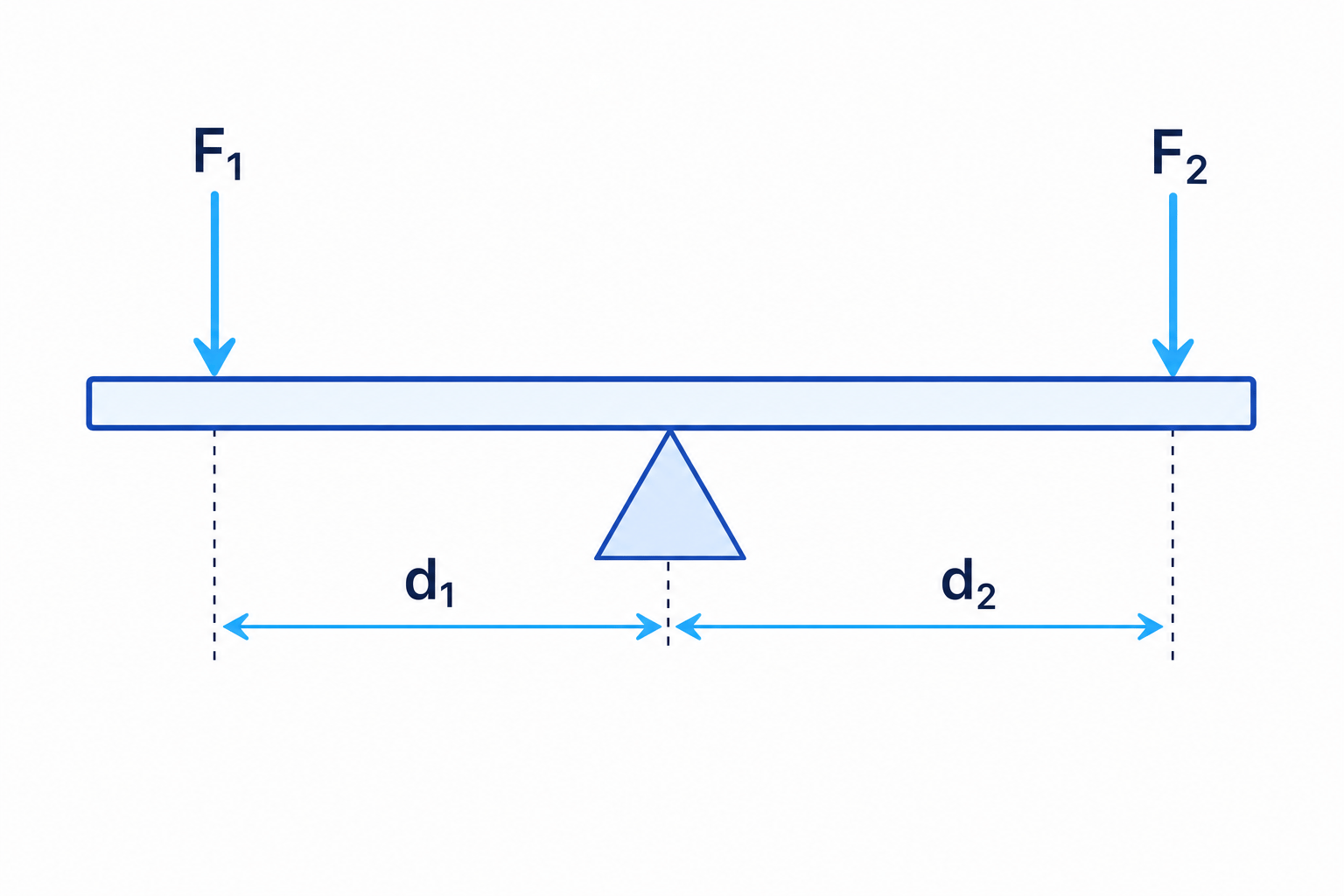
Forces can cause objects to rotate. A turning effect of a force is called a moment.
Definition
Moment of a force
A moment is the turning effect of a force about a pivot. It is measured in newton metres (N m).
Moment (N m)=force (N)×distance (m) \text{Moment (N m)} = \text{force (N)} \times \text{distance (m)} Moment (N m)=force (N)×distance (m) M=Fd M = Fd M=FdWhere ddd is the perpendicular distance from the pivot to the line of action of the force.
The Principle of Moments
When an object is balanced and not rotating, it is in rotational equilibrium.
Key Idea
The Principle of Moments
For a balanced system, the sum of the clockwise moments about a pivot must equal the sum of the anticlockwise moments about that same pivot:
Total Clockwise Moments=Total Anticlockwise Moments \text{Total Clockwise Moments} = \text{Total Anticlockwise Moments} Total Clockwise Moments=Total Anticlockwise MomentsExample
Applying the Principle of Moments
A uniform 1-metre ruler is balanced at its centre (the 50 cm mark). A weight of 4.0 N is placed at the 20 cm mark. Where must a 6.0 N weight be placed to balance the ruler?
- Calculate the distance of the 4.0 N weight from the pivot:
This force will try to turn the ruler anticlockwise. 2. Calculate the anticlockwise moment:
Anticlockwise Moment=F1×d1=4.0 N×0.3 m=1.2 N m \begin{aligned} \text{Anticlockwise Moment} &= F_1 \times d_1 \\ &= 4.0\text{ N} \times 0.3\text{ m} = 1.2\text{ N m} \end{aligned} Anticlockwise Moment=F1×d1=4.0 N×0.3 m=1.2 N m- Set up the equation for equilibrium:
- Solve for the unknown distance (d2d_2d2):
- Determine the exact mark on the ruler: Since the 6.0 N weight must be 20 cm to the right of the central pivot (50 cm mark):
Levers and Gears
Both levers and gears transmit the rotational effects of forces, acting as force multipliers:
- Levers: A lever uses a pivot to increase the distance (ddd) from where the effort is applied to the pivot. Because M=FdM = FdM=Fd, a smaller input force applied further from the pivot creates a large moment, which translates into a much larger output force closer to the pivot.
- Gears: Gears are circular wheels with teeth. When two gears mesh together, turning one causes the other to turn in the opposite direction.
- If a small gear drives a larger gear, the turning force (moment) is multiplied because the radius of the larger gear is greater.
- The ratio of the teeth/radii determines how much the force is multiplied. However, the larger gear will turn more slowly than the smaller gear.
6. Pressure in Fluids (Separate Physics Only ☑)
A fluid is any substance that can flow—this includes both liquids and gases.
Key Idea
Fluid Pressure
The particles in a fluid collide with the walls of their container. These collisions create a net force. The pressure in fluids causes a force that acts at right angles (normal) to any surface it touches.
To calculate pressure on a surface:
Key Idea
Pressure Equation
Pressure (Pa)=force normal to a surface (N)area of that surface (m2)
\text{Pressure (Pa)} = \frac{\text{force normal to a surface (N)}}{\text{area of that surface (m}^2\text{)}}
Pressure (Pa)=area of that surface (m2)force normal to a surface (N)
P=FA
P = \frac{F}{A}
P=AF
You must recall and apply this equation. The unit of pressure is the pascal (Pa), where 1 Pa=1 N/m21\text{ Pa} = 1\text{ N/m}^21 Pa=1 N/m2.
Analogy
Snowshoes vs Stilettos
A person wearing snowshoes doesn't sink into the snow because their weight is spread over a very large area, resulting in low pressure. Conversely, someone wearing high-heeled stiletto shoes exerts a huge pressure because their weight is concentrated on a tiny surface area.
Hydraulic Systems
Because liquids are virtually incompressible, any pressure applied to a confined liquid is transmitted equally in all directions throughout the liquid. We use this principle in hydraulics to multiply forces.
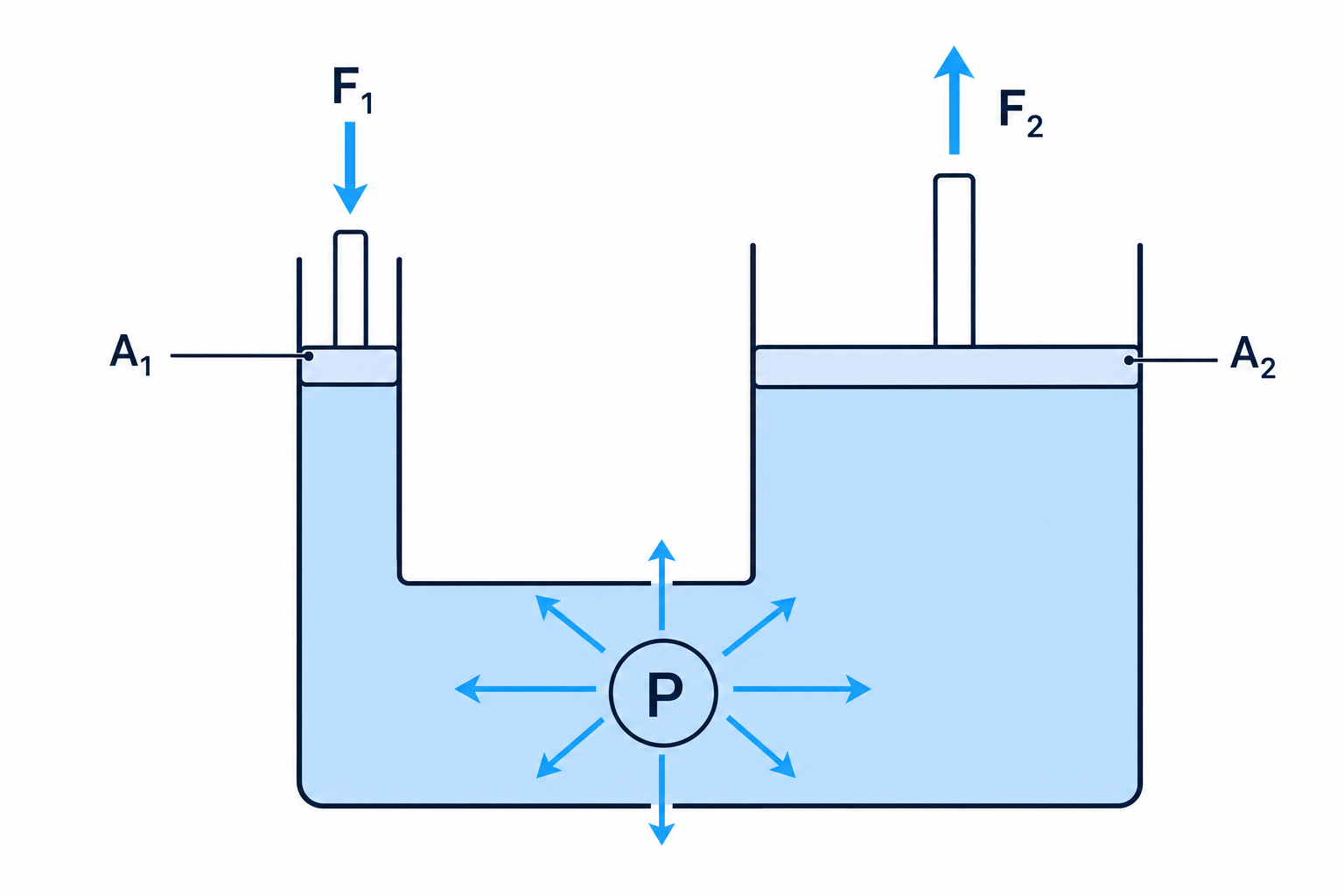
A hydraulic system consists of two pistons connected by a liquid-filled pipe.
- A small force (F1F_1F1) applied to a small master piston (A1A_1A1) creates pressure (PPP) in the liquid.
- This same pressure (PPP) is transmitted to a larger slave piston (A2A_2A2).
- Since F=P×AF = P \times AF=P×A, and the area A2A_2A2 is much larger, the output force (F2F_2F2) is multiplied!
Example
Calculating forces in a hydraulic jack
A hydraulic jack has an input piston of area 0.02 m20.02\text{ m}^20.02 m2 and an output piston of area 0.10 m20.10\text{ m}^20.10 m2. A force of 50 N is applied to the input piston. Calculate the output force.
- Calculate the pressure created at the input piston:
- State the hydraulic principle: The pressure is transmitted equally through the liquid, so the pressure at the output piston is also 2500 Pa2500\text{ Pa}2500 Pa.
- Calculate the output force (F2F_2F2):
The force has been multiplied by 5 times because the output piston area is 5 times larger!
Exam technique
In the exam
- Convert your units: Keep a sharp lookout for distances in centimetres (cm) or areas in cm2\text{cm}^2cm2. Always convert them to metres (m) and square metres (m2\text{m}^2m2) before performing calculations.
- Hooke's Law Limit: If an exam question asks why a spring did not return to its original length, write that it was "stretched beyond its limit of proportionality / elastic limit" and underwent "plastic deformation".
- Perpendicular Distances: When calculating moments, ensure you identify the distance that is strictly perpendicular (at 90 degrees) to the direction of the force. Do not use diagonal distances!
- Equally Transmitted Pressure: In hydraulic questions, remember that pressure remains constant throughout the fluid. Use the first piston to find the pressure, and then apply that identical pressure to the second piston.
Self review
Check yourself
- Why is it impossible to stretch a spring by applying only a single force?
- What physical quantity does the gradient of a linear Force-Extension graph represent?
- Explain the difference between mass and weight, including their standard units.
- (Separate Physics ☑) State the Principle of Moments.
- (Separate Physics ☑) How does a hydraulic system act as a force multiplier?

Recap questions
Test yourself with 5 quick questions on this guide. Answer them all correctly to complete it.
Forces
Guide 3 of 3
You've reached the end
Test yourself on this topic, or move on to the next guide.
How was this guide?