Gas molecules
Definition
Closed system
A system that no matter can enter or leave, so its total mass stays constant.
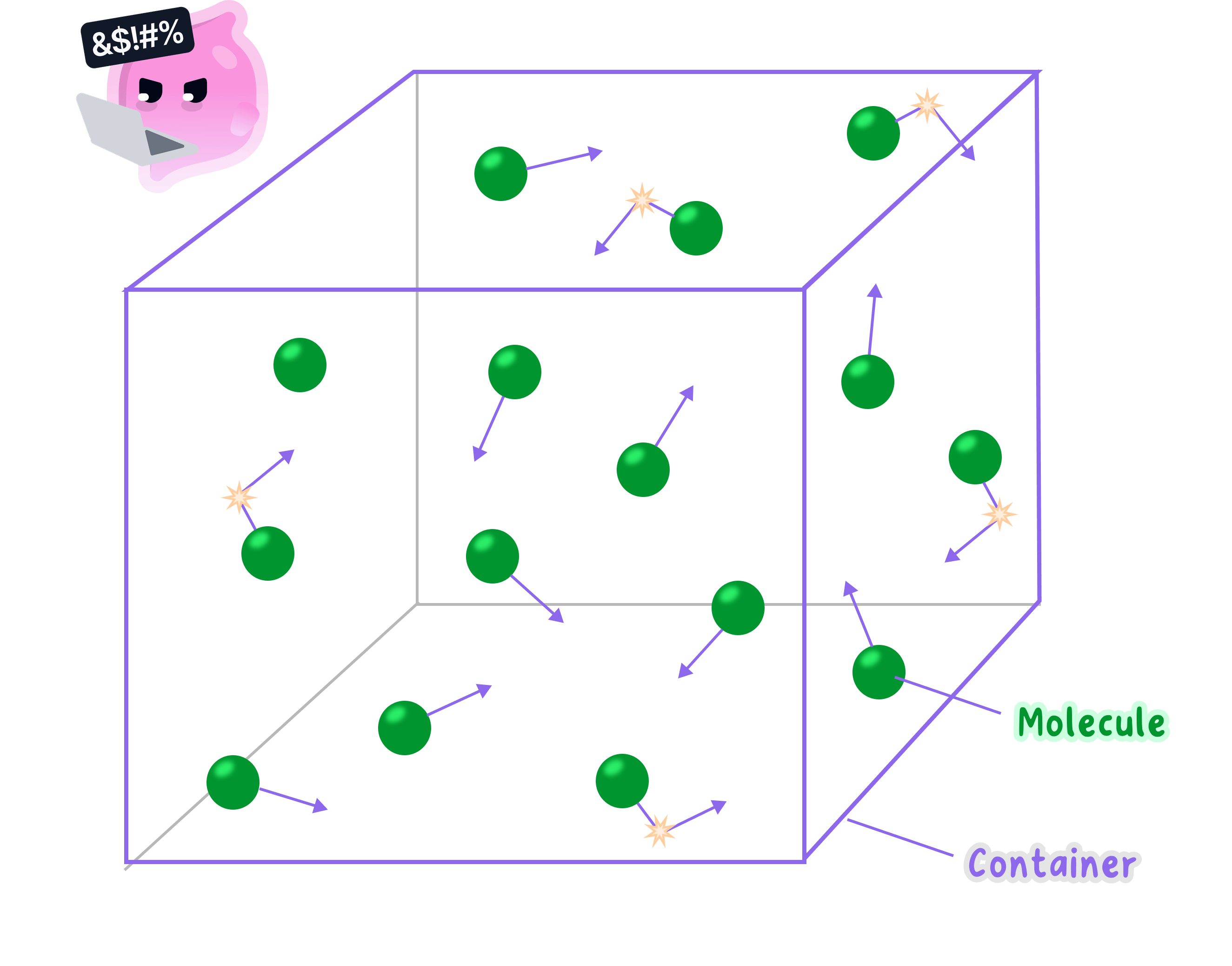
- A gas is made of tiny molecules that are very far apart compared with their own size.
- The molecules move randomly in all directions at high speed, travelling in straight lines between collisions.
- At room temperature a typical air molecule moves at about 500 m/s500\ \text{m/s}500 m/s, which is faster than a passenger jet.
- The molecules do not all move at the same speed, because collisions keep sharing energy between them, so a gas always contains a range of speeds.
- Each molecule changes direction every time it collides with another molecule or with a wall of its container.
- Because the molecules are moving, they store energy in their kinetic energy stores.
- In this topic a gas is treated as a closed system, so no molecules enter or leave its container.
- With the number of molecules fixed, any change in the gas has to come from a change in how the existing molecules move.
Motion and temperature
Definition
Temperature
A measure of how hot or cold an object is, which depends on the average kinetic energy of its particles.
- The temperature of a gas is linked to the average kinetic energy of its molecules.
- The faster the molecules move on average, the greater their average kinetic energy and the higher the temperature of the gas.
- Heating a gas transfers energy to the kinetic energy stores of its molecules, so they speed up and the temperature rises.
- Cooling a gas transfers energy away from its molecules, so they slow down and the temperature falls.
- Temperature describes the average motion, so at any instant some molecules are moving faster than average and some are moving slower.
- Temperature is measured in degrees Celsius, ∘C^\circ\text{C}∘C, using a thermometer.
Motion and pressure
Definition
Pressure
The force acting at right angles to a surface on each unit area of that surface.
Definition
Gas pressure
The force per unit area that gas molecules exert on the walls of their container when they collide with them.
Definition
Pascal
The unit of pressure, equal to a force of one newton acting at right angles on an area of one square metre.
- When a molecule hits a wall it bounces off in a new direction, and at the same moment it pushes on the wall, so every collision exerts a tiny force on the wall.
- One collision is far too small to notice, but billions of collisions every second add up to a steady force on every part of the wall.
- Pressure is the force acting at right angles on each unit area of a surface.
- Gas pressure is therefore the total force from the collisions on a wall divided by the area of that wall.
- Pressure is measured in pascals, Pa\text{Pa}Pa, where 1 Pa=1 N/m21\ \text{Pa} = 1\ \text{N/m}^21 Pa=1 N/m2.
- The molecules move randomly in every direction, so they strike all the walls of a container equally often and the gas pushes with the same pressure on every wall.
- The size of the pressure depends on two features of the collisions:
- how often the molecules hit each square metre of wall every second;
- how hard each molecule hits the wall.
- Faster molecules cross the container in less time, so they reach the walls more often.
- Faster molecules also hit the walls harder, so each collision exerts a larger force.
- The speed of the molecules is therefore the link between the two quantities: it sets the temperature of the gas and it controls the pressure the gas exerts.
- Slower molecules hit the walls less often and less hard, so a gas whose molecules slow down exerts a lower pressure on any wall that cannot move away from it.
Practical
Heating and cooling trapped air
- Aim: to show how heating and cooling a fixed amount of trapped air changes the motion of its molecules and the pressure they exert, first with balloons and then with a manometer.
- Apparatus: two identical balloons, a piece of string and a ruler, a freezer, a warm radiator or a bowl of water at about 50 ∘C50\ ^\circ\text{C}50 ∘C, a conical flask with a one-holed bung and glass tube, rubber tubing, a glass U-tube clamped in front of a metre rule, coloured water, two large troughs, a kettle, ice, petroleum jelly and eye protection.
- Method, the balloons:
- Inflate both balloons to the same size, tie them, and measure the circumference of each around its widest part using the string and ruler.
- Put one balloon in a freezer for about 202020 minutes and hold the other close to a warm radiator, or float it in the warm water, for the same time.
- Take each balloon out and measure its circumference again straight away.
- Squeeze each balloon gently and compare how firm it feels.
- Leave both balloons at room temperature for another 202020 minutes and measure them again to check that the changes reverse.
- Method, the manometer:
- Pour coloured water into the U-tube until both arms are about half full and the two levels are equal.
- Smear the bung with petroleum jelly, push it firmly into the flask, and connect the glass tube to one arm of the U-tube with the rubber tubing, leaving the other arm open to the air.
- Check that the two levels are still equal, which shows that the trapped air starts at the same pressure as the air in the room.
- Fill one trough with hot water from the kettle and hold the flask in it so that the whole flask is under the surface.
- Record the difference in height between the two liquid levels with the metre rule every 303030 seconds until it stops changing.
- Move the flask into a trough of ice and water and record the level difference again as the trapped air cools.
- Results: the frozen balloon shrinks and feels softer, while the warmed balloon grows slightly and feels firmer.
- Results: when the flask is heated, the liquid is pushed down in the arm joined to the flask and rises in the open arm, and when the flask is cooled the liquid moves the opposite way.
- Explanation: heating gives the air molecules more kinetic energy, so they move faster and hit the rubber or the liquid surface more often and harder, which raises the pressure.
- Explanation: cooling slows the molecules down, so they hit less often and less hard, and the pressure falls.
- Reading the manometer: a bigger difference between the two levels means a bigger difference between the pressure of the trapped air and the pressure of the room.
- Watch out: a leaking bung lets air escape, so the gas is no longer a closed system and the level difference is smaller than it should be.
- Watch out: read each level at eye level from the bottom of the curved meniscus, so that every reading is taken in the same way.
- Safety: wear eye protection, use heatproof gloves near the hot water, and never heat the sealed flask directly over a Bunsen burner, because the pressure inside could force out the bung or crack the glass.
Common Mistake
- Do not say that the molecules get bigger when a gas is heated, because the molecules stay the same size and only their speed changes.
- Do not say that heating produces more molecules, because in a closed system the number of molecules never changes.
- Do not write "more collisions" on its own; say the molecules collide with the walls more often, because the change is in the number of collisions each second.
- Do not say gas molecules vibrate, because they move freely through the whole container.
Exam technique
Explaining gas pressure
- Write the explanation as a chain: the molecules move, they collide with the walls, each collision exerts a force, and the force on each unit area is the pressure.
- When the molecules speed up, mention both effects on the collisions, saying the molecules hit the walls more often and with more force, because each effect usually carries its own mark.
- Say the molecules gain kinetic energy rather than writing "heat energy", which earns no credit.
- Use either "molecules" or "particles" and stick with it, rather than switching to "atoms".
Self review
- Describe how the molecules in a gas move.
- State what the temperature of a gas tells you about its molecules.
- Explain how molecules colliding with a wall produce gas pressure.
- Name the two features of the collisions that decide the size of the gas pressure.
- State the unit of pressure and what it is equal to in newtons and square metres.
