A fixed volume of gas
Definition
Gas pressure
The force per unit area that gas molecules exert on the walls of their container when they collide with them.
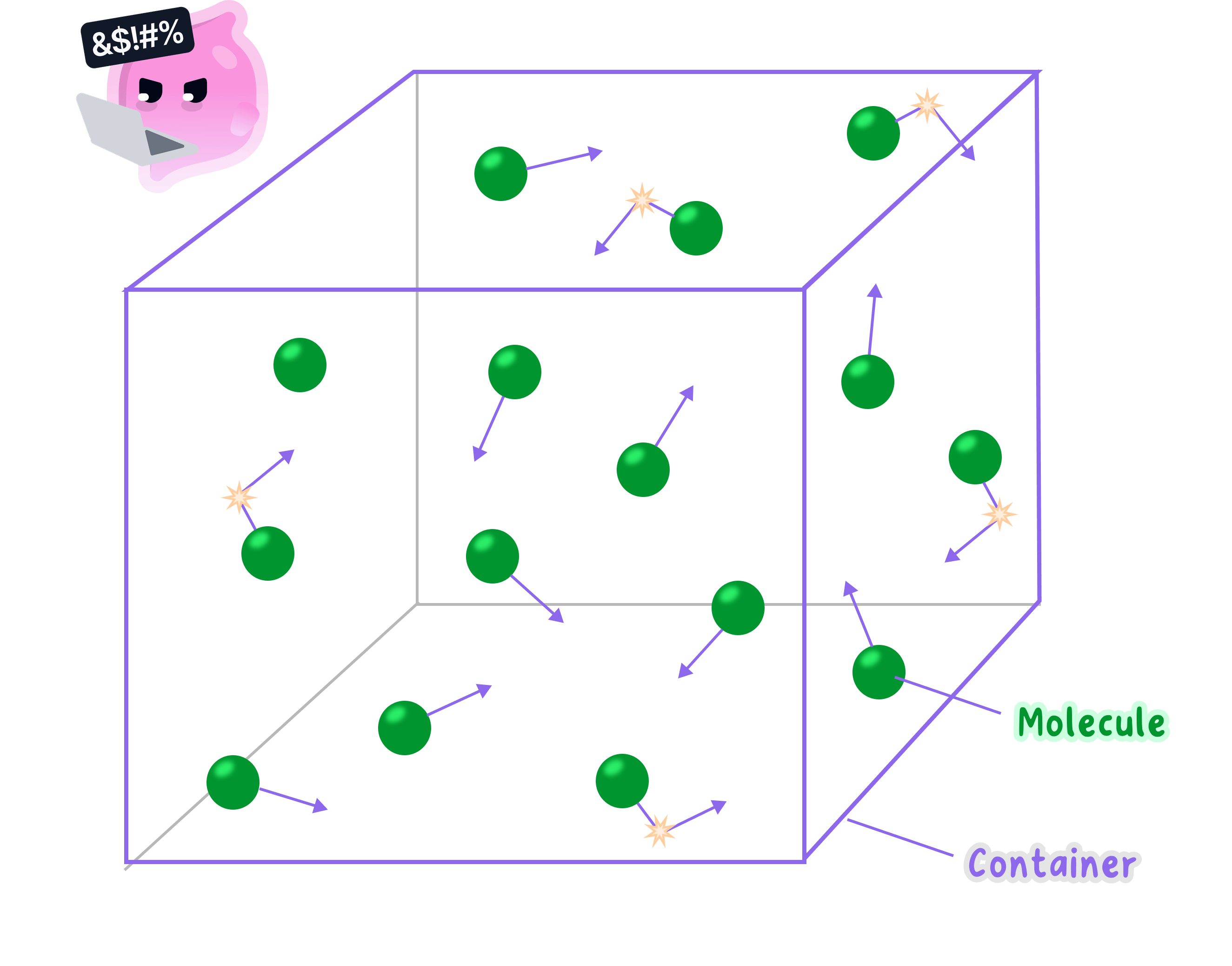
- A gas has a constant volume when it is sealed inside a rigid container whose walls cannot move, such as a steel gas cylinder, a sealed metal can or a stoppered glass flask.
- Because the container is sealed, the number of molecules inside stays the same as well.
- With the volume and the number of molecules both fixed, the only way the pressure can change is through a change in the speed of the molecules.
- The speed of the molecules is set by the temperature, so at constant volume the pressure of a gas depends on its temperature.
Raising the temperature
Definition
Temperature
A measure of how hot or cold an object is, which depends on the average kinetic energy of its particles.
- Heating the container transfers energy to the gas and increases the kinetic energy of its molecules.
- The molecules move faster on average, which is what a rise in temperature means.
- Faster molecules cross the container in less time, so each one hits the walls more often.
- Faster molecules also hit the walls harder, so each collision exerts a greater force.
- More frequent collisions and a greater force per collision together increase the total force on each square metre of wall.
- The pressure of the gas therefore increases, even though its volume and the number of molecules have not changed.
- You only need to explain this relationship in words, so no calculation is needed for a change of temperature at constant volume.
Lowering the temperature
- Cooling the container transfers energy away from the gas, so its molecules move more slowly on average.
- Slower molecules hit the walls less often and less hard.
- The total force on each square metre of wall falls, so the pressure decreases.
- Warming the gas back to its starting temperature returns the pressure to its starting value, because nothing has left the sealed container.
- The pattern holds in both directions: at constant volume, a higher temperature gives a higher pressure and a lower temperature gives a lower pressure.
Constant volume in everyday life
- A car tyre holds a fixed amount of air in a casing that barely stretches, so its pressure rises during a long motorway drive as the tyre warms up.
- This is why drivers are told to check tyre pressures when the tyres are cold, because a reading taken straight after a journey is higher than normal.
- Aerosol cans warn you not to leave them in temperatures above 50 ∘C50\ ^\circ\text{C}50 ∘C, because heating the sealed can raises the pressure inside and could make it burst.
- A gas cylinder for a barbecue is stored in the shade for the same reason.
- A plastic bottle sealed on a warm day and then put in a fridge is squashed slightly, because the pressure of the cooled air inside falls below the pressure of the air outside.
Example
Heating a sealed can
- A sealed metal can of air at 20 ∘C20\ ^\circ\text{C}20 ∘C is left on a hot radiator and warms to 60 ∘C60\ ^\circ\text{C}60 ∘C.
- The can is rigid and sealed, so the volume of the air and the number of molecules stay the same.
- Energy is transferred from the radiator to the air, so the air molecules gain kinetic energy and move faster.
- The faster molecules strike the inside of the can more often and with a greater force.
- The force on each square metre of the can increases, so the pressure of the air inside rises.
- If the heating continued, the pressure could keep rising until the can bulged or split along its weakest seam.
Common Mistake
- Do not say the molecules expand when the gas is heated, because the molecules stay the same size and the volume of the container is fixed.
- Do not say the pressure rises because there are more molecules, because the container is sealed and the number of molecules has not changed.
- Do not explain the rise only by "more collisions"; say the collisions happen more often, and add that each one exerts a greater force.
- Do not use this explanation for a balloon or a syringe, because their volume can change and the gas can expand instead.
Exam technique
Writing the full chain
- A typical three-mark explanation rewards three linked points: the molecules move faster, they collide with the walls more often or harder, and so the pressure increases.
- State that the volume stays the same, because that is why the faster molecules cannot simply spread out.
- If the question mentions energy, say the molecules gain kinetic energy rather than "heat".
- For a cooling question, write the same chain in reverse instead of saying "the opposite happens".
Self review
- State what is meant by a gas at constant volume.
- Explain why the pressure of a gas in a sealed rigid container rises when it is heated.
- Describe what happens to the pressure of the gas when the container is cooled.
- Explain why drivers should check tyre pressures before a journey rather than straight after one.
