Revision notes for OCR GCSE Physics Static and charge. Open the guide for explanations and worked examples. Written against the OCR GCSE Physics (J249) specification, so the content matches what's examinable rather than general Physics background.
Static and charge
What you'll learn
- What electric charge is, including positive, negative and neutral objects.
- How rubbing can produce static electricity by transferring electrons.
- Why charged objects can attract or repel without touching.
- How current links to charge flow using Q=ItQ = I tQ=It.
The starting point: atoms and charge
Everything around you is made from atoms. An atom contains:
- protons, which have positive charge
- electrons, which have negative charge
- neutrons, which have no charge
In most solids, the protons are fixed inside the atoms. Electrons, especially the outer electrons, are the charges that can sometimes move or be transferred.
Definition
Electric charge
Electric charge is a property of matter that can cause objects to exert forces on each other. There are two types of charge: positive and negative. Charge is measured in coulombs, C.
An object is neutral if its positive and negative charges balance overall. Neutral does not mean “no charges at all” — it means equal amounts of positive and negative charge.
Key Idea
Neutral objects still contain charge
A neutral object contains positive and negative charges, but they cancel out overall.
Attraction and repulsion
Charged objects can exert electrostatic forces on each other. These are non-contact forces, meaning the objects do not need to touch.
The simple rules are:
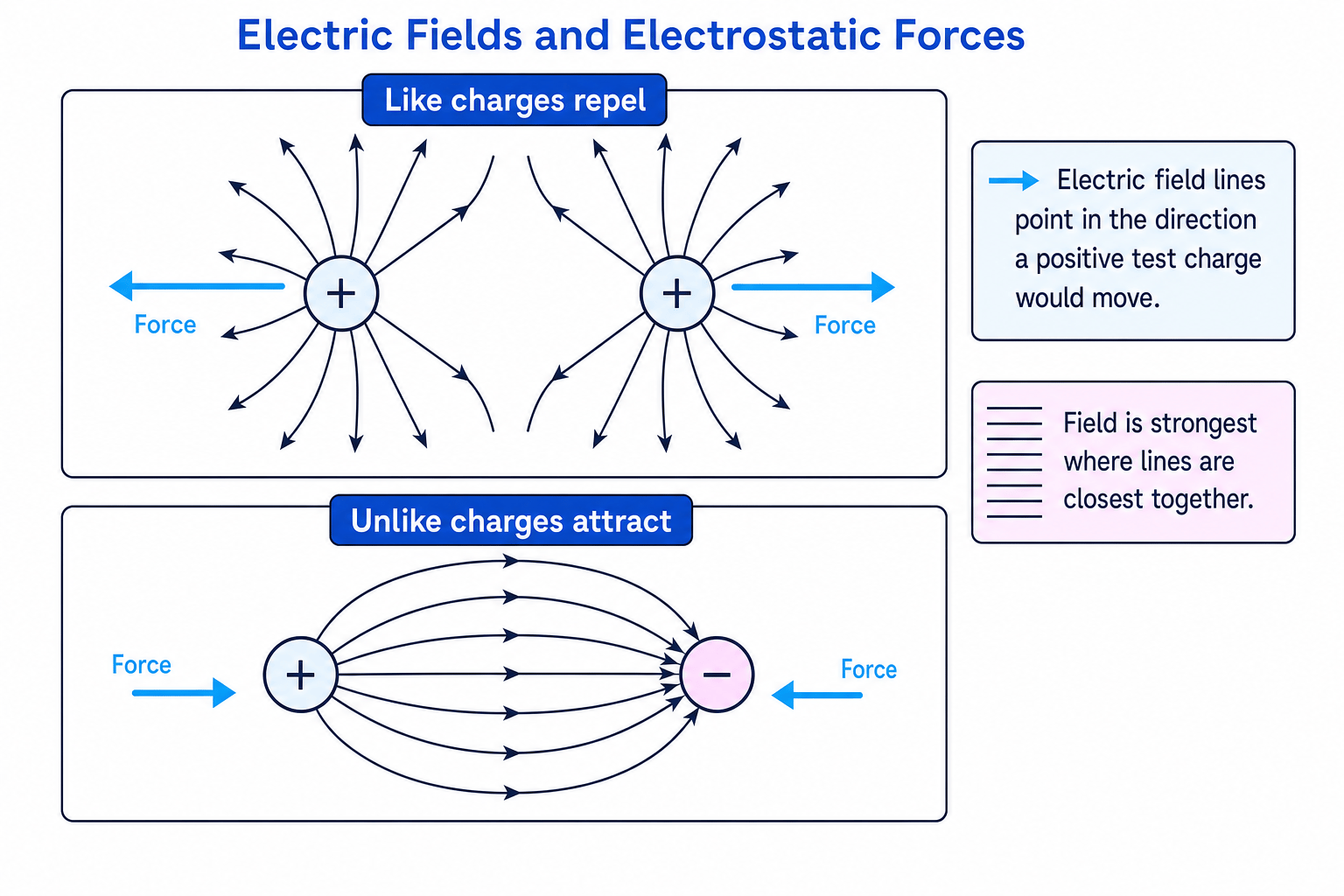
- like charges repel: positive repels positive, negative repels negative
- unlike charges attract: positive attracts negative
This can be shown using charged rods, charged balloons, small bits of paper, or a thin stream of water.
Common Mistake
Positive charge does not usually move in solids
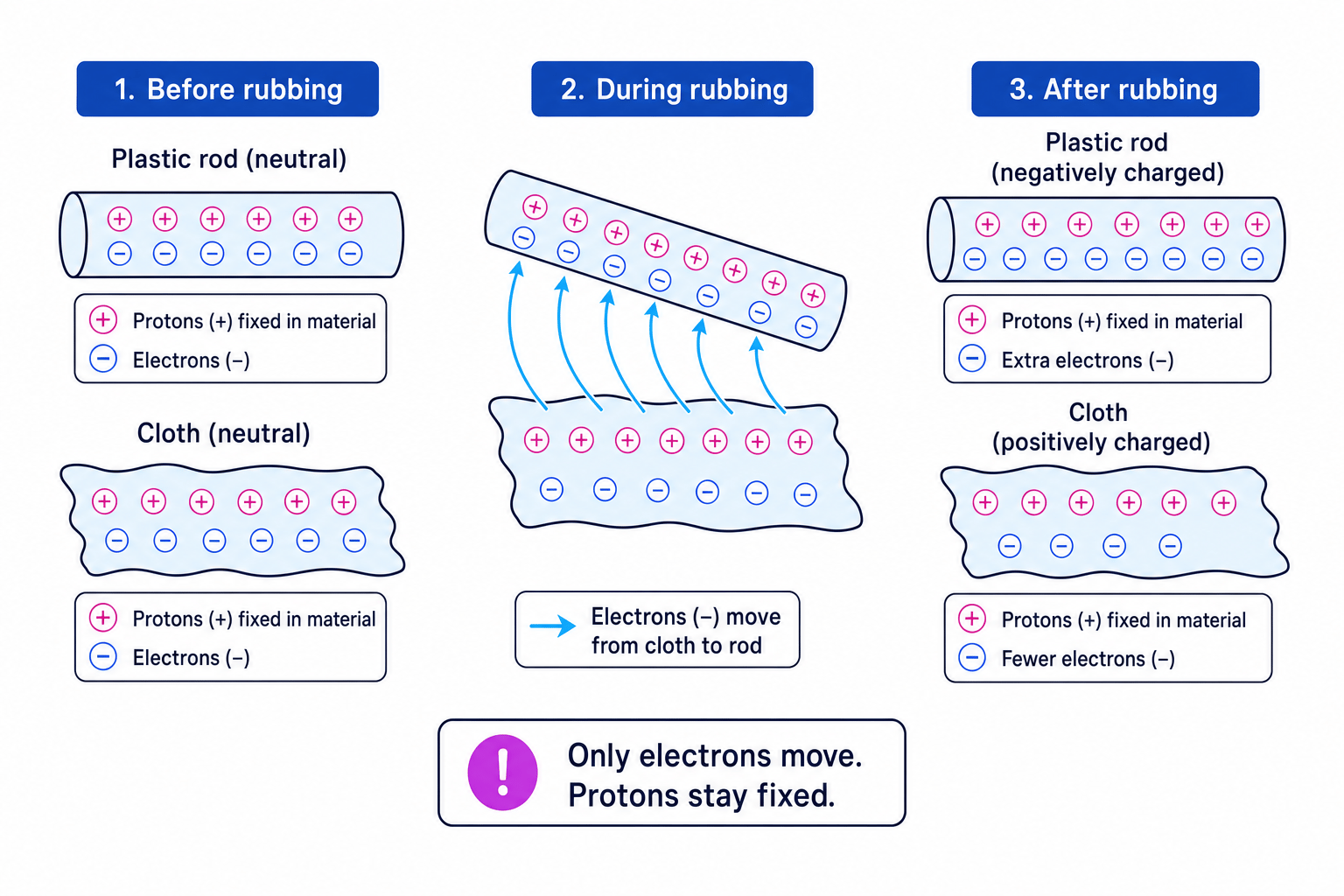
If an object becomes positively charged, it has usually lost electrons. It has not gained extra protons. In this topic, remember: electrons move; protons stay fixed.
Conductors and insulators
A conductor is a material that allows charge to move through it easily. Metals are good electrical conductors because electrons can move through them.
An insulator is a material that does not allow charge to move through it easily. Plastic, rubber, glass and dry cloth are common insulators.
Static electricity builds up more easily on insulators because any transferred charge cannot quickly flow away.
Tip
Classifying materials
Metals are usually conductors. Plastic, rubber, glass and dry fabrics are usually insulators. A metal object can still become charged if it is insulated from the ground, so the charge cannot escape.
Static electricity from rubbing
Static electricity is a build-up of electric charge on an object. It often happens when two insulating materials are rubbed together.
Rubbing does not “make” charge from nothing. Instead, electrons are transferred from one surface to the other.
Definition
Static electricity
Static electricity is the build-up of electric charge on an object, usually because electrons have been transferred and cannot easily flow away.
If an object gains electrons, it becomes negatively charged.
If an object loses electrons, it becomes positively charged.
Example
Explaining charge after rubbing
A neutral plastic rod is rubbed with a neutral cloth. Electrons move from the cloth to the rod. Explain the charges afterwards.
-
Before rubbing, both objects are neutral because their positive and negative charges balance overall.
-
During rubbing, electrons transfer from the cloth to the rod. The protons stay fixed in the materials.
-
The rod now has extra electrons, so it has more negative charge than positive charge. The rod is negatively charged.
-
The cloth has lost electrons, so it has more positive charge than negative charge. The cloth is positively charged.
Why charged objects can attract neutral objects
A charged object can sometimes attract a neutral object, such as a charged balloon sticking to a wall or a charged rod picking up small paper pieces.
The neutral object still contains charges. The charged object can cause the charges inside the neutral object to shift slightly. This makes the side nearer the charged object have the opposite charge overall, so attraction happens.
Example
Explaining paper attracted to a charged rod
A negatively charged rod is brought near small neutral pieces of paper. Explain why the paper is attracted.
-
The rod has extra electrons, so it is negatively charged.
-
Electrons in the paper are repelled slightly away from the rod, leaving the near side of the paper slightly positive.
-
The positive near side is attracted to the negative rod. This attraction is stronger than the repulsion from the negative charges farther away, so the paper moves towards the rod.
Sparking
A spark happens when charge suddenly jumps through the air between two objects.
Air is normally an insulator, but if the charge build-up is large enough, the electric force can make the air conduct briefly. Electrons then move across the gap very quickly, transferring energy as light, sound and heating. This is what you feel in a small static shock.
Common examples include:
- touching a metal door handle after walking on a carpet
- sparks from a Van de Graaff generator
- lightning, which is a much larger version of the same idea
Key Idea
Sparks are sudden charge flow
A spark is not charge being created. It is charge that has built up and then suddenly flows through the air.
Electric fields
This part is for separate Physics J249. It is not assessed in OCR Gateway Combined Science.
An electric field is a region around a charged object where another charged object experiences a force. Electric fields help explain how charged objects can affect each other without touching.
Definition
Electric field
An electric field is the region around a charged object where another charge experiences an electrostatic force.
We draw electric fields using field lines:
- field lines show the direction a positive test charge would move
- around a positive charge, field lines point away
- around a negative charge, field lines point towards it
- where field lines are closer together, the field is stronger
Example
Using electric field lines
At a point near a positive charge, the electric field line points to the right. Predict the force on a small positive charge and on a small negative charge placed there.
-
Field lines show the direction of the force on a positive test charge, so a small positive charge would be pushed to the right.
-
A negative charge experiences a force in the opposite direction to the field line, so a small negative charge would be pushed to the left.
-
If the field lines are close together at that point, the force would be stronger than in a region where the lines are spread out.
Common Mistake
Field lines are a model
Electric field lines are not real strings or paths in space. They are a diagram model to show direction and relative strength of the electric field.
From static charge to current
Static electricity is about charge building up. Electric current is about charge flowing.
Definition
Current
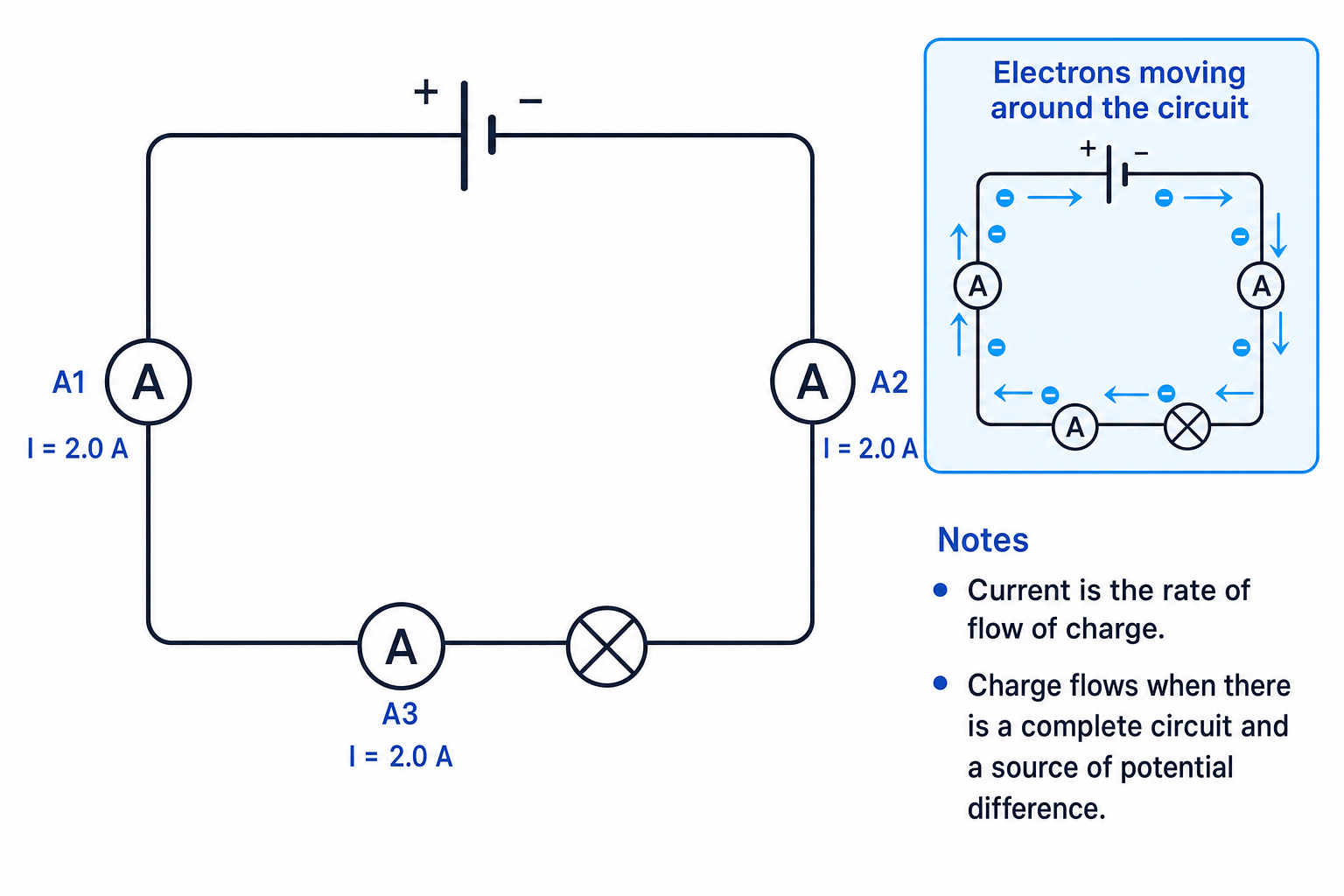
Current is the rate of flow of charge. In metal wires, the moving charges are electrons. Current is measured in amperes, A.
For charge to flow in a circuit, you need:
- a complete circuit, meaning an unbroken closed loop
- a source of potential difference, such as a cell or battery
- mobile charges, such as electrons in metal wires
If the circuit is broken, for example by an open switch, charge cannot keep flowing around the loop.
Current in one closed loop
In a single closed loop circuit, the current has the same value at every point in the loop. This is because charge is not used up as it goes around the circuit.
A lamp transfers energy from the moving charges to the surroundings, but it does not “use up” the current.
Key Idea
Current is the same in a single loop
In one complete loop, the current is the same at every point because the same rate of charge flow passes through each component.
Common Mistake
Current is not used up
Do not say the current is smaller after a lamp in a single loop. The lamp transfers energy, but the current is the same all the way around that loop.
Charge flow, current and time
You need to recall and use this equation:
Q=ItQ = I tQ=Itwhere:
- QQQ is charge flow in coulombs, C
- III is current in amperes, A
- ttt is time in seconds, s
This equation means that a bigger current moves more charge each second. One ampere means one coulomb of charge flowing each second:
1 A=1 C/s1\ \text{A} = 1\ \text{C/s}1 A=1 C/sExample
Calculating charge flow
A current of 0.50 A0.50\ \text{A}0.50 A flows through a lamp for 2 minutes. Calculate the charge flow.
-
Convert the time into seconds, because the equation uses seconds: 2 minutes = 120 s.
-
Choose the equation and substitute the values:
Q=It=0.50 A×120 sQ = I t = 0.50\ \text{A} \times 120\ \text{s}Q=It=0.50 A×120 s -
Calculate the charge flow:
Q=60 CQ = 60\ \text{C}Q=60 C
Tip
Equation check
If current is in amperes and time is in seconds, your answer for charge will be in coulombs. If the time is given in minutes, always convert to seconds first.
Exam technique
In the exam
-
For static electricity explanations, always say electrons transfer; do not say protons move through the material.
-
For attraction and repulsion, identify the charges first, then apply: like repel, unlike attract.
-
For Q=ItQ = I tQ=It calculations, check the units carefully and convert time to seconds before substituting.
Self review
Check yourself
- If a neutral cloth loses electrons while rubbing a rod, what charge does the cloth end up with?
- Why can a charged balloon stick to a neutral wall?
- A current flows for a longer time at the same value. What happens to the total charge flow?

Recap questions
Test yourself with 5 quick questions on this guide. Answer them all correctly to complete it.
Electricity
Guide 1 of 2
You've reached the end
Test yourself on this topic, or move on to the next guide.
How was this guide?