Definition
Fleming's left-hand rule
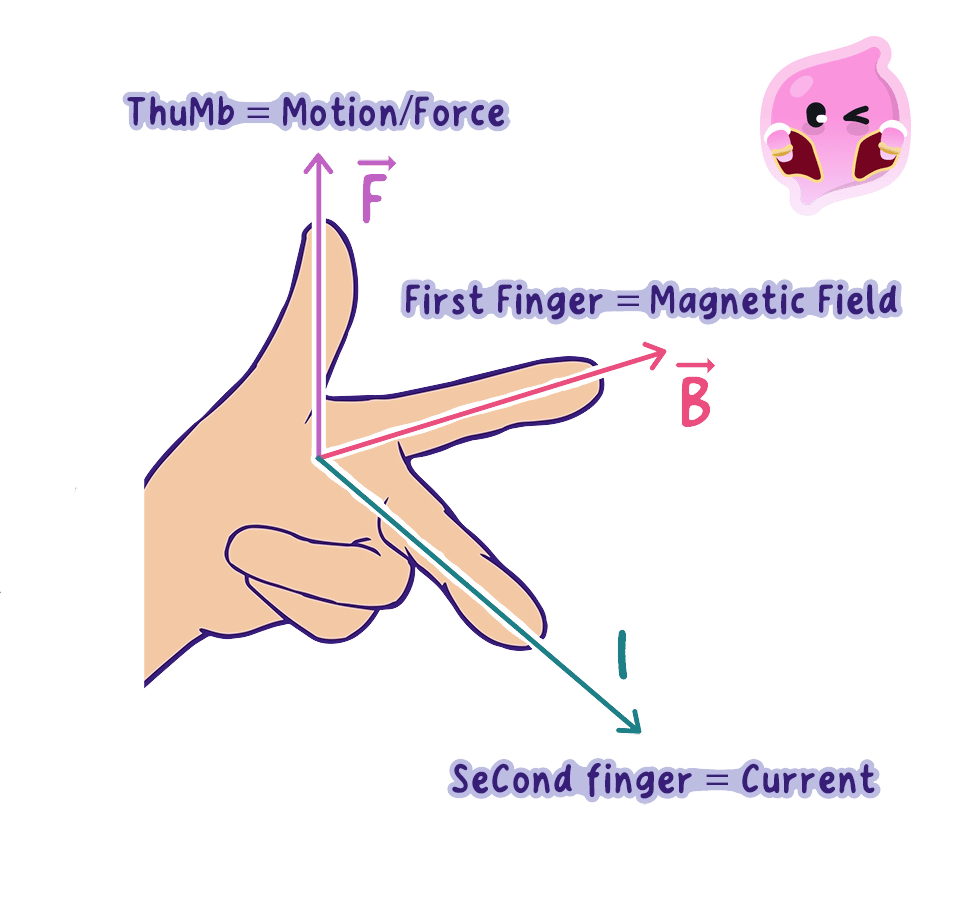
A rule in which the thumb, first finger and second finger of the left hand, held at right angles to each other, show the directions of the force, the magnetic field and the conventional current.
Definition
Mutually perpendicular
Describes three directions that are each at right angles to the other two.
Definition
Conventional current
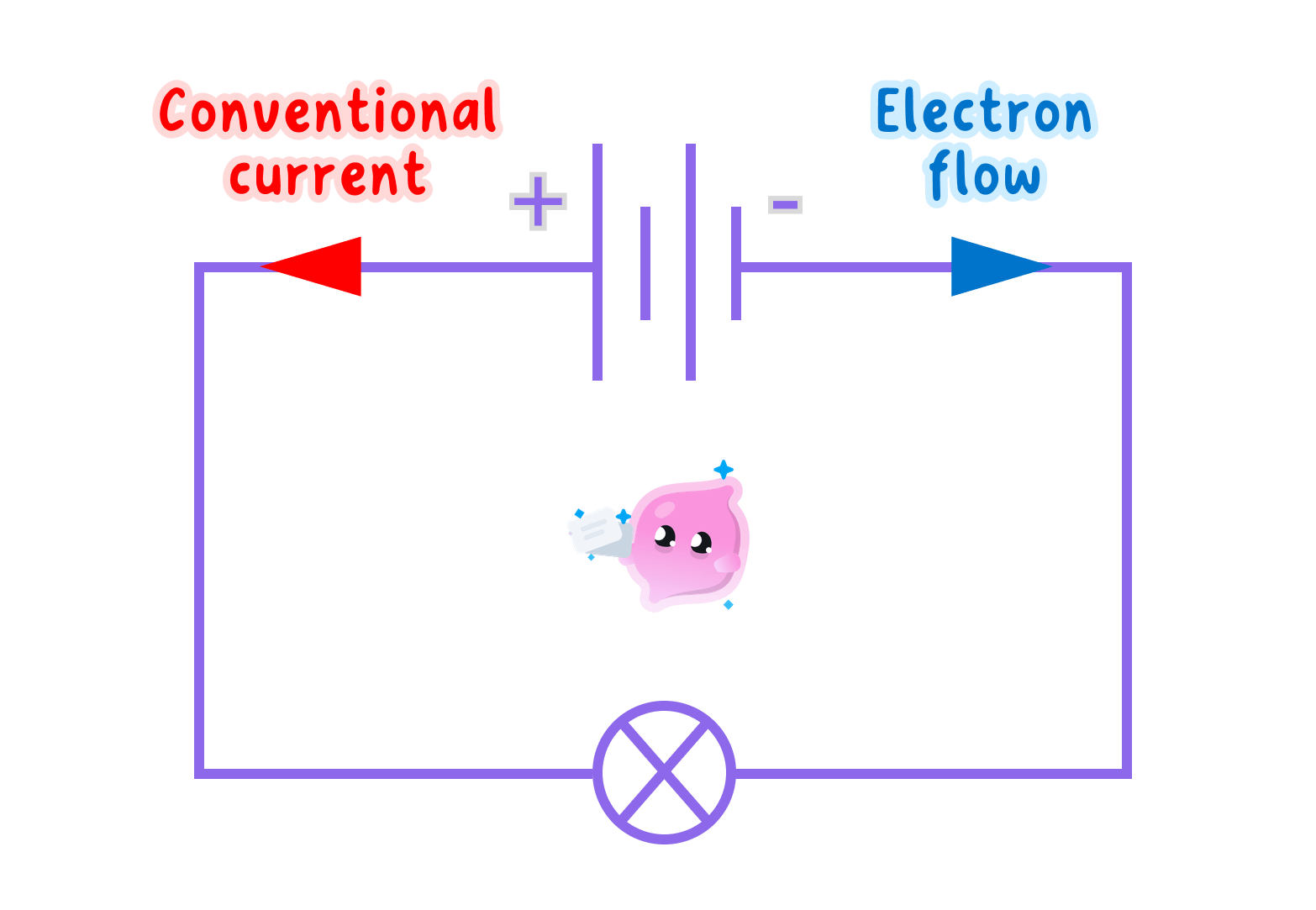
The direction of current shown on circuit diagrams, from the positive terminal of the supply, around the circuit, to the negative terminal.
- The motor effect produces a force on a current-carrying conductor in a magnetic field, and Fleming's left-hand rule tells you which way that force acts.
- The rule is used when the current and the magnetic field are at right angles to each other.
- In that arrangement the force, the magnetic field and the current are mutually perpendicular, so each one is at right angles to the other two.
- Hold your left hand with the thumb pointing up, the first finger pointing straight ahead and the second finger bent sideways, so the three point in directions at right angles.
- The first finger points in the direction of the magnetic field, which runs from the north pole to the south pole.
- The second finger points in the direction of the conventional current, which runs from the positive terminal of the supply to the negative terminal.
- The thumb then points in the direction of the force on the conductor, which is the direction in which the conductor moves.
- A memory aid links each digit to a letter: First finger for Field, seCond finger for Current, and thuMb for Motion.
Using the rule step by step
- Find the direction of the magnetic field on the diagram, remembering that field lines run from north to south.
- Point your first finger in that direction and keep it fixed.
- Turn your wrist about the first finger until your second finger points along the conventional current.
- Read off the direction of your thumb, which gives the direction of the force on the conductor.
- Diagrams often show a direction going into or out of the page with a cross or a dot.
- A cross (⊗\otimes⊗) shows a direction into the page, like the feathered tail of an arrow flying away from you.
- A dot (⊙\odot⊙) shows a direction out of the page, like the point of an arrow flying towards you.
- Reversing the current reverses the force, because your second finger now points the other way and your thumb flips over.
- Reversing the magnetic field also reverses the force, because your first finger now points the other way.
- Reversing both the current and the field leaves the force acting in the same direction as before.
- The rule gives only the direction of the force and tells you nothing about its size.
Conventional current and electron flow
Definition
Electron flow
The movement of electrons through a circuit from the negative terminal to the positive terminal, in the opposite direction to the conventional current.
- In a metal wire the current is carried by electrons, which are negatively charged.
- The electrons drift from the negative terminal of the supply, around the circuit, towards the positive terminal.
- Conventional current was defined before electrons were discovered, as flowing from positive to negative, so it points the opposite way to the electron flow.
- Fleming's left-hand rule always uses the direction of conventional current.
- If a diagram shows the direction in which electrons move, point your second finger the opposite way to the electron flow.
- The same rule finds the force on a beam of charged particles moving through a magnetic field, because a stream of moving charge is a current.
- For positively charged particles the current is in the same direction as their motion, while for electrons the current is in the opposite direction to their motion.
- A positive particle and an electron moving the same way through the same field are therefore pushed in opposite directions.
Example
Wire carrying current up the page
- A straight wire runs up the page and carries a conventional current upwards.
- The magnetic field between two poles points from left to right across the page.
- Point the first finger of your left hand to the right, along the field.
- Turn your hand so the second finger points up the page, along the current.
- Your thumb now points into the page, so the force on the wire acts into the page.
Example
Electron flow shown on the diagram
- A wire lies across a magnetic field that points into the page.
- The diagram shows electrons moving along the wire from left to right.
- The conventional current therefore flows from right to left.
- Point your first finger into the page and your second finger to the left.
- Your thumb points down the page, so the force on the wire acts downwards.
Common Mistake
- Use your left hand, because the right hand gives the opposite answer every time.
- Do not point your second finger along the electron flow, because the rule is built on conventional current.
- Do not try to use the rule when the wire is parallel to the field, because there is then no force to find.
Exam technique
Stating a direction
- Turn your hand to match the diagram on the paper rather than relying on the memory of a similar diagram, because examiners often rotate the set-up.
- Give the direction in the terms the question uses, such as up the page, to the left or into the page.
- When asked to show the force on a diagram, draw a single arrow that starts on the conductor and points in the direction of the force.
- If the question reverses one quantity, apply the rule again from the start rather than guessing which way the force now acts.
Self review
- Which finger of the left hand represents the magnetic field, and which represents the current?
- What does a cross drawn in a circle mean on a diagram?
- A wire carries conventional current to the right through a field pointing up the page; in which direction is the force?
- How do you use the rule when a diagram shows the direction of electron flow?
- What happens to the force on a wire if the current and the field are both reversed?
