Stores of motion and position
Energy store
A way in which energy is held by an object or system, such as a kinetic, gravitational, elastic, thermal or chemical store.
Kinetic energy
The energy held in the kinetic store of an object because it is moving.
Gravitational potential energy
The energy held in the gravitational store of an object because of its height in a gravitational field.
Elastic potential energy
The energy held in the elastic store of an object that has been stretched, compressed or bent elastically.
- An energy store describes where energy is held, and the amount of energy in each store is measured in joules, J\text{J}J.
- Describing a change to a system means saying which stores decrease and which stores increase, from the start of the process to the end.
- The kinetic store holds energy because an object is moving, so it increases when the object speeds up and decreases when it slows down.
- A heavier object holds more energy in its kinetic store than a lighter one moving at the same speed, so a loaded lorry at 20 m/s20\ \text{m/s}20 m/s holds far more than a cyclist at 20 m/s20\ \text{m/s}20 m/s.
- The gravitational potential energy store holds energy because of an object's height in a gravitational field, so it increases when the object is raised and decreases when it falls.
- This store belongs to the object and the Earth together, because it depends on the gravitational attraction between them.
- The elastic potential energy store holds energy when an object is stretched, squashed or bent and can return to its original shape, such as a stretched bungee cord or a compressed spring.
- These three stores change whenever an object speeds up, slows down, rises, falls, stretches or springs back.
Stores of particles and fields
Thermal energy store
The energy store of an object that increases when its temperature rises.
Chemical energy store
The energy store held in fuels, foods and batteries that is transferred when chemical reactions take place.
Nuclear energy store
The energy store held in the nuclei of atoms that is transferred when nuclei split apart or join together.
Magnetic energy store
The energy store that changes when magnets or magnetic materials that attract or repel each other move closer together or further apart.
Electrostatic energy store
The energy store that changes when electric charges that attract or repel each other move closer together or further apart.
- The thermal store of an object increases when its temperature rises, because its particles vibrate or move faster.
- A large object at a low temperature can hold more energy in its thermal store than a small object at a high temperature, so a swimming pool at 25 ∘C25\ ^\circ\text{C}25 ∘C holds far more than a mug of tea at 80 ∘C80\ ^\circ\text{C}80 ∘C.
- The chemical store is found in fuels such as petrol and natural gas, in food and in batteries, and it decreases when a chemical reaction such as burning or respiration takes place.
- The nuclear store is held in the nuclei of atoms and decreases when nuclei split apart in a nuclear power station or join together in the Sun.
- The magnetic store changes when magnets or magnetic materials that attract or repel each other move closer together or further apart, as when two fridge magnets snap together.
- The electrostatic store changes when electric charges that attract or repel each other move closer together or further apart, as when a charged balloon is pulled towards a wall.
- Electricity, light and sound are not stores, because they are ways of transferring energy from one store to another.
Projecting an object upwards
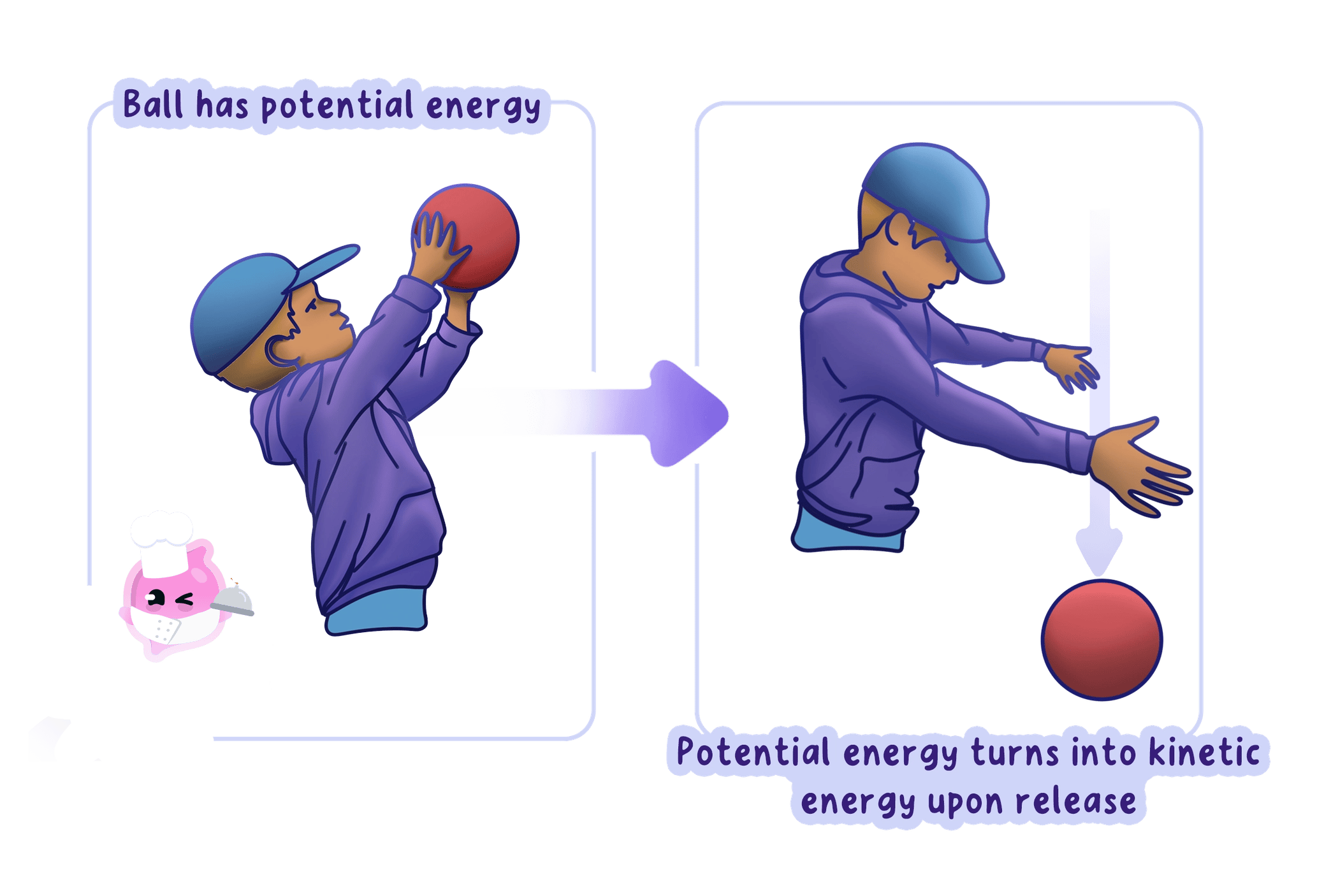
- When you throw a ball straight up, your muscles transfer energy from the chemical store in your body to the kinetic store of the ball.
- As the ball rises it slows down, so its kinetic store decreases while its gravitational potential energy store increases.
- At the top of its flight the ball is momentarily still, so its kinetic store is empty and its gravitational potential energy store is at its largest.
- As the ball falls back down, its gravitational potential energy store decreases and its kinetic store increases, so it speeds up.
- Air resistance acts on the ball throughout its flight and increases the thermal stores of the ball and the air, so the ball returns to your hand slightly slower than it left.
- An object pushed up a slope behaves in the same way, with its kinetic store decreasing and its gravitational potential energy store increasing as it climbs.
- Friction between the object and the slope also increases the thermal stores of both surfaces, so a trolley pushed up a ramp stops lower down than it would on a perfectly smooth ramp.
A child on a playground slide
- At the top of the slide the child is still, so the child's kinetic store is empty and the gravitational potential energy store is at its largest.
- As the child slides down, the gravitational potential energy store decreases.
- Most of that energy goes into the child's kinetic store, so the child speeds up.
- Friction between the child's clothes and the slide increases the thermal stores of the child and the slide, which both become slightly warm.
- On the flat run-out at the bottom, friction slows the child down, so the kinetic store decreases to zero.
- By the end, all the energy that left the gravitational potential energy store is in the thermal stores of the child, the slide and the surrounding air.
Hitting an obstacle
- A moving object that hits an obstacle, such as a car hitting a crash barrier or a hammer hitting a nail, loses most or all of its kinetic store in a fraction of a second.
- During the impact the object and the obstacle are squashed or bent, and the energy is transferred to their thermal stores and carried away to the surroundings as sound.
- If the change of shape is elastic, as when a tennis ball hits a wall, some energy is held briefly in the elastic potential energy store and then returned to the kinetic store as the ball bounces away.
- If the change of shape is plastic, as in the crumple zone of a car, the shape change is permanent and the energy ends up in thermal stores rather than being returned.
- When a hammer drives a nail into wood, the kinetic store of the hammer decreases and the thermal stores of the nail, the hammer head and the wood increase, which is why the nail feels warm afterwards.
- The sound produced by any impact also ends up in the thermal store of the surrounding air once the sound waves have died away.
Accelerating with a constant force
- When a constant resultant force acts on an object in its direction of motion, the object speeds up, so its kinetic store increases steadily.
- The energy always comes from the store that supplies the force, such as the chemical store of a car's petrol, a cyclist's muscles or the battery in an electric scooter.
- An electric car pulling away from traffic lights transfers energy from the chemical store of its battery to its kinetic store.
- Not all of that energy reaches the kinetic store, because the motor, the tyres and the air all warm up, so their thermal stores increase too.
- A rocket at launch shows several changes at once: the chemical store of its fuel decreases while its kinetic store and gravitational potential energy store both increase.
Slowing a vehicle down
- When a driver brakes, the brake pads press against discs fixed to the wheels, and friction between them acts against the motion.
- The kinetic store of the car decreases as it slows down.
- The thermal stores of the brake pads and discs increase, and the discs can glow red after repeated hard stops from high speed.
- Energy then spreads from the hot brakes to the thermal store of the surrounding air, and squealing brakes or tyres also carry some energy away as sound.
- Air resistance and friction in the moving parts act on a vehicle all the time, so a car that coasts with its engine off also slows down and its kinetic store decreases.
- A cyclist who stops pedalling on a flat road shows the same change more slowly, with the kinetic store going to thermal stores in the air, the tyres and the bearings.
Boiling water in a kettle
- An electric kettle is plugged into the mains, so energy is transferred electrically from the mains supply to the kettle's heating element.
- The thermal store of the element increases, and because the element is hotter than the water, energy is transferred by heating to the water around it.
- The thermal store of the water increases and its temperature rises steadily from room temperature towards 100 ∘C100\ ^\circ\text{C}100 ∘C.
- Once the water reaches 100 ∘C100\ ^\circ\text{C}100 ∘C, its temperature stops rising and the energy supplied turns some of the liquid water into steam.
- The plastic body of the kettle, its lid and the air in the kitchen also warm up, so their thermal stores increase as well.
- Steam escaping from the spout carries energy into the room, and the rumbling sound of the boiling water carries a little more away.
- In every one of these situations, the decreases and increases balance, so the total energy is unchanged once all the stores are included.
- Do not write heat energy, movement energy or height energy, because these are not the names of energy stores.
- Do not describe an electrical energy store, because electricity is a way of transferring energy, not a store.
- Do not stop at the useful store, because a full description also includes the thermal stores of the surroundings that increase.
- Do not say that a stationary object at the top of its flight has no energy, because its gravitational potential energy store is at its largest there.
Describing every change
- Work through the event in time order, describing what happens to each store at the start, during the process and at the end.
- Pair every store with the word increases or decreases, such as the gravitational potential energy store of the ball decreases.
- Give the reason for each change, such as the kinetic store increases because the ball speeds up.
- Finish by naming the thermal stores of the surroundings that increase because of friction, air resistance or sound, because an answer that leaves them out describes only part of the change.
- Name the energy store that increases when an object speeds up.
- Name two places where energy is held in a chemical store.
- Describe the changes in energy stores when a ball is thrown upwards and caught again.
- Describe the changes in energy stores when a car brakes to a stop.
- Describe the changes in energy stores when a moving hammer hits a nail.
- Describe the changes in energy stores when water is brought to the boil in an electric kettle.
