Mass and charge of a nucleus
Definition
Parent nucleus
The original unstable nucleus before it undergoes radioactive decay.
Definition
Daughter nucleus
The nucleus that is left after a parent nucleus has undergone radioactive decay.
- When an unstable nucleus decays, the original nucleus is called the parent nucleus and the nucleus left behind is called the daughter nucleus.
- The change to the nucleus is described by what happens to its mass and its charge.
- The mass number, AAA, measures the mass of the nucleus, because it counts the nucleons.
- The atomic number, ZZZ, measures the charge of the nucleus, because it counts the protons.
- Any change in the atomic number changes the element, so the daughter nucleus belongs to a different element whenever the charge changes.
- Each type of emission changes the mass, the charge, both or neither.
Alpha emission
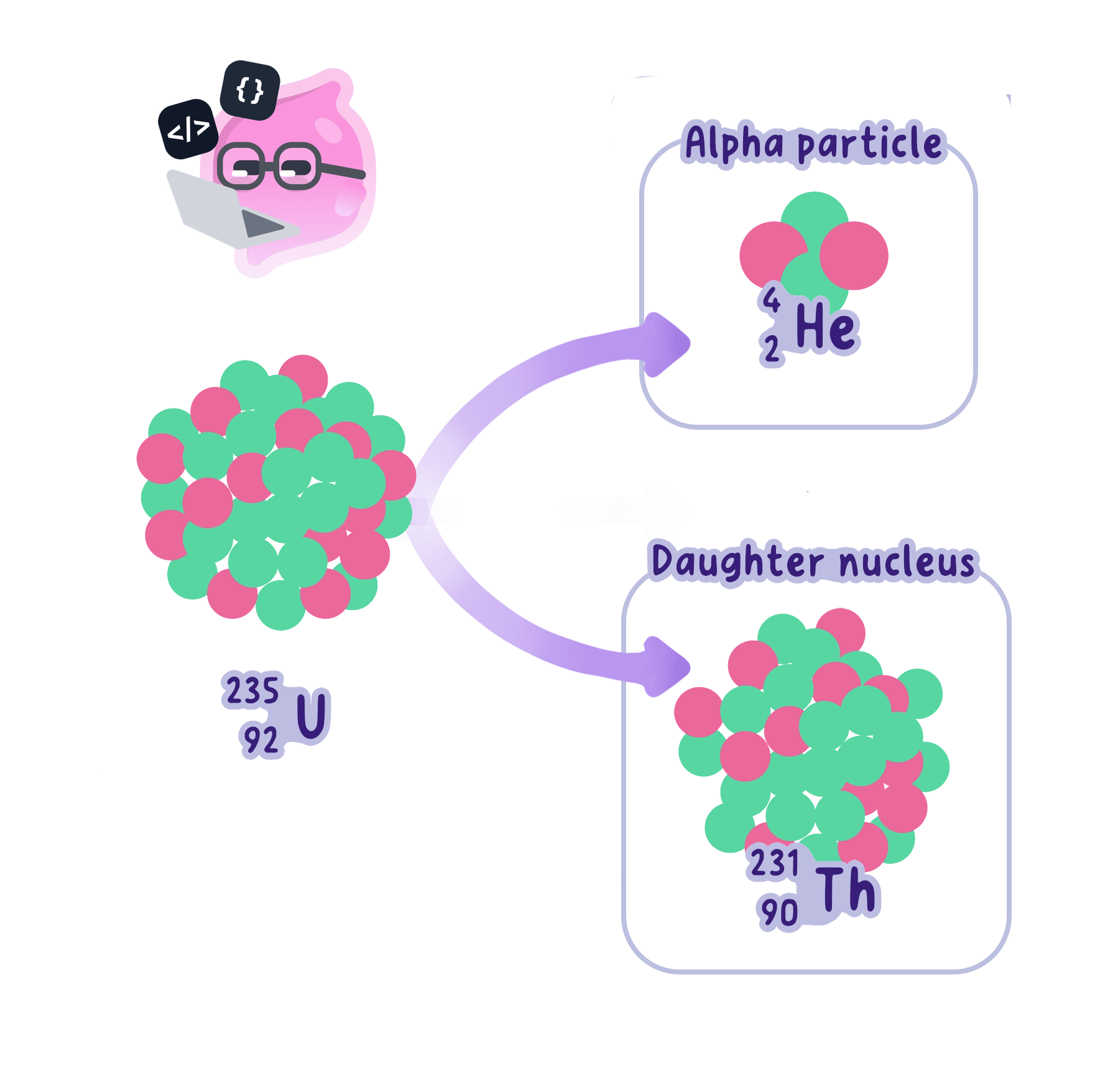
- An alpha particle carries away two protons and two neutrons.
- The nucleus loses four nucleons, so the mass number falls by 4.
- The nucleus loses two protons, so the atomic number falls by 2 and the charge of the nucleus falls by +2+2+2.
- Alpha emission changes both the mass and the charge of the nucleus.
- The daughter nucleus is an element two places earlier in the periodic table.
- When uranium-235 emits an alpha particle, its mass number falls from 235235235 to 231231231 and its atomic number falls from 929292 to 909090, so it becomes thorium-231.
Beta emission
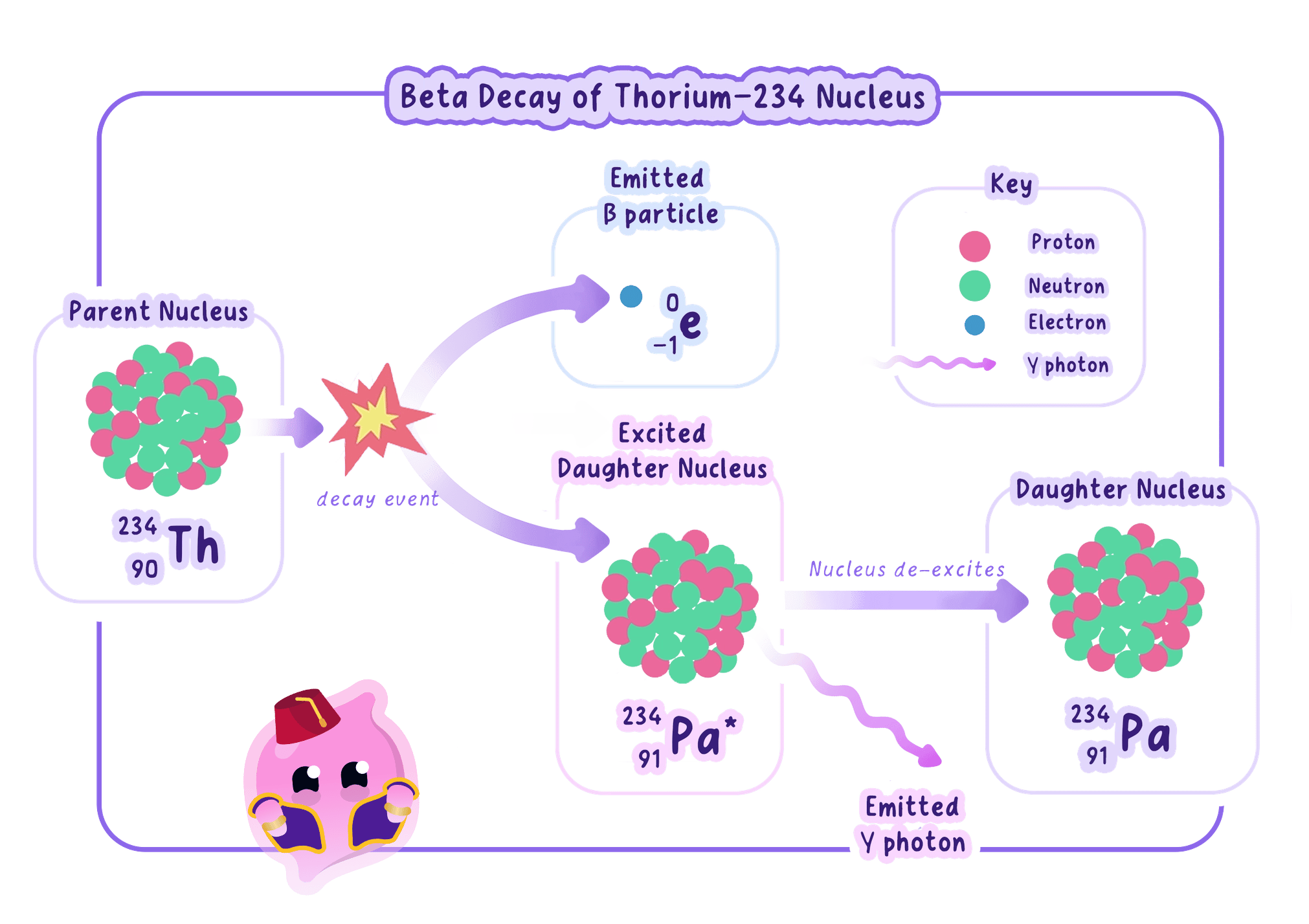
- In beta decay, a neutron in the nucleus changes into a proton, and a fast electron is created and emitted as the beta particle.
- The nucleus loses one neutron but gains one proton, so the total number of nucleons stays the same and the mass number does not change.
- The nucleus gains one proton, so the atomic number rises by 1 and the charge of the nucleus increases by +1+1+1.
- Beta emission changes the charge of the nucleus but not its mass number.
- The daughter nucleus is an element one place later in the periodic table.
- When thorium-234 emits a beta particle, its mass number stays at 234234234 while its atomic number rises from 909090 to 919191, so it becomes protactinium-234.
Gamma emission
- A gamma ray has no mass and no charge, so emitting it leaves the number of protons and the number of neutrons unchanged.
- Gamma emission changes neither the mass number nor the atomic number, so the nucleus stays as the same isotope of the same element.
- The nucleus loses energy instead, because the gamma ray carries away the extra energy it had.
- Gamma emission often follows alpha or beta emission, because the daughter nucleus is frequently left with excess energy, as happens to the protactinium-234 nucleus above.
Neutron emission
- When a nucleus emits a neutron, it loses one nucleon, so its mass number falls by 1.
- The number of protons is unchanged, so the atomic number and the charge stay the same.
- Neutron emission changes the mass but not the charge of the nucleus.
- The daughter nucleus is a lighter isotope of the same element, so beryllium-13 becomes beryllium-12 when it emits a neutron.
Key Idea
Changes caused by each emission
- Alpha: mass number falls by 444 and atomic number falls by 222, so the mass and the charge both change.
- Beta: mass number stays the same and atomic number rises by 111, so only the charge changes.
- Gamma: mass number and atomic number stay the same, so neither changes and the nucleus only loses energy.
- Neutron: mass number falls by 111 and atomic number stays the same, so only the mass changes.
Example
Following a nucleus through two decays
- A radium-226 nucleus has a mass number of 226226226 and an atomic number of 888888, and it emits an alpha particle.
- The element with atomic number 868686 is radon, so the daughter nucleus is radon-222.
- A lead-210 nucleus has a mass number of 210210210 and an atomic number of 828282, and it emits a beta particle.
- The element with atomic number 838383 is bismuth, so the daughter nucleus is bismuth-210.
Common Mistake
- Do not say that beta emission reduces the mass number, because the neutron that is lost is replaced by a proton.
- Do not say that alpha emission reduces the atomic number by 444, because only two of the four nucleons lost are protons.
- Do not say that gamma emission creates a new element, because the number of protons does not change.
Exam technique
Describing changes to a nucleus
- Comment on both the mass and the charge for each emission, including saying "no change" where there is none.
- For beta emission, the mark usually depends on stating that a neutron changes into a proton.
- Use the words mass number and atomic number or proton number, because "the number goes down" does not say which number changes.
Self review
- By how much do the mass number and atomic number change when a nucleus emits an alpha particle?
- What happens to a neutron in the nucleus during beta decay?
- Why does beta emission not change the mass number?
- Which emission changes neither the mass nor the charge of the nucleus?
- Why is the daughter nucleus after neutron emission an isotope of the same element?
