Weight and gravity
Definition
Weight
Weight is the force acting on an object because of a gravitational field.
- Weight is a vector force. Near the surface of a planet or moon it acts towards the centre of that body, described locally as vertically downwards.
- The symbol for weight is WWW and its unit is the newton, N\text{N}N. Weight must not be stated in kilograms.
- An object has weight whenever it is in a gravitational field. An astronaut in orbit still has weight because gravity provides the force that keeps the astronaut in orbit.
Gravitational field strength
Definition
Gravitational field strength
Gravitational field strength is the force per unit mass acting on an object placed in a gravitational field, measured in newtons per kilogram (N/kg).
- The symbol is ggg and the unit is newtons per kilogram, N kg−1\text{N kg}^{-1}N kg−1. A field strength of 10 N kg−110\ \text{N kg}^{-1}10 N kg−1 means that every kilogram experiences a gravitational force of 10 N10\ \text{N}10 N.
- Near Earth's surface, use g=10 N kg−1g=10\ \text{N kg}^{-1}g=10 N kg−1 unless a different value is supplied. Values such as 9.8 N kg−19.8\ \text{N kg}^{-1}9.8 N kg−1 may be used when given.
- Gravitational field strength depends on location. It is different on different planets and moons, and becomes weaker with increasing distance from the body producing the field.
Mass and weight
Definition
Mass
Mass is a measure of the amount of matter in an object and is measured in kilograms.
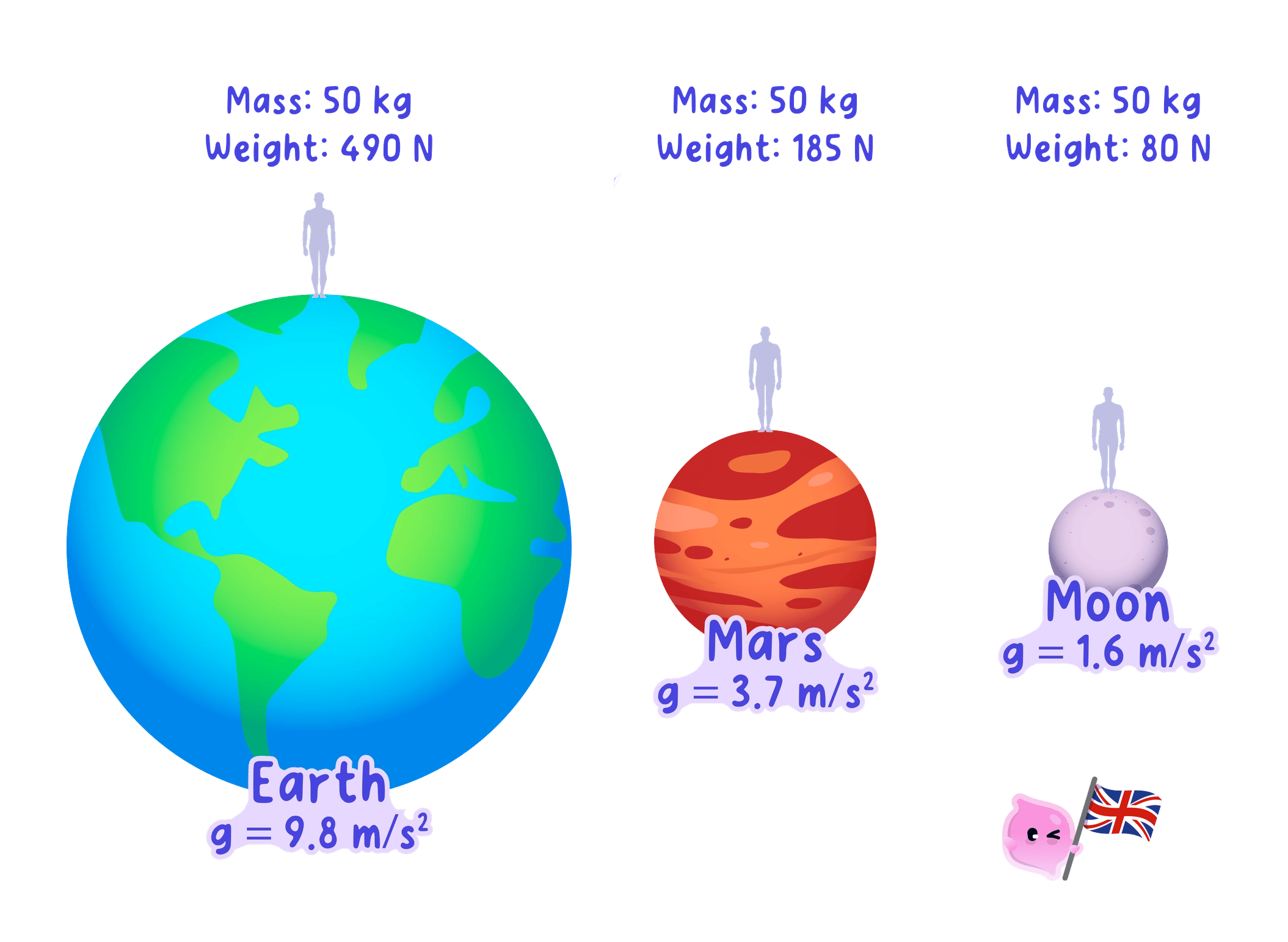
- Mass is a scalar and does not change when an object moves from Earth to the Moon. Weight changes because gravitational field strength changes.
- A 50 kg50\ \text{kg}50 kg person has the same mass everywhere. On Earth, using g=9.8 N kg−1g=9.8\ \text{N kg}^{-1}g=9.8 N kg−1, the weight is 490 N490\ \text{N}490 N. On the Moon, using g=1.6 N kg−1g=1.6\ \text{N kg}^{-1}g=1.6 N kg−1, the weight is 80 N80\ \text{N}80 N.
The weight equation
- The relationship is W=mgW=mgW=mg, where WWW is weight in newtons, mmm is mass in kilograms and ggg is gravitational field strength in newtons per kilogram.
- The rearranged forms are m=Wgm=\dfrac{W}{g}m=gW and g=Wmg=\dfrac{W}{m}g=mW.
- For a fixed mass, W∝gW\propto gW∝g. Doubling the gravitational field strength doubles the weight.
- For a fixed gravitational field strength, W∝mW\propto mW∝m. Doubling the mass doubles the weight.
Example
Calculating weight
- A student has a mass of 58 kg58\ \text{kg}58 kg where g=10 N kg−1g=10\ \text{N kg}^{-1}g=10 N kg−1.
- Use W=mgW=mgW=mg.
- Substitution gives W=58×10=580 NW=58\times10=580\ \text{N}W=58×10=580 N.
- The student's weight is 580 N580\ \text{N}580 N.
Example
Finding mass and weight
- A rock weighs 96 N96\ \text{N}96 N on the Moon, where g=1.6 N kg−1g=1.6\ \text{N kg}^{-1}g=1.6 N kg−1.
- Rearrange W=mgW=mgW=mg to m=Wgm=\dfrac{W}{g}m=gW.
- Substitution gives m=961.6=60 kgm=\dfrac{96}{1.6}=60\ \text{kg}m=1.696=60 kg.
- The mass remains 60 kg60\ \text{kg}60 kg on Earth. Using g=10 N kg−1g=10\ \text{N kg}^{-1}g=10 N kg−1, W=60×10=600 NW=60\times10=600\ \text{N}W=60×10=600 N.
Measuring weight
Definition
Newtonmeter
A newtonmeter is a calibrated force meter that measures force in newtons by the extension of a spring.
- Check that the newtonmeter reads zero before attaching the object. Correct the zero setting where possible.
- Select a newtonmeter with a range large enough for the expected weight and a scale fine enough to give a useful resolution.
- Hold or clamp the newtonmeter vertically, attach the object securely and allow it to hang freely without touching another surface.
- Wait for oscillations to stop, then read the scale at eye level to reduce parallax error.
- Record the value in newtons. A balance measures mass in kilograms, whereas a newtonmeter measures weight in newtons.
- The spring stretches because the attached weight pulls on it. The scale is calibrated so the extension gives the force directly.
Weight in different fields
- The same object weighs less where ggg is smaller because W=mgW=mgW=mg and its mass remains constant.
- A value of g=1.6 N kg−1g=1.6\ \text{N kg}^{-1}g=1.6 N kg−1 on the Moon gives a weight about one sixth of the value on Earth when g≈9.8 N kg−1g\approx9.8\ \text{N kg}^{-1}g≈9.8 N kg−1.
- The strength of a gravitational field decreases with distance from the body producing it. This reduces weight, although mass remains unchanged.
Exam technique
Explaining changes in weight
- Give the complete causal chain: the gravitational field strength is smaller, mass is unchanged, and W=mgW=mgW=mg, so weight is smaller.
- For calculations, write the equation, substitute values with consistent units, evaluate and state the final unit.
- Use mass for kilograms and weight for newtons. Calling kilograms a unit of weight loses precision and can lose the mark.
- When describing measurement, name the newtonmeter, state that it is read in newtons and include a method detail such as zeroing or reading at eye level.
Common Mistake
Common gravity errors
- Do not say that mass changes with location. The gravitational field strength and weight change.
- Do not use m s−2\text{m s}^{-2}m s−2 when the required quantity is gravitational field strength. Use N kg−1\text{N kg}^{-1}N kg−1.
- Do not claim that orbit means no gravity. Orbiting objects are continuously falling under the gravitational force.
Self review
- Define weight and gravitational field strength.
- State the instrument used to measure weight and describe how it is read accurately.
- Calculate the weight of a 6.0 kg6.0\ \text{kg}6.0 kg object where g=10 N kg−1g=10\ \text{N kg}^{-1}g=10 N kg−1.
- Explain why an object's mass stays constant but its weight changes on the Moon.
- Rearrange W=mgW=mgW=mg to make ggg the subject.
