Speed and velocity
Definition
Velocity
Velocity is speed in a stated direction, measured in metres per second.
- Speed is a scalar quantity. Velocity is a vector quantity. An object can therefore have constant speed while its velocity changes.
- An object travelling in a circle constantly changes its direction of motion. Its velocity changes even if its speed remains constant.
- At any point on the circular path, the instantaneous velocity is directed along a tangent to the circle. The tangent direction changes from point to point.
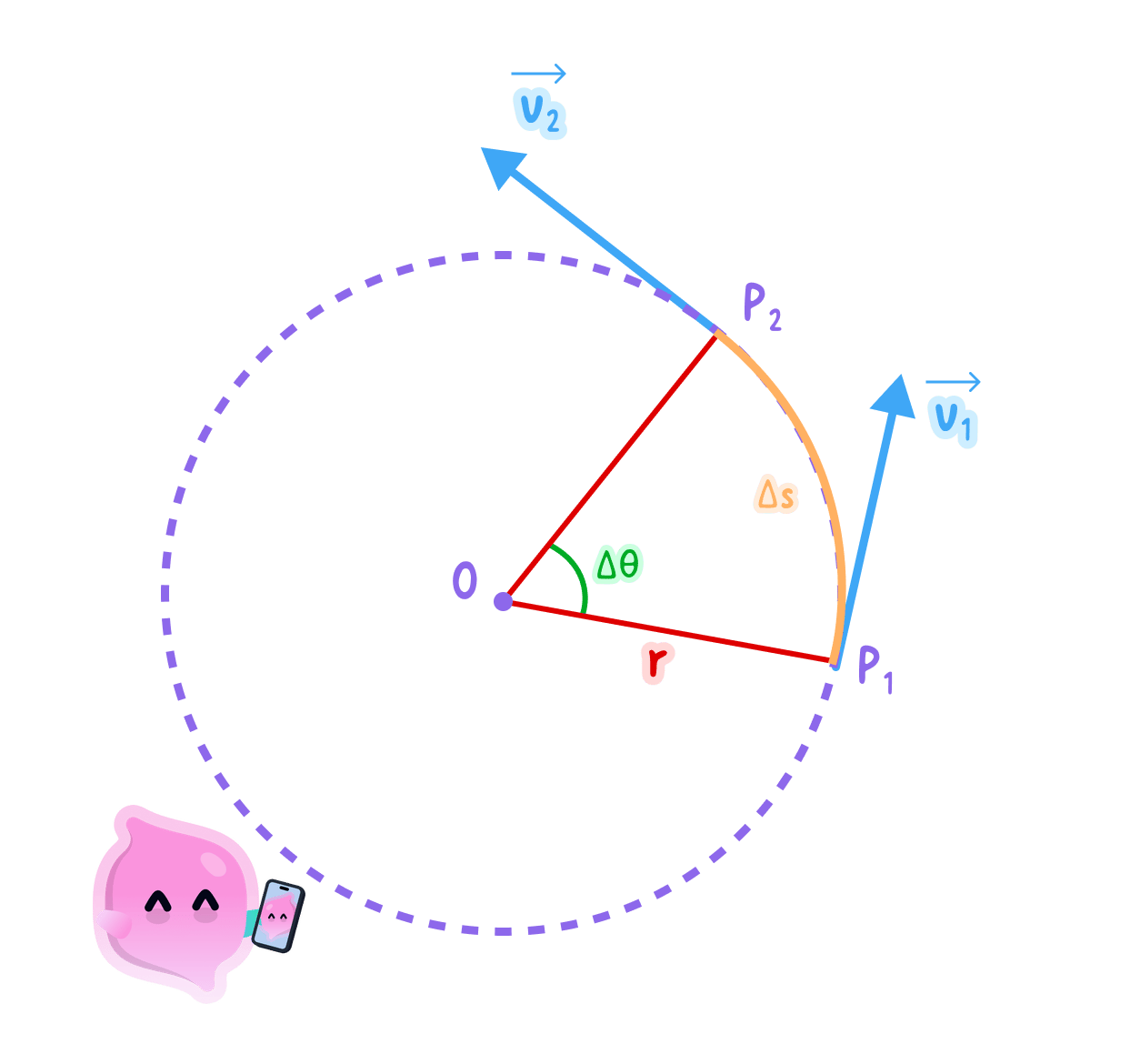
Acceleration in a circle
Definition
Acceleration
Acceleration is the rate of change of velocity.
- The relationship a=v−uta=\dfrac{v-u}{t}a=tv−u describes change in velocity. In circular motion, the change is in direction rather than necessarily in speed.
- An object moving in a circle at constant speed is accelerating because its velocity direction changes continuously.
- A changing velocity requires a non-zero resultant force. Without that force, Newton's first law predicts motion at constant velocity in a straight line.
Centripetal force
Definition
Centripetal force
Centripetal force is the resultant force acting on an object moving in a circle, directed towards the centre of the circle.
- The centripetal force acts towards the centre at every point on the path. It is perpendicular to the instantaneous velocity in uniform circular motion.
- The inward force continually changes the direction of the velocity, producing circular motion. It does not point along the tangent.
- If the centripetal force suddenly disappears, the object initially moves along the tangent to the circle at the point where the force stopped acting.
Forces that provide centripetal force
- Centripetal force is not an additional type of force. It is the name given to whichever real force, or resultant of forces, acts towards the centre.
- For a satellite or moon in orbit, gravitational force provides the centripetal force towards the centre of the planet.
- For a ball moving in a circle on a string, tension in the string provides the centripetal force towards the hand or pivot.
- For a car turning on a level road, friction between the tyres and road provides the centripetal force towards the centre of the bend.
- For clothes moving in a circle inside a washing-machine drum, the normal contact force from the drum provides the inward force.
Example
Explaining an orbit
- A satellite moves around Earth in a circular orbit at constant speed.
- Its direction changes continuously, so its velocity changes.
- A change in velocity means the satellite is accelerating even though its speed is constant.
- The gravitational force acts towards the centre of Earth and provides the centripetal resultant force.
Example
A string breaks
- A ball moves in a horizontal circle on a string.
- The tension acts towards the centre and provides the centripetal force.
- When the string breaks, the tension disappears and there is no inward force.
- The ball initially continues in a straight line along the tangent at the breaking point, in accordance with Newton's first law.
Exam technique
Explaining circular motion
- Use the linked chain: direction changes, so velocity changes, therefore the object accelerates.
- State that the resultant force acts towards the centre of the circle. Words such as sideways or inwards are less precise.
- For a named situation, identify the real force providing the centripetal force, such as gravity, tension, friction or normal contact force.
- Keep the explanation qualitative. No centripetal-force calculation is required for this content.
Common Mistake
Common circular-motion errors
- Constant speed does not mean constant velocity when direction changes.
- Do not draw an outward force on the moving object. The resultant force required for circular motion is towards the centre.
- Do not say that an orbiting object has no gravity. Gravity supplies the centripetal force.
Self review
- Explain why an object moving in a circle at constant speed is accelerating.
- State the direction of the centripetal resultant force.
- Name the force providing centripetal force for a satellite, a ball on a string and a car on a bend.
- Describe the motion of a ball immediately after its string breaks.
- Explain why centripetal force is not an additional type of force.
