4.2.1 Behaviour of waves at material interfaces
Waves at boundaries
Definition
Reflection
The change in direction of a wave at a boundary so that it remains in the original medium.
Definition
Refraction
The change in direction of a wave caused by a change in speed as it passes from one medium into another.
- When a wave reaches a material interface, its energy may be reflected, transmitted or absorbed, and a transmitted wave may also be refracted.
- A material interface is the boundary between two materials or between two regions with different wave properties.
- The proportions of energy in each outcome depend on the two materials, the wavelength and the angle at which the wave meets the boundary.
Reflection
- A reflected wave remains in the original material and travels away from the boundary.
- For a straight boundary, the angle of incidence equals the angle of reflection: i=ri=ri=r.
- Both angles are measured from the normal, an imaginary line at 90∘90^\circ90∘ to the surface.
- Reflection changes the direction of travel, but the wave remains in the same material, so its speed, frequency and wavelength stay unchanged.
Transmission and refraction
Definition
Transmission
The passage of electromagnetic radiation through a substance or across a boundary.
- A transmitted wave carries energy beyond the boundary.
- If its speed changes and it arrives at an angle to the normal, its direction changes by refraction.
- The source continues to set the frequency, so frequency does not change at the boundary.
- Because v=fλv=f\lambdav=fλ, a change in speed at constant frequency causes the wavelength to change.
- A wave that slows bends towards the normal, whereas a wave that speeds up bends away from the normal.
Absorption
Definition
Absorption
The transfer of energy from electromagnetic radiation to a material when the radiation is taken in rather than reflected or transmitted.
- Absorption reduces the amplitude and energy of the wave that continues through or returns from the material.
- The absorbed energy commonly increases the material's temperature, although it may produce another response in a detector.
- A surface can partly absorb and partly reflect or transmit the same incident wave, so these outcomes are not mutually exclusive.
Energy at an interface
- Energy is conserved at the boundary, so the incident wave energy is shared between reflected, transmitted and absorbed energy.
- In symbols, Eincident=Ereflected+Etransmitted+EabsorbedE_{\text{incident}}=E_{\text{reflected}}+E_{\text{transmitted}}+E_{\text{absorbed}}Eincident=Ereflected+Etransmitted+Eabsorbed.
- A wave with a smaller transmitted amplitude has not necessarily lost energy from the system; some energy may have been reflected or absorbed.
Example
Tracking wave energy
- A wave transfers 120 J120\ \text{J}120 J to a boundary, where 35 J35\ \text{J}35 J is reflected and 50 J50\ \text{J}50 J is transmitted.
- Use energy conservation: Eabsorbed=120−35−50E_{\text{absorbed}}=120-35-50Eabsorbed=120−35−50.
- The material absorbs 35 J35\ \text{J}35 J.
Exam technique
- For a description question, name the outcome and state what happens to the wave: it returns, crosses the boundary, changes direction or transfers energy to the material.
- For an explanation of refraction, link the change in speed to the change in direction.
Common Mistake
- Measure incidence and reflection angles from the normal, not from the surface.
- Do not state that refraction always means bending; a wave travelling along the normal changes speed and wavelength without changing direction.
Self review
- What happens to a wave during reflection?
- How are the angles of incidence and reflection related?
- Why can a transmitted wave change wavelength without changing frequency?
- What happens to wave energy during absorption?
- How is incident energy divided at a material interface?
4.2.2 Refraction at a boundary
Refraction and wave speed
Definition
Refraction
The change in direction of a wave caused by a change in speed as it passes from one medium into another.
- A wave changes speed when the properties of the medium that determine its propagation change.
- The source does not change at the boundary, so the wave frequency remains constant.
- Using v=fλv=f\lambdav=fλ, constant fff means that a lower speed gives a shorter wavelength and a higher speed gives a longer wavelength.
Direction of bending
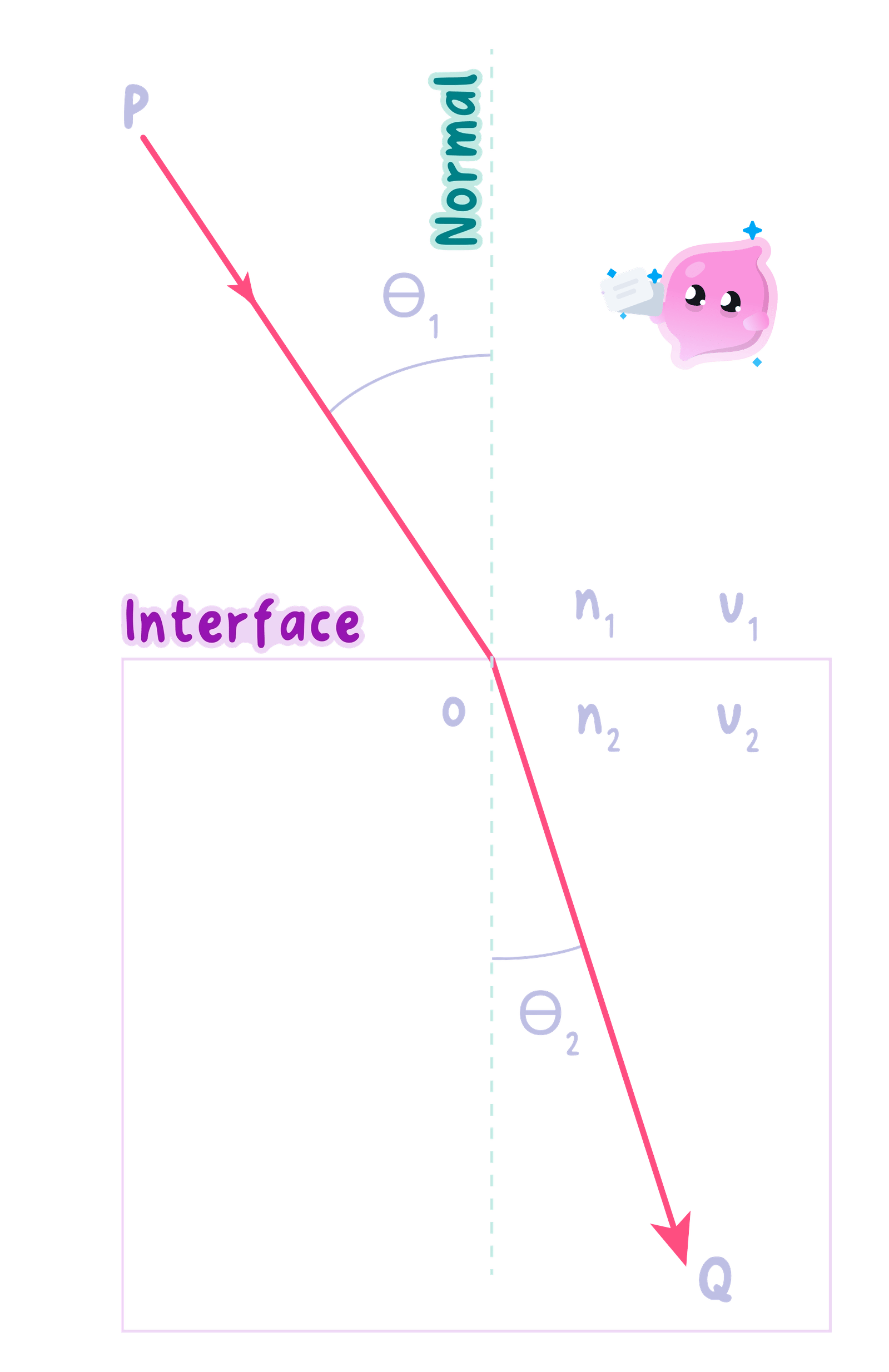
- Draw a normal at 90∘90^\circ90∘ to the boundary where the wave arrives.
- If the wave slows down, it bends towards the normal, so the angle of refraction is smaller than the angle of incidence.
- If the wave speeds up, it bends away from the normal, so the angle of refraction is larger than the angle of incidence.
- The rule depends on the change in wave speed, not simply on which material is denser.
- If the wave travels along the normal, every part of the wavefront changes speed together, so the direction does not change.
Why the wave turns
- A wavefront arriving at an angle reaches the new medium one side first.
- That side changes speed before the rest of the wavefront.
- The unequal distances travelled by the two sides during the change rotate the wavefront.
- The direction of travel, which is perpendicular to the wavefront, therefore changes.
Wave quantities at the boundary
- Frequency remains unchanged because each incoming oscillation produces one transmitted oscillation.
- Speed changes because the wave now travels through a different medium.
- Wavelength changes in the same ratio as speed because λ=vf\lambda=\dfrac{v}{f}λ=fv and fff is constant.
Example
Wavelength after refraction
- Water waves with frequency 5.0 Hz5.0\ \text{Hz}5.0 Hz move at 0.30 m s−10.30\ \text{m s}^{-1}0.30 m s−1 before entering shallow water, where their speed is 0.18 m s−10.18\ \text{m s}^{-1}0.18 m s−1.
- In deep water, λ=vf=0.305.0=0.060 m\lambda=\dfrac{v}{f}=\dfrac{0.30}{5.0}=0.060\ \text{m}λ=fv=5.00.30=0.060 m.
- In shallow water, λ=0.185.0=0.036 m\lambda=\dfrac{0.18}{5.0}=0.036\ \text{m}λ=5.00.18=0.036 m.
- The wave slows and its wavelength decreases, so an oblique wave bends towards the normal.
Exam technique
- Write a complete causal chain: the wave changes speed at the boundary, so one side of the wavefront changes speed first and the wave changes direction.
- On a ray diagram, draw the normal before measuring the angles from it.
Common Mistake
- Do not say that frequency changes when a wave crosses a boundary; the source fixes the frequency.
- A wave entering along the normal is still refracted in speed and wavelength, although its direction is unchanged.
Self review
- What causes refraction at a boundary?
- How does a wave bend when it slows down?
- Which wave quantity remains constant across a boundary?
- Why does wavelength change when speed changes?
- Why is there no change of direction at normal incidence?
4.2.3 Wavelength-dependent behaviour of waves
Wavelength changes interactions
Definition
Wavelength
The distance between consecutive points on a wave that are at the same stage of an oscillation.
- The same substance can interact differently with waves of different wavelengths.
- For each wavelength, a material may absorb, transmit, reflect or refract a different proportion of the incident wave energy.
- A statement that a material is transparent or reflective is incomplete unless the relevant part of the electromagnetic spectrum is clear.
Selective absorption and transmission
- A material transmits a wavelength well when only a small fraction of that wave energy is absorbed or reflected.
- Visible glass transmits much visible light, but different glass compositions can absorb more ultraviolet or infrared radiation.
- A coloured filter transmits a limited range of visible wavelengths and absorbs many of the others.
- An object appears coloured because the wavelengths reaching the eye depend on which wavelengths the object reflects or transmits.
Reflection depends on wavelength
- A surface can be smooth compared with one wavelength but rough compared with a shorter wavelength.
- This difference changes whether reflection is concentrated in one direction or scattered over many directions.
- Metallic surfaces reflect many radio wavelengths effectively, which allows metal dishes to direct radio and microwave signals.
Refraction depends on wavelength
- The speed of electromagnetic waves in a material can depend on wavelength.
- Different wavelengths therefore change speed by different amounts at the same boundary and are refracted through different angles.
- In a prism, visible wavelengths spread into a spectrum because each wavelength is refracted by a different amount.
- This separation of wavelengths is called dispersion.
Comparing materials
- A valid comparison must keep wave intensity, angle of incidence, material thickness and detector arrangement controlled.
- The detector must be suitable for the wavelength being tested because the human eye detects only visible light.
- The measured incident, reflected and transmitted signals can be compared, while absorption is inferred from the missing energy.
Example
Interpreting wavelength data
- A sheet transmits 82%82\%82% of incident visible radiation but only 12%12\%12% of incident infrared radiation.
- The sheet is much more transparent to visible wavelengths than to infrared wavelengths.
- The remaining energy at each wavelength is reflected or absorbed, so transmission data alone cannot distinguish those two outcomes.
Exam technique
- When comparing two wavelengths, name both the interaction and the direction of change, such as more infrared is absorbed but more visible light is transmitted.
- Use evidence from the values or graph rather than describing a material as simply transparent or opaque.
Common Mistake
- Do not assume that a material behaves in the same way for every wavelength.
- Do not treat colour as a property independent of illumination; the wavelengths present in the incident light affect what is observed.
Self review
- Why can one material transmit visible light but absorb infrared radiation?
- How can wavelength affect reflection from a surface?
- Why does a prism separate visible light into colours?
- Which variables should be controlled when comparing transmission by wavelength?
- Why can transmission data alone not determine absorption?
