Wave speed changes at a boundary
Definition
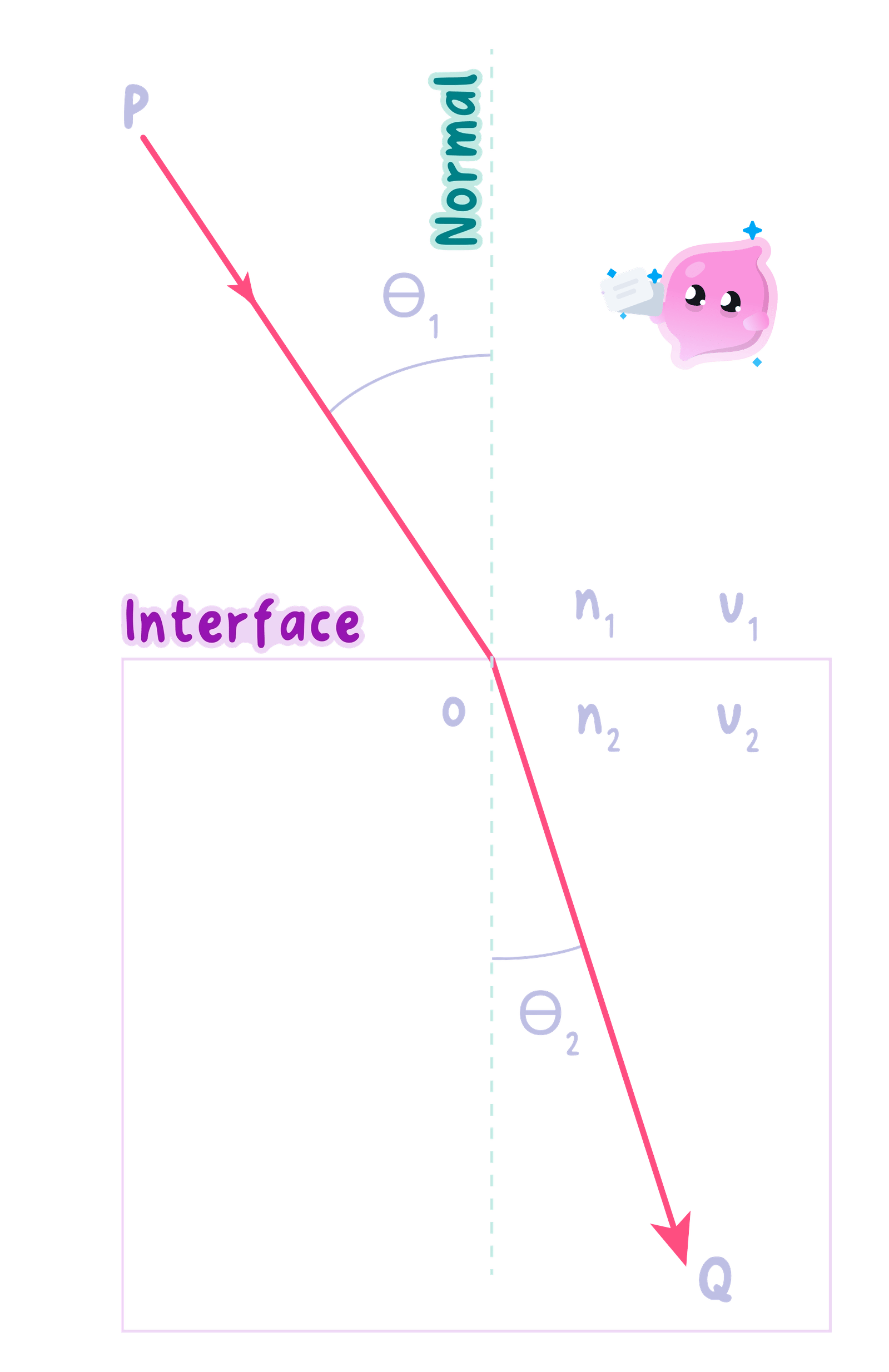
Refraction
The change in direction of a wave caused by a change in speed as it passes from one medium into another.
- Electromagnetic waves travel at 3.0×10⁸ m s−13.0\times10^8\,\text{m s}^{-1}3.0×10⁸m s−1 in a vacuum but usually travel more slowly in transparent substances.
- When a wave crosses a boundary, its frequency remains constant because the source fixes the frequency.
- The relationship v=fλv=f\lambdav=fλ means that a lower speed at constant frequency produces a shorter wavelength.
- A higher speed at constant frequency produces a longer wavelength.
Example
Calculating wavelength in glass
- Light has frequency 6.0×10¹⁴ Hz6.0\times10^{14}\,\text{Hz}6.0×10¹⁴Hz and speed 2.0×10⁸ m s−12.0\times10^8\,\text{m s}^{-1}2.0×10⁸m s−1 in glass.
- Use λ=vf=2.0×1086.0×1014=3.3×10⁻⁷ m\lambda=\dfrac{v}{f}=\dfrac{2.0\times10^8}{6.0\times10^{14}}=3.3\times10^{-7}\,\text{m}λ=fv=6.0×10142.0×108=3.3×10⁻⁷m.
Speed determines the direction of bending
- A ray entering a slower substance at an angle bends towards the normal.
- A ray entering a faster substance at an angle bends away from the normal.
- A ray crossing along the normal changes speed and wavelength but does not change direction.
- The greater the change in speed between two substances, the greater the change in direction for the same angle of incidence.
Frequency stays fixed across the boundary
Definition
Frequency
The number of complete waves or oscillations passing a point each second.
- Wave crests cannot accumulate or disappear at a boundary, so the number of cycles crossing each second is unchanged.
- For light entering glass from air, speed decreases, frequency stays constant and wavelength decreases.
- For light leaving glass for air, speed increases, frequency stays constant and wavelength increases.
Example
Comparing wavelengths
- A wave travels at 3.0×10⁸ m s−13.0\times10^8\,\text{m s}^{-1}3.0×10⁸m s−1 in air and 2.0×10⁸ m s−12.0\times10^8\,\text{m s}^{-1}2.0×10⁸m s−1 in glass.
- At constant frequency, λglassλair=vglassvair=2.03.0\dfrac{\lambda_{\text{glass}}}{\lambda_{\text{air}}}=\dfrac{v_{\text{glass}}}{v_{\text{air}}}=\dfrac{2.0}{3.0}λairλglass=vairvglass=3.02.0, so the wavelength in glass is two-thirds of the wavelength in air.
Ray explanations need a complete chain
- First state whether the wave speed increases or decreases on entering the new substance.
- Then state that the frequency is unchanged.
- Use v=fλv=f\lambdav=fλ to determine whether wavelength increases or decreases.
- Finally state whether the ray bends towards or away from the normal when it meets the boundary at an angle.
Common Mistake
- Do not say that frequency decreases when light slows down in glass; frequency remains constant and wavelength decreases.
- Do not describe bending for a ray travelling along the normal.
Calculations use one consistent set of units
- Use wave speed in m s−1\text{m s}^{-1}m s−1, frequency in Hz\text{Hz}Hz and wavelength in m\text{m}m.
- Convert nanometres using 1 nm=1×10⁻⁹ m1\,\text{nm}=1\times10^{-9}\,\text{m}1nm=1×10⁻⁹m before substituting into v=fλv=f\lambdav=fλ.
- A correct numerical answer should include a unit and an appropriate number of significant figures.
Exam technique
- For an explanation, link speed change, constant frequency, wavelength change and direction of bending.
- For a calculation, show the rearrangement before substitution and keep powers of ten in standard form.
Self review
- What happens to the speed of light when it enters glass from air?
- Why does frequency stay constant at a boundary?
- How does wavelength change when speed decreases at constant frequency?
- When does a ray bend towards the normal?
- What units are used in v=fλv=f\lambdav=fλ?
