Temperature controls thermal radiation
Definition
Thermal radiation
Electromagnetic radiation emitted by an object because of its temperature.
- Every object above absolute zero emits electromagnetic radiation, including objects that feel cold.
- At everyday temperatures, most emitted radiation is infrared, which is invisible to the human eye.
- As temperature rises, the total intensity of emitted radiation increases, so more energy is transferred each second from each square metre of surface.
- A sufficiently hot object also emits visible light, changing from dull red towards orange, yellow and white as its temperature rises.
Hotter objects emit shorter wavelengths
Definition
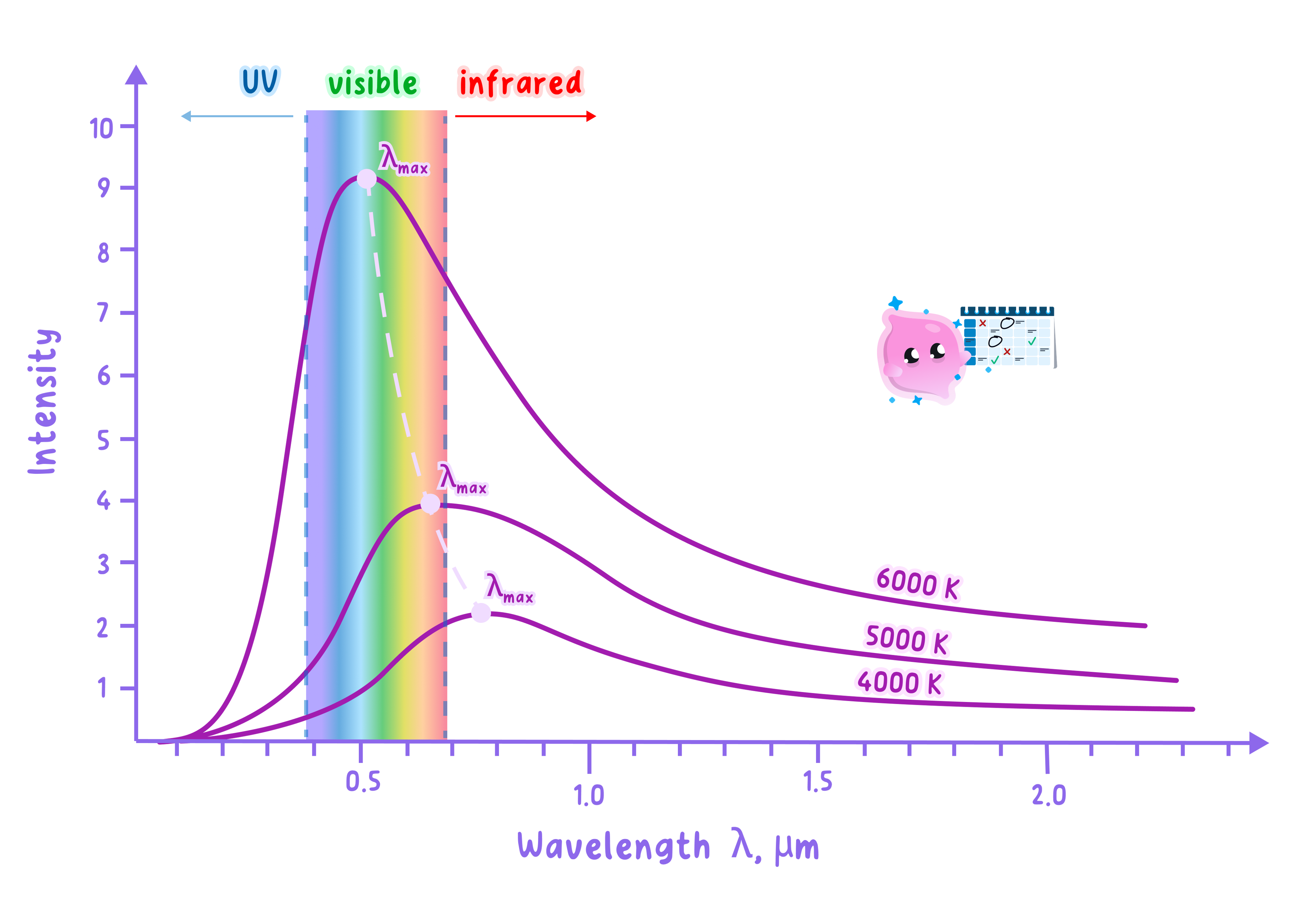
Wavelength distribution
A graph or pattern showing how the intensity of radiation emitted by an object is spread across a range of wavelengths.
- An object emits a continuous range of wavelengths rather than one exact wavelength.
- The peak wavelength is the wavelength at which the emitted intensity is greatest.
- As temperature increases, the curve becomes higher and its peak shifts to a shorter wavelength.
- The greater area beneath the hotter curve represents a greater total power emitted.
Example
Comparing two identical surfaces
- A surface at 600 K600\,\text{K}600K emits radiation with greater total intensity than the same surface at 300 K300\,\text{K}300K.
- Its wavelength distribution peaks at a shorter wavelength.
- Both surfaces still emit a range of wavelengths, mainly in the infrared at these temperatures.
Common Mistake
Do not write that only glowing objects emit radiation; glowing objects are hot enough for part of their emission to lie in the visible range.
Exam technique
Write a complete comparison
- State that both objects emit radiation.
- State that the hotter object emits with greater intensity.
- State that the hotter object's distribution peaks at a shorter wavelength.
Self review
- What is thermal radiation?
- How does emitted intensity change as temperature rises?
- What happens to peak wavelength as temperature rises?
- Why can a very hot object glow visibly?
