Question 3
FA student finds the density of a small stone.
The Figure shows the reading on a top-pan balance with the stone on it, and a measuring cylinder before and after the stone is added.
Figure
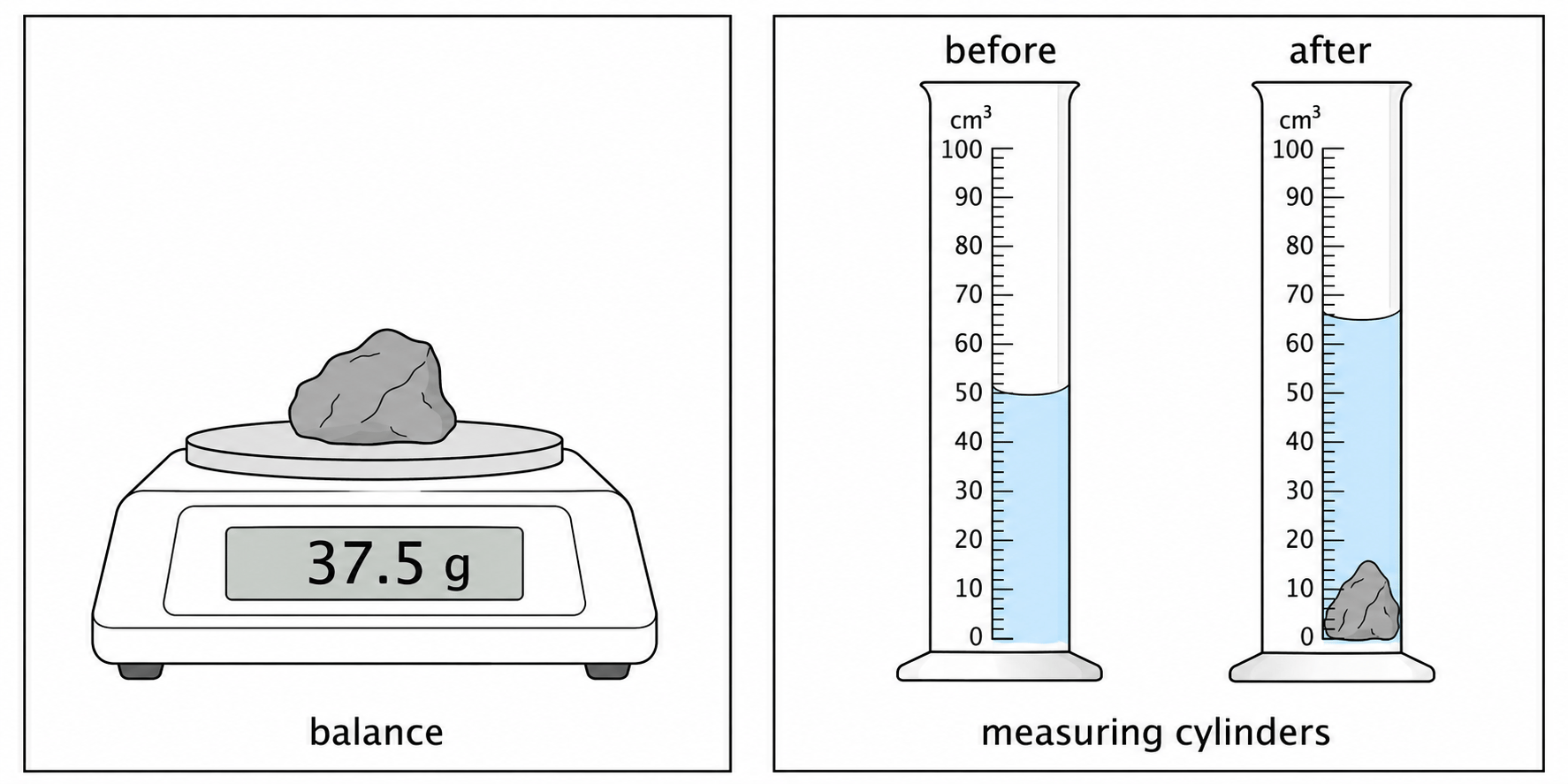
a.[1]
Determine the volume of the stone in cm3\text{cm}^{3}cm3.
b.[2]
Calculate the density of the stone in g/cm3\text{g/cm}^{3}g/cm3.
Use the equation
density=mass÷volume\text{density} = \text{mass} \div \text{volume}density=mass÷volume
c.[3]
Calculate the density of the stone in kg/m3\text{kg/m}^{3}kg/m3.
Use 1 m3=1 000 000 cm31\ \text{m}^{3} = 1\,000\,000\ \text{cm}^{3}1 m3=1000000 cm3.
d.[2]
Explain why the density in kg/m3\text{kg/m}^{3}kg/m3 is 1000 times the density in g/cm3\text{g/cm}^{3}g/cm3.
1.1 Units and quantities Questions
39 exam-style questions on Edexcel GCSE Physics 1.1 Units and quantities, covering 1.1.1 SI units for physical quantities and 1.1.2 Unit prefixes, conversions, significant figures and standard form. Each one has a worked solution and a mark scheme showing where the marks go.