Clockwise and anticlockwise moments
Definition
Principle of moments
The principle of moments states that for rotational forces in equilibrium, the sum of the clockwise moments about a pivot equals the sum of the anticlockwise moments about that same pivot.
- Every moment turns an object one of two ways about its pivot, either clockwise or anticlockwise.
- The direction is found by picturing which way the object would begin to rotate if that force acted on its own.
- On a seesaw with a central pivot, a weight on the right-hand side produces a clockwise moment and a weight on the left-hand side produces an anticlockwise moment.
- Several forces can turn the object the same way, so a beam may carry two or three clockwise moments at once and they are added together.
- When the total turning effect one way exactly matches the total the other way, there is no resultant moment and the object will not start to rotate.
- The principle of moments states that for rotational forces in equilibrium, sum of clockwise moments=sum of anticlockwise moments\text{sum of clockwise moments} = \text{sum of anticlockwise moments}sum of clockwise moments=sum of anticlockwise moments.
- Every moment in that statement must be taken about the same pivot, because a moment has no meaning until the pivot it turns about has been named.
- Equilibrium here does not mean that there are no moments, only that the clockwise total and the anticlockwise total are equal in size.
- If the two totals are not equal there is a resultant moment, and the object turns in the direction of the larger total.
- The pivot itself pushes on the object, but its line of action passes through the pivot, so it contributes no moment to either total.
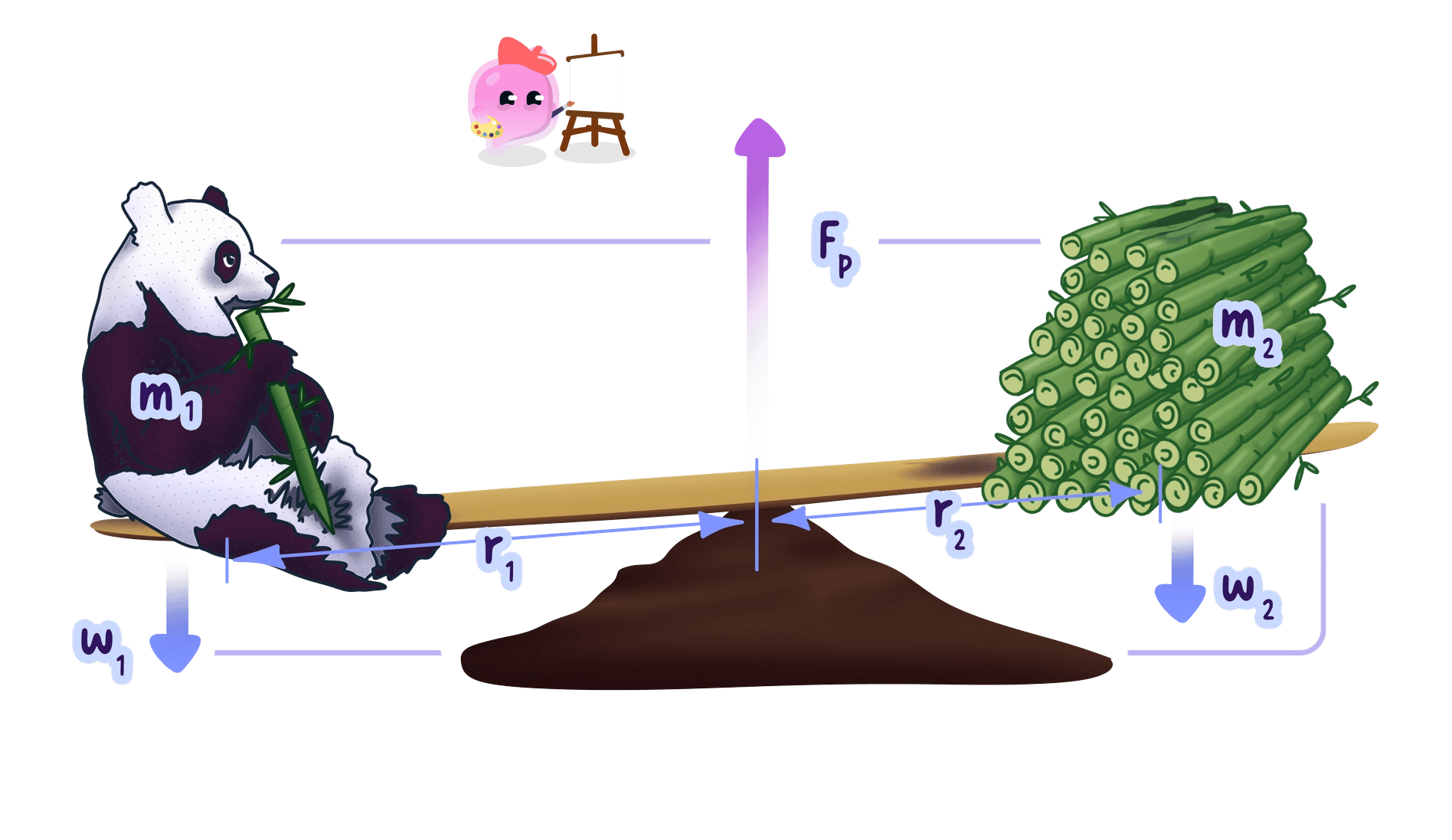
Using the principle in a calculation
- Each moment in the sum is worked out from M=F dM = F\,dM=Fd, using the perpendicular distance from the pivot to that particular force.
- The working follows a fixed order.
- Mark the pivot and label every force with its distance from it.
- Decide whether each force turns the object clockwise or anticlockwise.
- Calculate every clockwise moment and add them together.
- Calculate every anticlockwise moment and add them together.
- Set the two totals equal to each other, because the object is in equilibrium.
- Rearrange to find the unknown force or distance, and give the unit.
- When a load is given as a mass, turn it into a weight with W=m gW = m\,gW=mg before taking any moments, using the gravitational field strength stated in the question.
- The weight of a uniform beam acts at its centre of mass, which is the middle of the beam, so the beam's own weight produces a moment whenever the pivot is not at that point.
- A force whose line of action passes through the pivot contributes nothing to either total, so it can be left out of the sum entirely.
- A useful check is that the heavier load always sits closer to the pivot, because a larger force needs a smaller distance to give the same moment.
Example
Balancing a seesaw
- A child of weight 300 N300\ \text{N}300 N sits 1.2 m1.2\ \text{m}1.2 m to the left of the pivot of a seesaw, and a second child of weight 450 N450\ \text{N}450 N sits at an unknown distance ddd to the right, so that the seesaw balances.
- The anticlockwise moment is 300 N×1.2 m=360 N m300\ \text{N} \times 1.2\ \text{m} = 360\ \text{N m}300 N×1.2 m=360 N m.
- The clockwise moment is 450 N×d450\ \text{N} \times d450 N×d.
- Applying the principle of moments gives 450 d=360450\,d = 360450d=360.
- Rearranging gives d=360450=0.80 md = \dfrac{360}{450} = 0.80\ \text{m}d=450360=0.80 m.
- The heavier child sits 0.80 m0.80\ \text{m}0.80 m from the pivot, which is closer in than the lighter child, as expected.
Example
A beam carrying several moments
- A beam rests on a central pivot and carries two loads on the left and two on the right.
- The two left-hand loads produce anticlockwise moments of 18 N m18\ \text{N m}18 N m and 7 N m7\ \text{N m}7 N m.
- One right-hand load produces a clockwise moment of 9 N m9\ \text{N m}9 N m, and the second produces an unknown clockwise moment MMM.
- The anticlockwise total is 18+7=25 N m18 + 7 = 25\ \text{N m}18+7=25 N m.
- The clockwise total is 9+M9 + M9+M.
- Setting the totals equal gives 25=9+M25 = 9 + M25=9+M, so M=16 N mM = 16\ \text{N m}M=16 N m.
- Both totals now come to 25 N m25\ \text{N m}25 N m, which confirms that the beam is in rotational equilibrium.
Common Mistake
- Do not compare only one moment on each side when a question gives several forces, because every moment about the pivot belongs in the totals.
- Do not take moments about a different point for each force, since the principle only holds when all the moments are about one named pivot.
- Do not ignore the weight of a heavy uniform beam, because it acts at the centre of mass and produces a moment whenever the pivot is somewhere else.
- Do not describe a balanced beam as having no forces on it, because the pivot pushes upwards with a force equal to the total downward force.
Exam technique
Laying out a moments answer
- State the principle of moments in words or symbols before substituting any numbers into it.
- Label each moment as clockwise or anticlockwise as you calculate it, so the two totals stay separate.
- Keep every distance in metres and every force in newtons, and write N m\text{N m}N m on the final answer.
- Convert a mass into a weight before taking moments, because a mass in kilograms cannot be used in M=F dM = F\,dM=Fd.
- If the question asks why something balances, say that the clockwise and anticlockwise moments about the pivot are equal rather than saying that the forces are equal.
Self review
- State the principle of moments in full.
- Explain why every moment in the sum must be taken about the same pivot.
- Explain why a heavier child must sit closer to the pivot of a seesaw in order to balance a lighter one.
- Calculate the distance at which a 200 N200\ \text{N}200 N weight balances a 400 N400\ \text{N}400 N weight placed 0.50 m0.50\ \text{m}0.50 m from the pivot.
- Explain where the weight of a uniform beam acts and when it produces a moment.
