Question 15
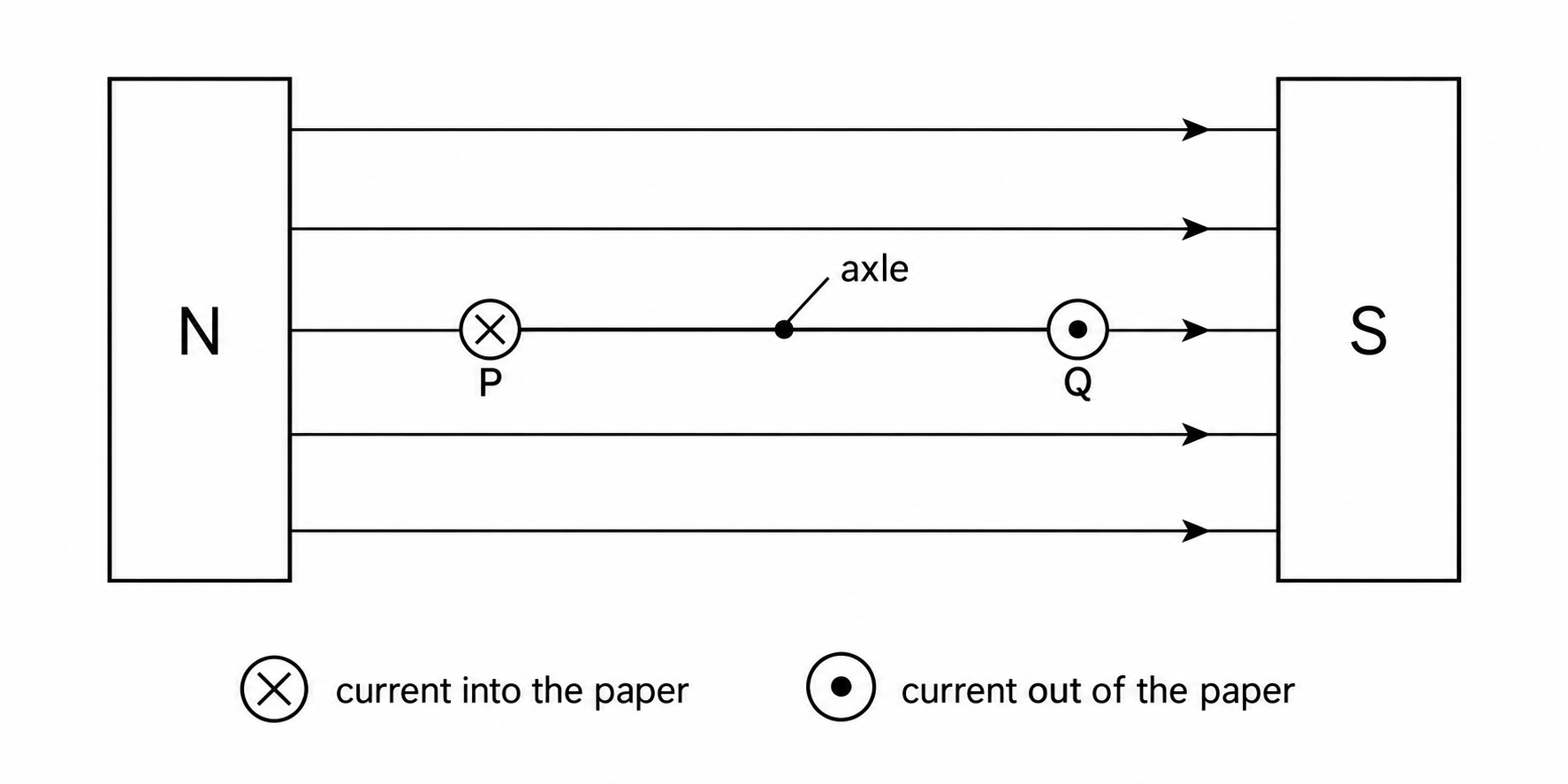
HThe Figure shows the coil of a simple electric motor seen from one end. The coil can turn about an axle at its centre.
The coil is horizontal at the instant shown. The current in side P is into the paper and the current in side Q is out of the paper.
Figure
a.[2]
Determine the direction of the force on side P and the direction of the force on side Q.
b.[2]
The forces on sides P and Q are equal in size and opposite in direction.
Explain why the coil still turns.
c.[2]
After a quarter of a turn, the coil is vertical with side P at the bottom. The current in the coil has not yet been reversed.
Explain why the forces on the coil do not produce a turning effect in this position.
d.[1]
Explain why the coil does not stop in the vertical position.
12.3 The motor effect Questions
86 exam-style questions on Edexcel GCSE Physics 12.3 The motor effect, covering 12.3.1 The motor effect, 12.3.2 Fleming's left-hand rule, 12.3.3 Force on a conductor, and 12.3.4 Electric motors. Each one has a worked solution and a mark scheme showing where the marks go.