Question 14
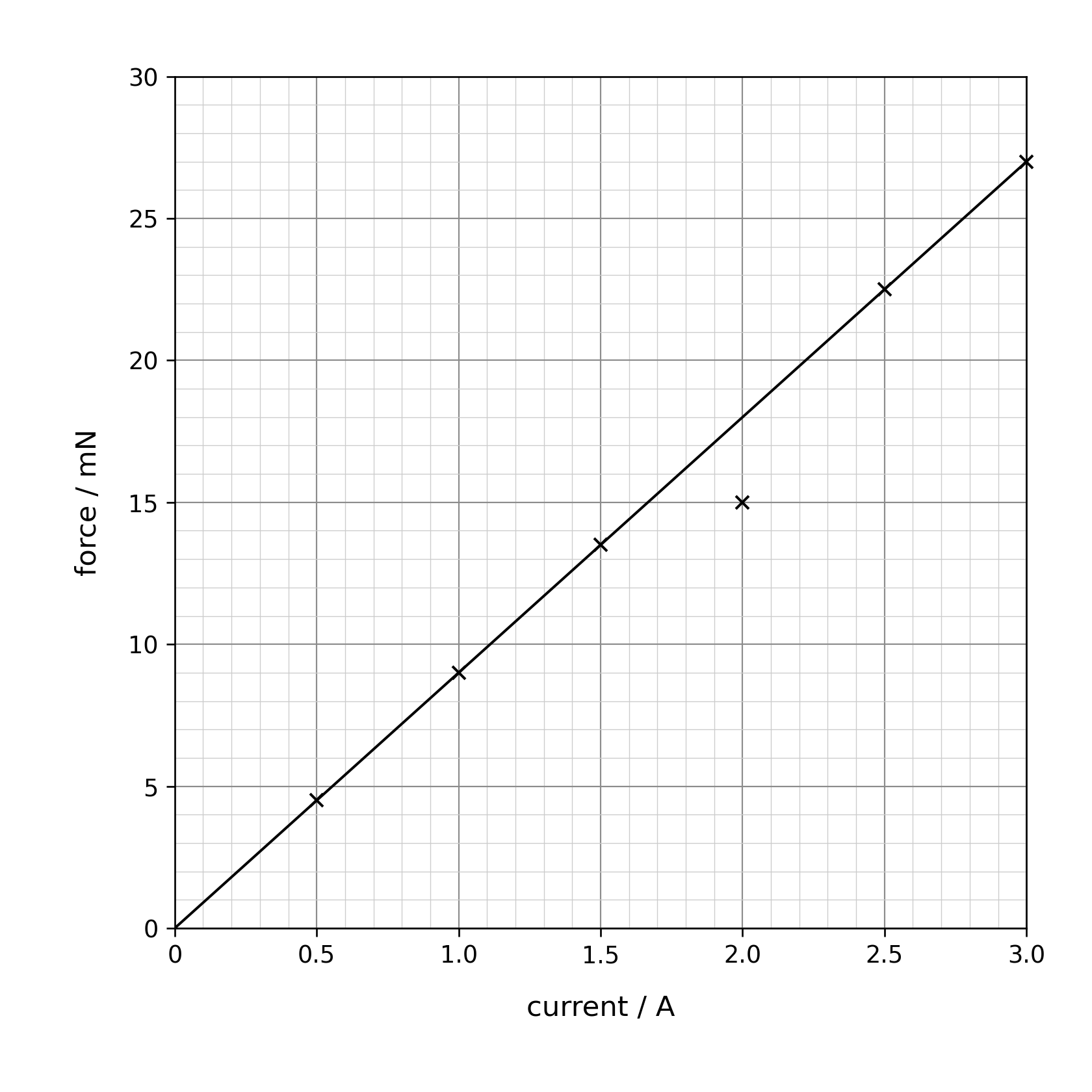
HA student measures the force on a wire in a magnetic field for different currents.
The wire is at right angles to the magnetic field. The length of wire in the field is 6.0 cm.
The Figure shows a graph of the results.
Figure
a.[1]
Identify the anomalous result.
b.[3]
Determine the gradient of the line.
Give the unit.
c.[2]
The equation for the force on the wire is
F=B×I×lF = B \times I \times lF=B×I×l
Explain why the gradient of the graph is equal to B×lB \times lB×l.
d.[2]
Calculate the magnetic flux density.
12.3 The motor effect Questions
86 exam-style questions on Edexcel GCSE Physics 12.3 The motor effect, covering 12.3.1 The motor effect, 12.3.2 Fleming's left-hand rule, 12.3.3 Force on a conductor, and 12.3.4 Electric motors. Each one has a worked solution and a mark scheme showing where the marks go.