Question 12
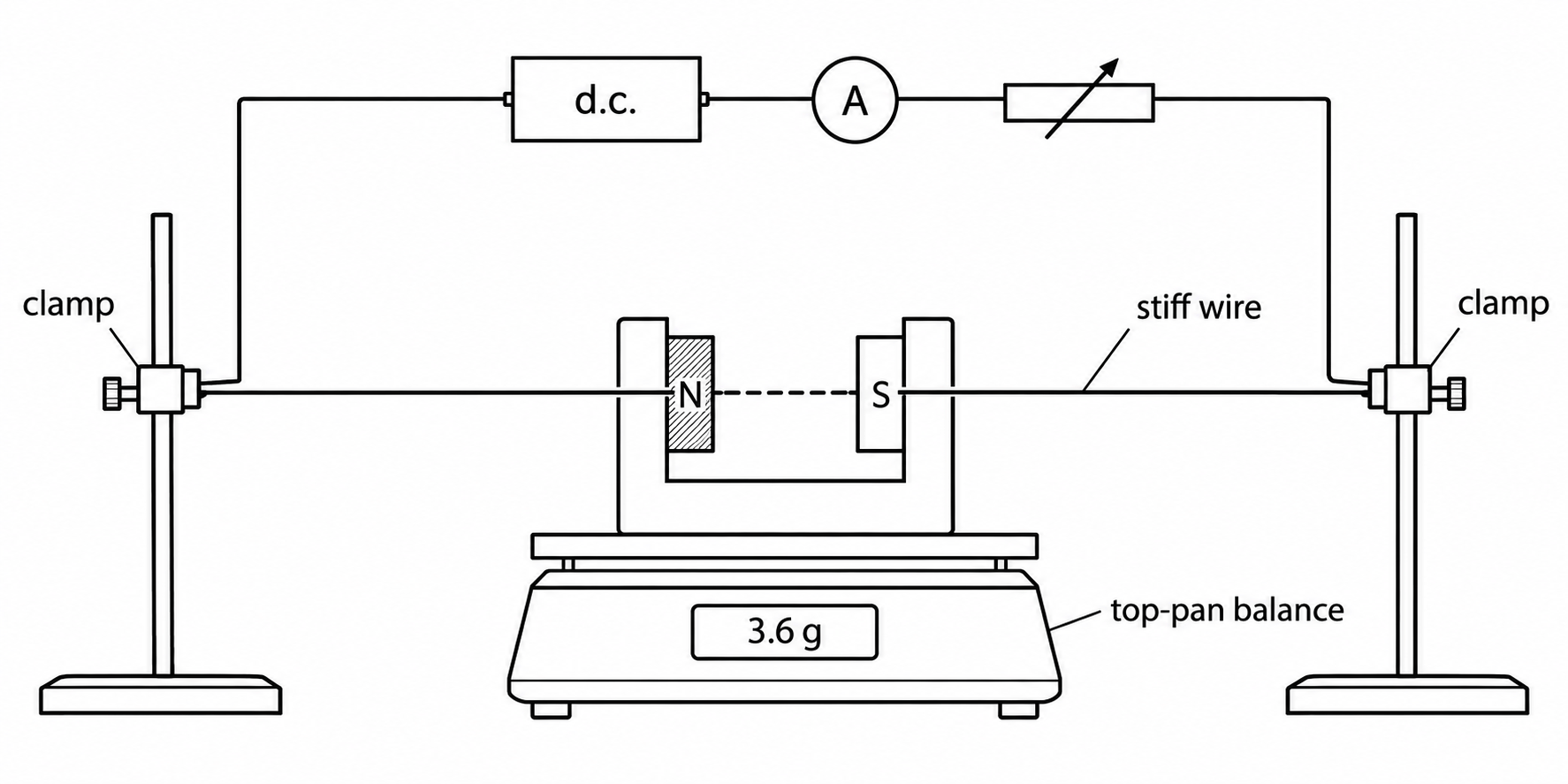
HThe Figure shows apparatus used to measure the force on a wire in a magnetic field.
A magnet rests on a top-pan balance. A stiff horizontal wire is clamped above the balance so that part of the wire is between the poles of the magnet. The wire does not touch the magnet.
The balance is set to read 0.00 g when there is no current in the wire.
When the current in the wire is 4.0 A, the reading on the balance is 3.6 g.
Figure
a.[3]
Explain why the reading on the balance increases when there is a current in the wire.
b.[2]
Calculate the size of the force on the wire.
Use g=10 N/kgg = 10\ \text{N/kg}g=10 N/kg.
c.[3]
The length of wire in the magnetic field is 5.0 cm.
Calculate the magnetic flux density between the poles of the magnet.
Use the equation
F=B×I×lF = B \times I \times lF=B×I×l
d.[2]
The current in the wire is reversed. The size of the current is still 4.0 A.
Predict the reading on the balance.
Give a reason for your answer.
12.3 The motor effect Questions
86 exam-style questions on Edexcel GCSE Physics 12.3 The motor effect, covering 12.3.1 The motor effect, 12.3.2 Fleming's left-hand rule, 12.3.3 Force on a conductor, and 12.3.4 Electric motors. Each one has a worked solution and a mark scheme showing where the marks go.