The Doppler effect
Definition
Doppler effect
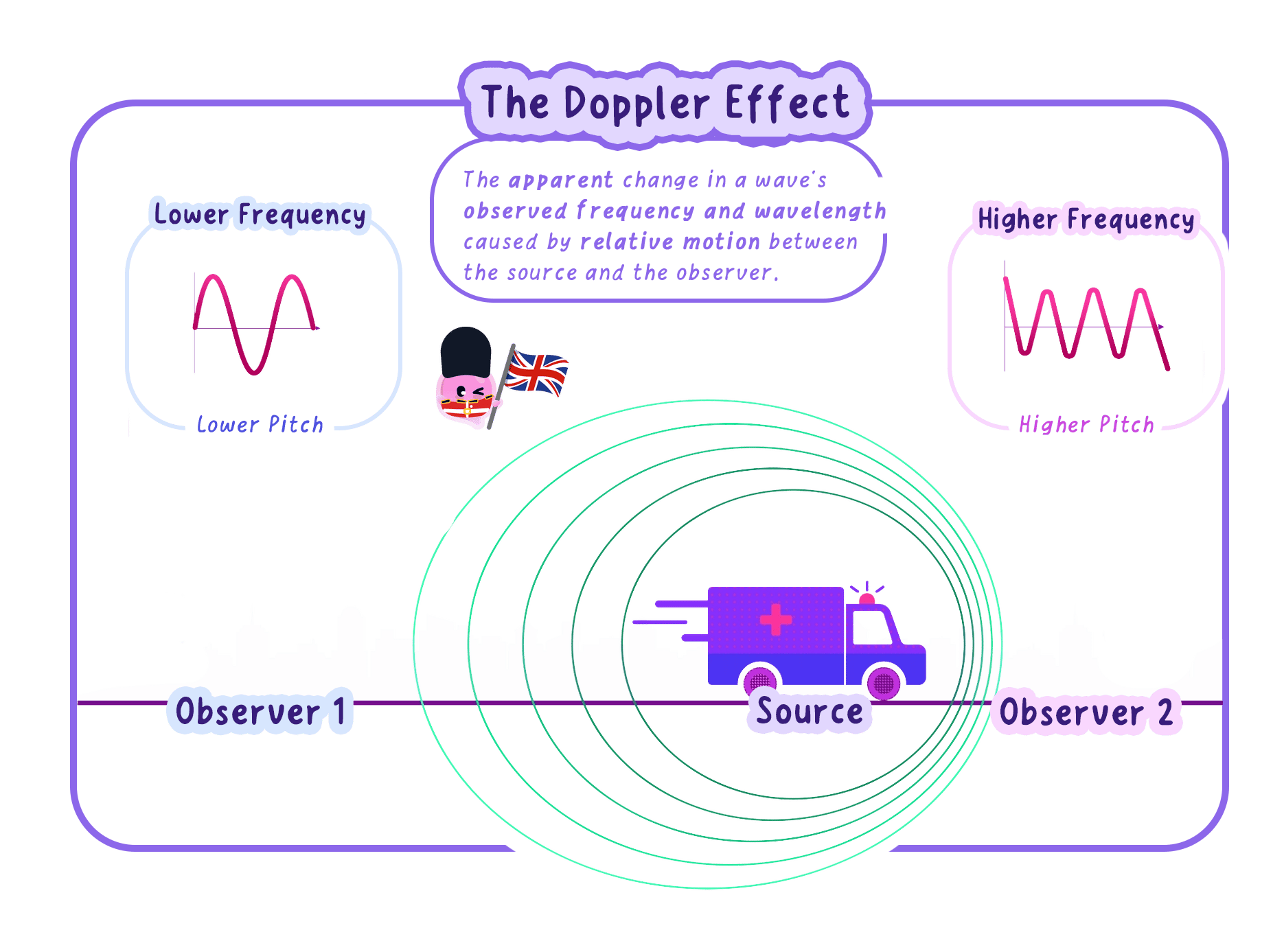
The Doppler effect is the change in the observed frequency and wavelength of a wave that occurs when the source is moving relative to the observer.
Definition
Frequency
The number of complete waves or oscillations passing a point each second.
Definition
Wavelength
The distance between consecutive points on a wave that are at the same stage of an oscillation.
- A stationary source sends out waves as a set of evenly spaced circles, so every observer around it measures the same wavelength and the same frequency.
- Once the source starts to move it travels a short distance between sending out one wave and sending out the next, so each new wave leaves from a slightly different place.
- Ahead of the moving source the waves are squashed together, so an observer in front measures a shorter wavelength and a higher frequency.
- Behind the moving source the waves are stretched apart, so an observer behind measures a longer wavelength and a lower frequency.
- Only the relative motion of source and observer matters, so the same change is measured whether the source approaches the observer or the observer approaches the source.
- The source itself never changes what it emits, since the change is created entirely by the motion and appears only in what the observer receives.
- Wavelength and frequency shift in opposite senses because the wave speed is set by the material the wave travels through, and v=f×λv = f \times \lambdav=f×λ must still hold.
Sound from a moving source
- The everyday example is an ambulance siren heard from the pavement as the ambulance drives past.
- While the ambulance approaches, the sound waves reaching you are compressed, the frequency you hear is higher than the siren produces, and the note sounds higher pitched.
- The moment the ambulance passes, the waves reaching you are stretched instead, and the note drops to a lower pitch even though the siren has been set to one steady note throughout.
- The driver hears no change at all, because the ambulance and the siren are not moving relative to each other.
- The speed of sound in the air stays at about 340 m/s340\ \text{m/s}340 m/s the whole time, so a shorter wavelength has to mean a higher frequency.
- The faster the source travels, the larger the change in the observed frequency, which is why a passing racing car produces a far more dramatic drop than a passing bicycle bell.
Light from a moving source
Definition
Red-shift
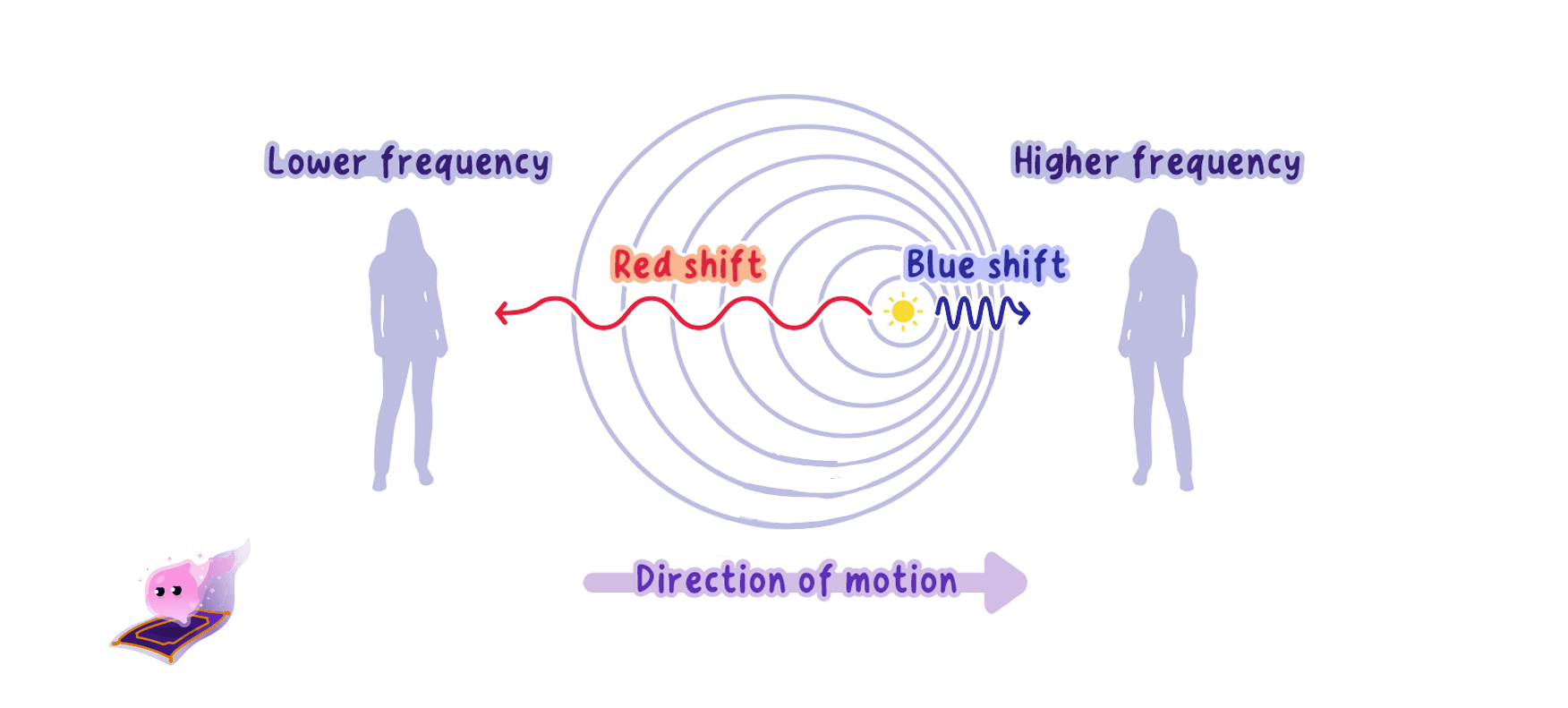
Red-shift is the increase in the observed wavelength, and decrease in the observed frequency, of light from a source that is moving away from the observer.
Definition
Blue-shift
Blue-shift is the decrease in the observed wavelength, and increase in the observed frequency, of light from a source that is moving towards the observer.
- Light is a wave, so a light source moving relative to an observer produces the same change in observed wavelength and frequency as a moving sound source does.
- A source moving away gives a longer observed wavelength and a lower observed frequency, and the light is described as red-shifted because red sits at the long wavelength end of the visible spectrum.
- A source moving towards the observer gives a shorter observed wavelength and a higher observed frequency, and the light is described as blue-shifted.
- The shift is detected by comparing the wavelengths of absorption lines from a star with the wavelengths the same elements produce in a laboratory.
- Everyday speeds give shifts far too small to notice, because light travels at 3.0×10⁸ m/s3.0 \times 10^{8}\ \text{m/s}3.0×108 m/s and a car is slower than that by a factor of many millions.
- The size of the shift depends on how fast the source is moving along the line of sight, so a larger shift means a larger speed of approach or recession.
Example
Pitch of an approaching siren
- A siren produces a steady note of frequency 850 Hz850\ \text{Hz}850 Hz and the speed of sound in air is 340 m/s340\ \text{m/s}340 m/s.
- Rearranging v=f×λv = f \times \lambdav=f×λ gives λ=vf=340850=0.40 m\lambda = \dfrac{v}{f} = \dfrac{340}{850} = 0.40\ \text{m}λ=fv=850340=0.40 m for a stationary siren.
- As the source drives towards a listener the waves ahead of it are compressed and the observed wavelength falls to 0.36 m0.36\ \text{m}0.36 m.
- The speed of sound in the air is unchanged, so f=vλ=3400.36f = \dfrac{v}{\lambda} = \dfrac{340}{0.36}f=λv=0.36340.
- The observed frequency is about 940 Hz940\ \text{Hz}940 Hz, which is higher than the emitted frequency and is heard as a higher pitch.
Example
A star moving towards the Earth
- A hydrogen line has a laboratory wavelength of 486 nm486\ \text{nm}486 nm and is recorded from a star at 480 nm480\ \text{nm}480 nm.
- The observed wavelength is shorter than the laboratory value, so the light is blue-shifted.
- Using f=vλf = \dfrac{v}{\lambda}f=λv the laboratory frequency is 3.0×108486×10−9=6.17×10¹⁴ Hz\dfrac{3.0 \times 10^{8}}{486 \times 10^{-9}} = 6.17 \times 10^{14}\ \text{Hz}486×10−93.0×108=6.17×10¹⁴ Hz.
- The observed frequency is 3.0×108480×10−9=6.25×10¹⁴ Hz\dfrac{3.0 \times 10^{8}}{480 \times 10^{-9}} = 6.25 \times 10^{14}\ \text{Hz}480×10−93.0×108=6.25×10¹⁴ Hz, which is higher.
- A shorter wavelength and a higher frequency together show that the star is moving towards the Earth.
Exam technique
Describing an observed change
- Say observed frequency and observed wavelength rather than just frequency and wavelength, because the emitted values never change.
- Give the change in both quantities, since a mark is usually available for the wavelength and another for the frequency.
- State the direction of motion clearly as towards or away from the observer, because approaching and receding give opposite answers.
- Keep the wave speed constant in any calculation, and use v=f×λv = f \times \lambdav=f×λ to convert between the two observed quantities.
- Convert nanometres to metres before substituting, since 486 nm486\ \text{nm}486 nm is 486×10−9 m486 \times 10^{-9}\ \text{m}486×10−9 m.
Common Mistake
- Do not say that the source changes the frequency it emits, because the source is unchanged and only the observed value differs.
- Do not say the wave travels faster when the source approaches, since the wave speed depends on the material rather than the motion of the source.
- Do not let wavelength and frequency change in the same direction, because one rises exactly as the other falls.
- Do not confuse loudness with pitch, because a passing siren changes pitch while its loudness changes for a different reason.
Self review
- State what happens to the observed wavelength and frequency when a source moves towards an observer.
- Explain why the waves ahead of a moving source are closer together.
- Describe what the driver of an ambulance hears compared with a person on the pavement.
- Define red-shift and blue-shift in terms of observed wavelength.
- Calculate the observed frequency of a sound of wavelength 0.36 m0.36\ \text{m}0.36 m travelling at 340 m/s340\ \text{m/s}340 m/s.
