What counts as evidence
Definition
Big Bang theory
The Big Bang theory states that the Universe began from a very small, extremely hot and dense region that has been expanding and cooling ever since.
Definition
Galaxy
A galaxy is a very large collection of stars, gas and dust held together by gravity.
- A theory about the Universe cannot be tested in a laboratory, so it is judged by whether its predictions match what telescopes actually record.
- Two observations are treated as the supporting evidence for the Big Bang theory, the red-shift of light from distant galaxies and the cosmic microwave background radiation.
- Each of these is a measurement made with instruments rather than an argument, which is what makes them evidence rather than opinion.
- Both have been repeated by many independent teams using different telescopes, so neither depends on a single result that might be a fault in one instrument.
Red-shift of distant galaxies
Definition
Red-shift
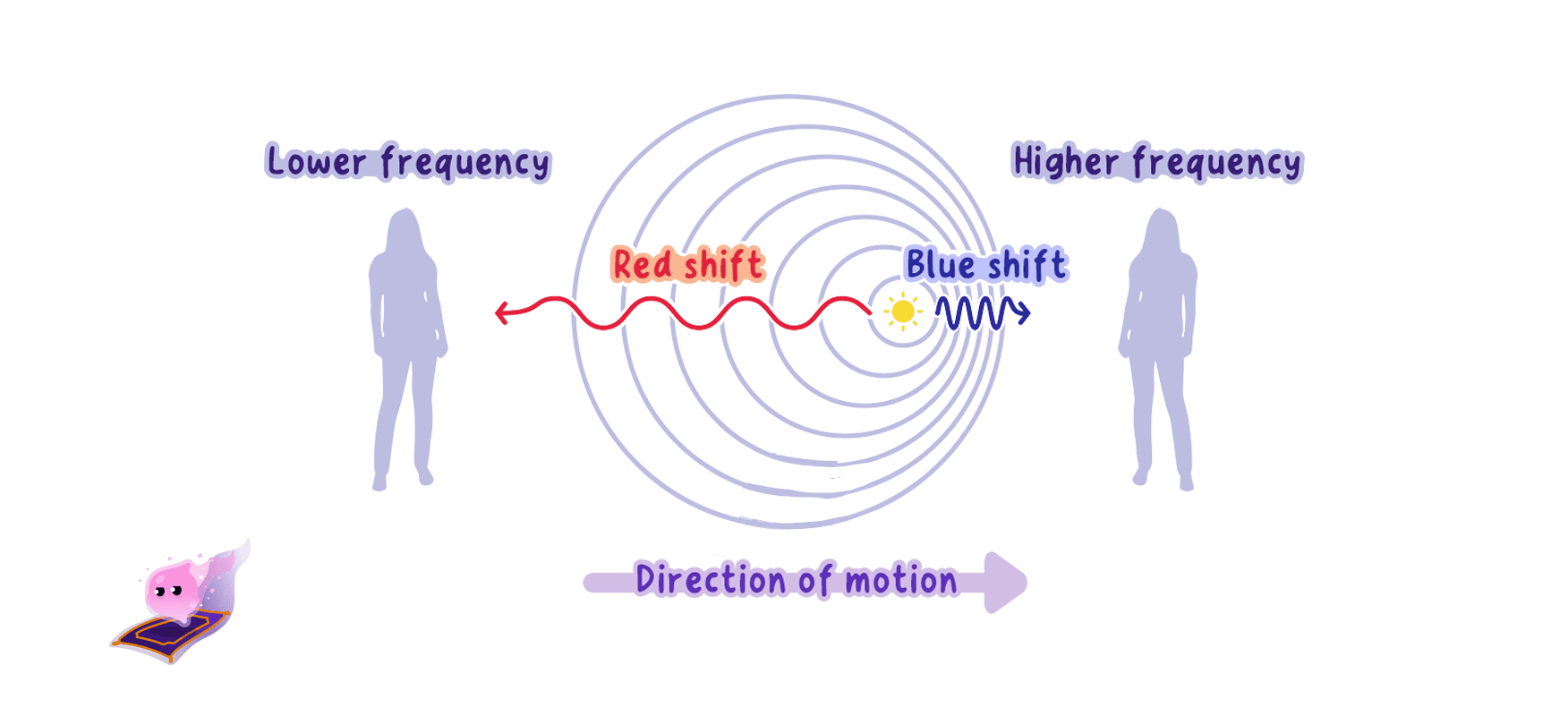
Red-shift is the increase in the observed wavelength, and decrease in the observed frequency, of light from a source that is moving away from the observer.
- Light from a galaxy is split into a spectrum, and that spectrum carries a pattern of dark absorption lines produced by the elements in the outer layers of its stars.
- The same elements produce the same pattern in a laboratory on Earth, so the two spectra can be laid side by side and compared directly.
- In the light from a distant galaxy the whole pattern sits at longer wavelengths, which means it has moved towards the red end of the visible spectrum.
- The spacing and order of the lines are unchanged, so the elements in the galaxy are the same as those on Earth and only the wavelengths have shifted.
- Almost every galaxy shows this shift, and the more distant the galaxy the larger the shift measured.
- A red-shift is produced when a source of light moves away from the observer, so the measurement shows that these galaxies are receding from us.
The cosmic microwave background
Definition
Cosmic microwave background radiation
Cosmic microwave background radiation is faint microwave radiation of almost the same intensity that reaches the Earth from every direction in space.
- A faint signal in the microwave part of the electromagnetic spectrum arrives at the Earth from every direction in the sky.
- It does not come from any star, galaxy or other object that can be pointed at, and it is present even where the sky looks completely empty.
- Its intensity is almost exactly the same in every direction, with variations of only a tiny fraction of the total.
- The radiation matches what a body at a temperature just under 3 K3\ \text{K}3 K would emit, which is only a few kelvin above absolute zero.
- The Big Bang theory accounts for it as radiation released when the young Universe was extremely hot, stretched to microwave wavelengths by the expansion of space since then.
- On that account the microwave background is leftover heat radiation that has been cooling for the whole life of the Universe.
Why this evidence carries weight
- The microwave background was predicted before it was found, so the Big Bang theory was committed to it in advance rather than fitted to it afterwards.
- A prediction that is confirmed later is stronger support than an explanation invented once the measurement is already known.
- The two pieces of evidence are independent, since one uses visible light from individual galaxies and the other uses microwaves from empty sky.
- Agreement between independent measurements is what turns a plausible idea into an accepted theory.
- Neither observation counts as proof, because a scientific theory is always open to being replaced if a later measurement contradicts it.
Example
Measuring a shift in a spectrum
- A hydrogen absorption line is measured in the laboratory at a wavelength of 656 nm656\ \text{nm}656 nm.
- The same line in the spectrum of a distant galaxy is recorded at 673 nm673\ \text{nm}673 nm.
- The change in wavelength is 673−656=17 nm673 - 656 = 17\ \text{nm}673−656=17 nm, and the wavelength has increased.
- As a fraction of the original wavelength this is 17656=0.026\dfrac{17}{656} = 0.02665617=0.026, so the line is red-shifted by about 2.6%2.6\%2.6%.
- A longer observed wavelength means the galaxy is moving away from the Earth.
Example
Frequency of the background signal
- The microwave background is strongest at a wavelength of about 1.1 mm1.1\ \text{mm}1.1 mm, which is 1.1×10⁻³ m1.1 \times 10^{-3}\ \text{m}1.1×10⁻³ m.
- All electromagnetic waves travel through space at 3.0×10⁸ m/s3.0 \times 10^{8}\ \text{m/s}3.0×108 m/s.
- Rearranging v=f×λv = f \times \lambdav=f×λ gives f=vλf = \dfrac{v}{\lambda}f=λv.
- Substituting gives f=3.0×1081.1×10−3=2.7×10¹¹ Hzf = \dfrac{3.0 \times 10^{8}}{1.1 \times 10^{-3}} = 2.7 \times 10^{11}\ \text{Hz}f=1.1×10−33.0×108=2.7×10¹¹ Hz.
- That frequency sits in the microwave region, well below the frequency of the visible light that was released when the radiation was first produced.
Exam technique
Naming the evidence precisely
- Give both pieces of evidence when a question asks for evidence, because the two carry a mark each and only these two are examinable.
- Describe the observation and not just its name, so write that the absorption lines are shifted towards longer wavelengths rather than writing red-shift on its own.
- Use the full phrase cosmic microwave background radiation at least once before shortening it to CMB.
- Say that the microwave signal comes from all directions, since that detail separates it from radiation coming from a particular object.
- Subtract wavelengths in the order observed value minus laboratory value, and state that the wavelength has increased.
Common Mistake
- Do not write that red-shift makes a galaxy look red, because the whole pattern of lines moves and the change is measured rather than seen by eye.
- Do not describe the microwave background as coming from one direction or one object, since it fills the whole sky.
- Do not offer evidence outside the two named observations, because the examiners credit only red-shift and the cosmic microwave background radiation.
- Do not call this evidence proof, because evidence supports a theory rather than settling it permanently.
Self review
- Name the two pieces of evidence that support the Big Bang theory.
- Describe what happens to the absorption lines in the spectrum of a distant galaxy.
- State how the size of the red-shift depends on the distance to the galaxy.
- Describe two features of the cosmic microwave background radiation.
- Explain why a confirmed prediction gives stronger support than an explanation offered afterwards.
