Atoms have a tiny, massive nucleus
Definition
Atom
The smallest particle of an element that can exist while retaining the properties of that element.
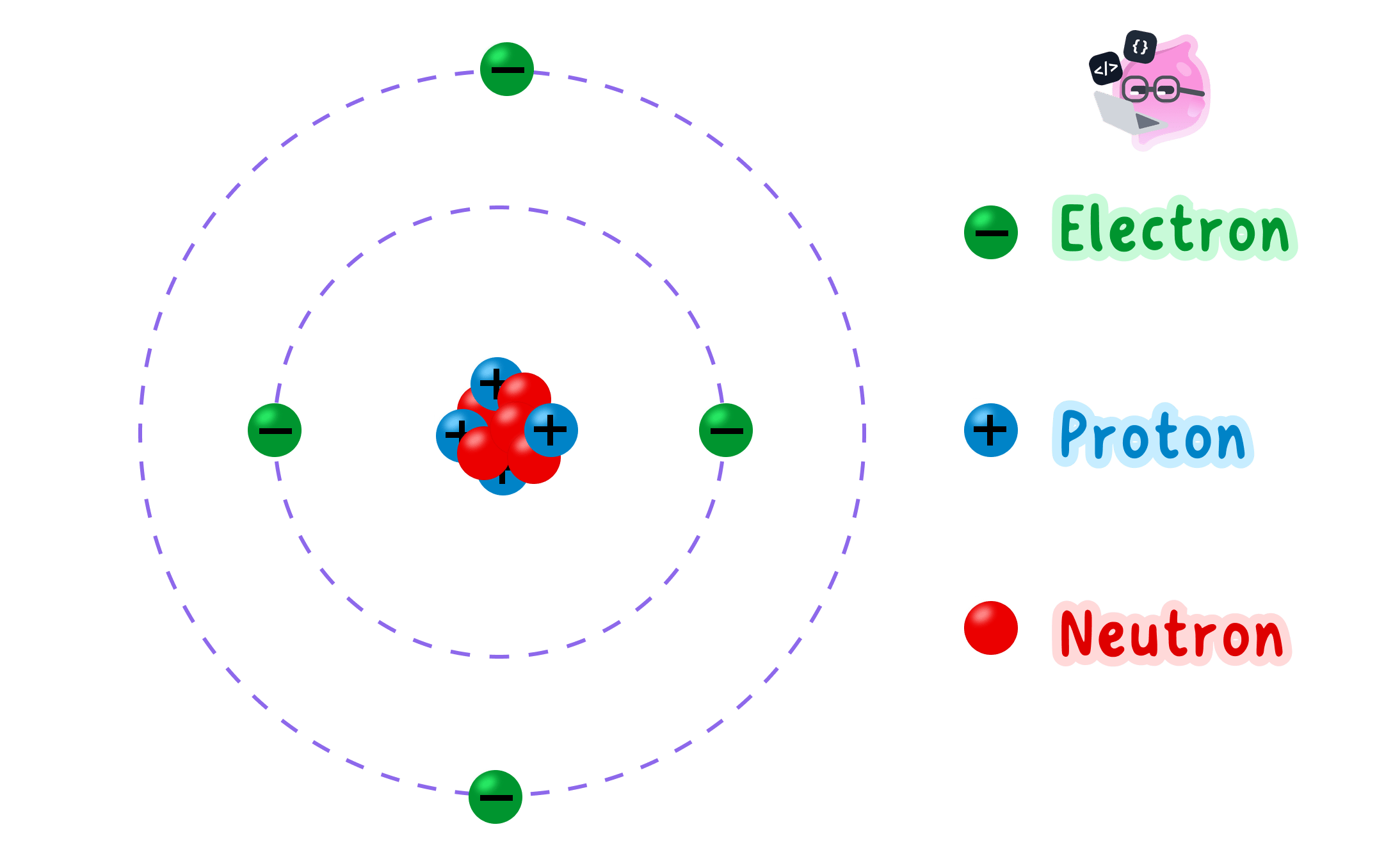
- An atom has a very small, positively charged nucleus at its centre.
- The nucleus contains protons and neutrons.
- Negatively charged electrons surround the nucleus at distances that determine the overall size of the atom.
- The positive charge of the nucleus comes from its protons because neutrons have no electric charge.
- Almost all the atom's mass is concentrated in the nucleus because protons and neutrons are far more massive than electrons.
- The nuclear radius is much smaller than the radius of the whole atom, so most of an atom's volume lies outside its nucleus.
Common Mistake
- Do not write that the whole atom is positively charged; the nucleus is positive, while a neutral atom has equal positive and negative charge overall.
- Do not confuse mass with volume; the nucleus contains almost all the mass but occupies only a tiny fraction of the atom.
Atomic size is about one ten-billionth of a metre
Definition
Order of magnitude
The nearest power of ten used to show the approximate size of a quantity.
- The typical size of an atom or small molecule is of order 10−10 m10^{-10}\,\text{m}10−10m.
- This is 0.0000000001 m0.0000000001\,\text{m}0.0000000001m or 0.1 nm0.1\,\text{nm}0.1nm.
- An order of magnitude is an estimate, so different atoms do not all have exactly the same radius.
Example
Converting atomic size to standard form
- Move the decimal point ten places to write 0.0000000001 m=1×10⁻¹⁰ m0.0000000001\,\text{m}=1\times10^{-10}\,\text{m}0.0000000001m=1×10⁻¹⁰m.
- The order of magnitude is therefore 10−10 m10^{-10}\,\text{m}10−10m.
A complete description links structure, charge and scale
- Name the nucleus and state that it contains protons and neutrons.
- State that negatively charged electrons surround the nucleus.
- Add that the nucleus is much smaller than the atom but contains almost all its mass.
Exam technique
Writing an atomic-structure answer
- Use nucleus, proton, neutron and electron precisely
- Keep the negative exponent in 10−10 m10^{-10}\,\text{m}10−10m because 1010 m10^{10}\,\text{m}1010m is twenty orders of magnitude larger.
Self review
- Which particles are found in the nucleus?
- Why is the nucleus positively charged?
- Where is almost all the mass of an atom?
- How does the nuclear radius compare with the atomic radius?
- What is the order of magnitude of the size of an atom?
