Series circuits
Definition
Series circuit
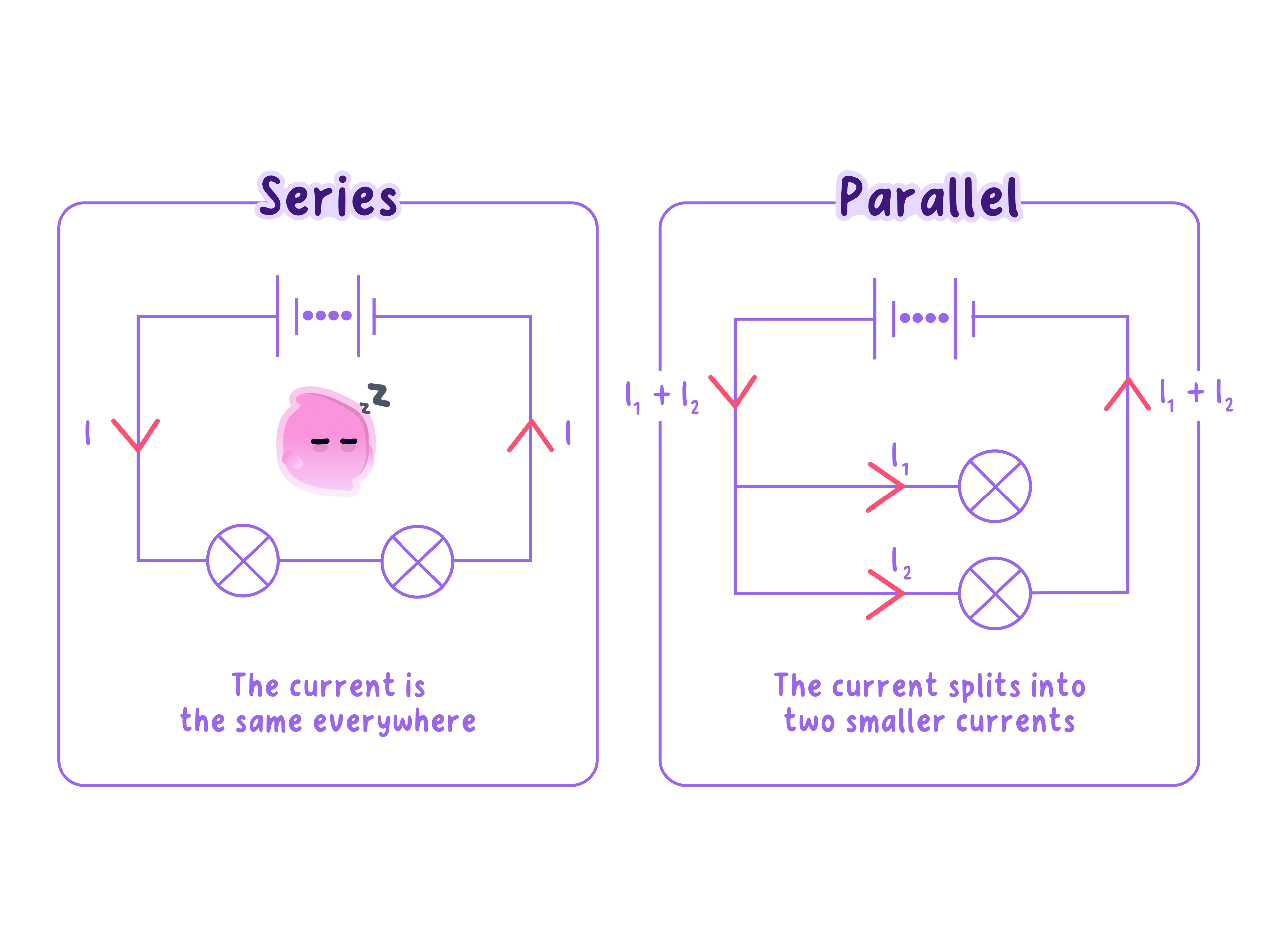
A series circuit is a circuit in which the components are joined one after another in a single loop, so there is only one path for the charge to follow.
- A series circuit is a single unbroken loop, so there is only one path that the charge can follow.
- The components are joined end to end in a chain, one after another, with no branches anywhere in the circuit.
- Charge that leaves one terminal of the supply must pass through every component in turn before it can reach the other terminal.
- Because there is no alternative route, nothing in the circuit can be bypassed and no component can be left out of the path.
- A switch placed anywhere in the loop controls the whole circuit, because opening it breaks the only path available.
Key Idea
The defining feature of a series circuit is that it offers the charge one path only, so everything in the loop is in the way of everything else.
Parallel circuits
Definition
Parallel circuit
A parallel circuit is a circuit in which components are connected across separate branches, so the charge has more than one path it can follow.
- A parallel circuit contains branches, so the charge has more than one path it can follow.
- The wire splits at one meeting point and the branches come back together at another, and each branch runs between that same pair of points.
- Every branch is a complete path of its own, leading from one terminal of the supply back to the other without passing through the other branches.
- Charge travelling along one branch therefore never passes through a component sitting on a different branch.
- A switch placed in one branch controls only that branch, while a switch placed in the main part of the circuit before the split controls all of the branches at once.
Telling them apart
- Start at one terminal of the supply and trace the line with a finger all the way back to the other terminal.
- If there is only one route back and no choice to make on the way, every component is in series.
- If the line splits at a dot and the separate routes join up again later, those routes are in parallel.
- Two components are in parallel with each other only when both of their ends are joined to the same pair of points in the circuit.
- A single circuit can contain both arrangements, for instance a pair of lamps in parallel with each other sitting inside a larger loop that also carries a switch and a resistor in series.
- The shape of the drawing is not the guide. Two symbols drawn side by side on the page are in series if only one path passes through them both, so the connections decide the answer rather than the layout.
Note
- Count the meeting points where three or more wires join: a series circuit has none at all.
- A parallel circuit always has at least two such points, one where the branches divide and one where they rejoin.
- Redrawing an awkward diagram as a plain rectangle with branches across it often settles the question immediately.
When a component breaks
- Removing or breaking one component in a series circuit leaves a gap in the only loop there is, so the circuit is no longer complete.
- With the loop broken there is no path for charge anywhere in the circuit, so every other component stops working too, even though nothing is wrong with them.
- A single blown lamp in a series chain therefore switches off the whole chain, and because all the lamps look the same afterwards it is awkward to find the faulty one.
- Breaking one branch of a parallel circuit leaves the remaining branches complete, so the components on those branches keep working.
- Only the branch that has been broken loses its path, which also makes the fault easy to locate: the branch that has stopped is the one at fault.
- Because each branch can be broken on its own, each one can be given its own switch and controlled independently of the rest.
Common Mistake
- Do not decide the arrangement from how the symbols are positioned on the page. Trace the paths instead.
- Do not describe a series circuit as one where the charge is used up as it goes. There is one path, and that is the whole point.
- Do not say that a broken branch stops a parallel circuit. Only that one branch is lost and the others still have complete paths.
- Do not write that components in parallel are unconnected. They are joined firmly to the same two points in the circuit.
- Do not assume a switch always turns off everything. In a branched circuit its effect depends on whether it sits in a branch or before the split.
Everyday wiring choices
- The lighting in a house is wired in parallel, so a lamp that fails in one room leaves the lamps in every other room working.
- Parallel wiring also allows each lamp its own switch, which is what makes it possible to light one room without lighting the whole house.
- Older decorative light strings were wired in series because it needs less wire and fewer connections, but one failed bulb left the entire string dark.
- Modern strings are built so that a failed bulb does not break the path for the rest, which is why the remaining bulbs stay lit.
- Car headlamps are wired in parallel for the same reason, so that a failed bulb on one side still leaves the driver with a working lamp on the other.
- Identical lamps run from the same supply glow more brightly in parallel than in series, and adding further lamps to a series chain makes every lamp in it dimmer.
Cells and building circuits
- Two or more cells connected in series give a larger total potential difference driving the circuit than a single cell on its own.
- The cells only add in this way when they all face the same direction round the loop, with the positive terminal of one joined to the negative terminal of the next.
- A cell fitted the wrong way round pushes against the others, so the total potential difference driving the circuit is reduced instead of increased.
- A larger driving potential difference makes the lamps in the circuit glow more brightly, which is the everyday sign that extra cells have been added.
- To build a series arrangement on the bench, link the components into one chain with a single lead between each neighbouring pair, then close the chain with a lead back to the supply.
- To build a parallel arrangement, choose two points in the circuit and run each branch separately between that same pair of points, which usually means clipping several leads onto one terminal.
- Check that every crocodile clip grips bare metal rather than insulation, and open the switch before changing any connection.
Exam technique
Answering on circuit type
- Justify the name by describing the paths, for example that the charge has one path only, or that the circuit divides into branches and joins again.
- When a fault is described, say which components stop and which keep working, and give the reason as a complete or broken path.
- When asked why household lighting is wired in parallel, give both reasons: independent failure and independent switching.
- Name the change and its effect together, such as adding a second cell in series so that the lamps glow more brightly.
- Where a circuit has to be drawn, mark the switch in the position that matches the control the question asks for.
Self review
- State the difference between a series circuit and a parallel circuit in terms of paths.
- Describe how to identify each arrangement from a circuit diagram.
- Explain what happens to the other lamps when one lamp fails in each arrangement.
- Give two reasons why household lighting is wired in parallel.
- State the effect of adding a second cell in series, and say which way round it must face.
