Question 10
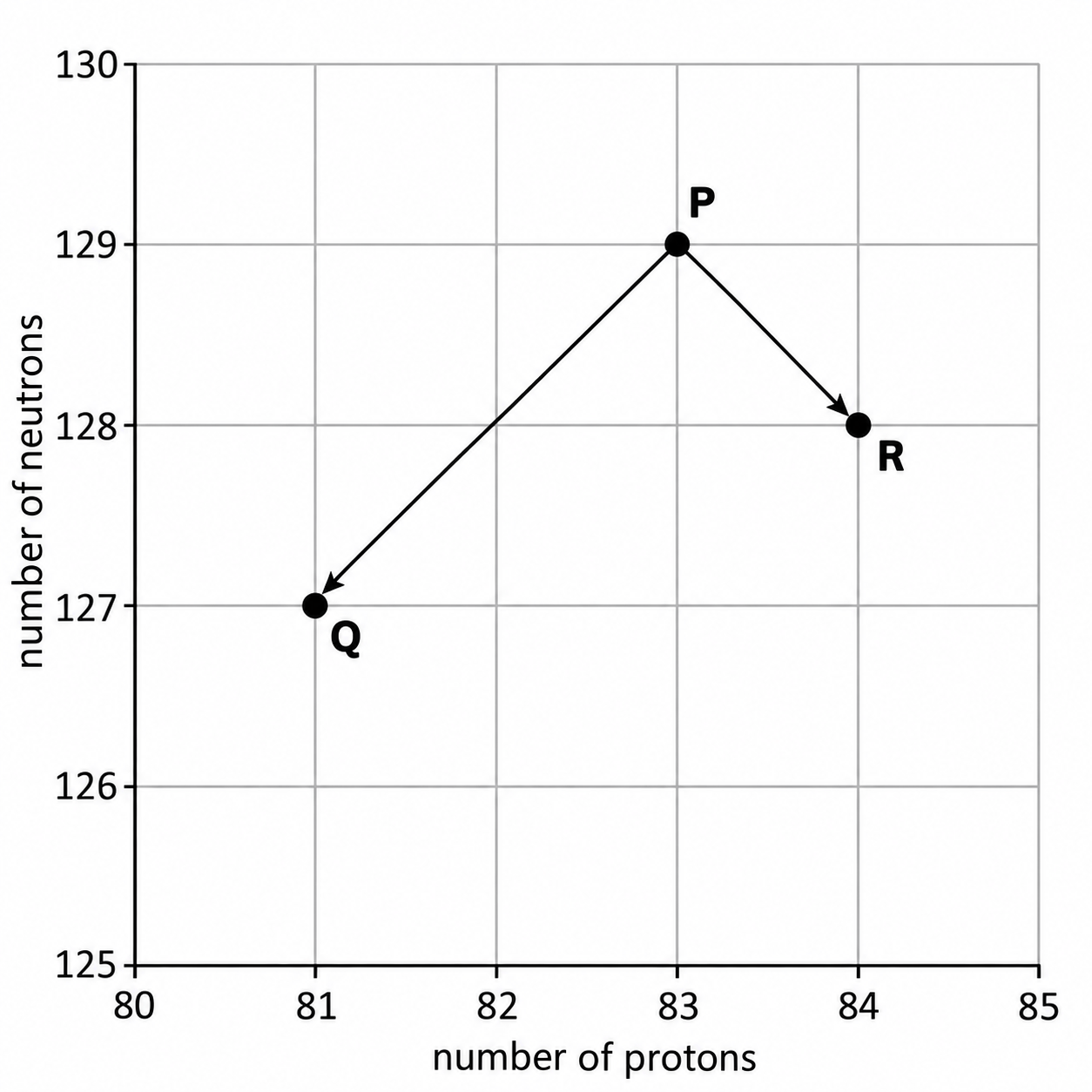
FThe Figure shows the number of neutrons and the number of protons in three nuclei, P, Q and R.
Nucleus P can decay to form either nucleus Q or nucleus R.
Figure
a.[1]
Give the mass number of nucleus P.
b.[2]
Nucleus P decays to form nucleus Q.
Identify the type of decay.
Give a reason for your answer.
c.[3]
Nucleus P decays to form nucleus R.
Identify the type of decay.
Explain your answer in terms of the particles in the nucleus.
d.[1]
Nucleus R then emits gamma radiation.
Describe how the position of R on the Figure changes.
6.3 Nuclear equations and decay Questions
120 exam-style questions on Edexcel GCSE Physics 6.3 Nuclear equations and decay, covering 6.3.1 Beta-minus and beta-plus decay, 6.3.2 Effects of decay on the nucleus, and 6.3.3 Balancing nuclear equations. Each one has a worked solution and a mark scheme showing where the marks go.